
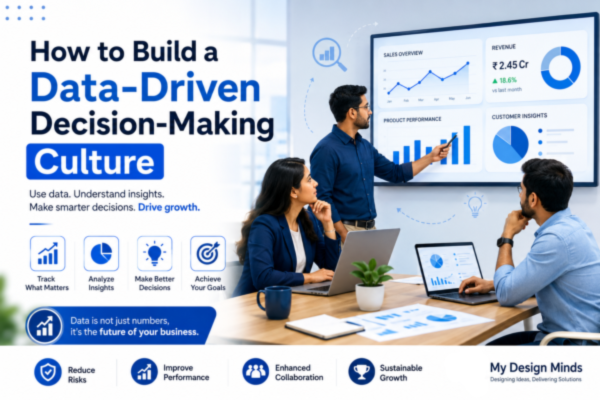
In today’s competitive business environment, intuition alone is no longer enough to make critical business decisions. Companies that rely on data-driven decision-making consistently outperform competitors because they use facts, analytics, and measurable insights rather than assumptions. Whether you’re a startup or an established business, building a data-driven decision-making culture empowers every team member to make informed choices that contribute to sustainable growth.
This guide explains how organizations can develop a culture where data becomes the foundation of every strategic, operational, and customer-focused decision.
What Is a Data-Driven Decision-Making Culture?
A data-driven decision-making culture is an organizational approach where employees at every level use reliable data, analytics, and measurable insights to guide their decisions instead of relying solely on opinions or intuition.
This culture encourages teams to:
- Measure performance continuously
- Track business KPIs
- Validate assumptions with data
- Improve processes using analytics
- Make objective business decisions
Organizations with strong data cultures innovate faster, minimize risks, and achieve higher profitability.
Why Data-Driven Decision-Making Culture Matters
Businesses generate enormous amounts of data every day through websites, CRMs, social media, sales systems, customer interactions, and marketing campaigns. Without analyzing this information, valuable insights remain hidden.
Benefits include:
- Faster strategic decisions
- Improved operational efficiency
- Better customer experiences
- Higher marketing ROI
- Reduced business risks
- More accurate forecasting
- Stronger competitive advantage
Companies that embrace analytics are better prepared to respond to market changes and customer needs.
Steps to Build a Data-Driven Decision-Making Culture
1. Define Clear Business Objectives
Before collecting data, identify what your organization wants to achieve.
Examples include:
- Increase revenue
- Reduce customer acquisition cost
- Improve customer retention
- Increase employee productivity
- Optimize manufacturing processes
Clear objectives help teams focus on collecting relevant data instead of overwhelming themselves with unnecessary information.
2. Identify the Right Key Performance Indicators (KPIs)
Not every metric matters.
Choose KPIs that directly support your business goals.
Examples include:
Marketing
- Website traffic
- Conversion rate
- Cost per lead
- Customer acquisition cost
Sales
- Monthly revenue
- Win rate
- Average deal size
- Sales cycle length
Customer Success
- Customer satisfaction score
- Net Promoter Score (NPS)
- Customer retention rate
- Churn rate
Tracking meaningful KPIs ensures decisions are based on valuable insights.
3. Improve Data Quality
Poor-quality data leads to poor decisions.
Maintain data quality by:
- Removing duplicate records
- Standardizing data formats
- Automating data collection
- Validating information regularly
- Updating outdated records
Reliable data builds trust across the organization.
4. Invest in Analytics Tools
Modern businesses should use analytics platforms that make data accessible to everyone.
Popular tools include:
- Google Analytics
- Power BI
- Tableau
- Microsoft Excel
- Looker Studio
- HubSpot Analytics
- Salesforce Reports
Interactive dashboards allow teams to visualize trends and make informed decisions quickly.
5. Encourage Data Literacy
Employees should understand how to read, interpret, and apply data effectively.
Provide training on:
- Dashboard interpretation
- KPI analysis
- Data visualization
- Basic statistics
- Reporting best practices
When employees are comfortable working with data, they make smarter decisions independently.
6. Make Data Accessible
Avoid restricting data to only senior management.
Create centralized dashboards where departments can access the information they need.
For example:
- Marketing monitors campaign performance.
- Sales tracks pipeline health.
- HR measures employee engagement.
- Finance reviews profitability.
- Operations analyzes efficiency.
Transparency improves collaboration and accountability.
7. Encourage Evidence-Based Discussions
Replace opinions with measurable evidence during meetings.
Instead of asking:
“What do you think?”
Ask:
- What does the data indicate?
- Which metrics support this decision?
- What trend are we observing?
- Do we have historical comparisons?
Evidence-based discussions reduce bias and improve decision quality.
8. Test Before Scaling
Successful organizations validate ideas before making significant investments.
Use:
- A/B testing
- Pilot programs
- Customer surveys
- Prototype testing
- Controlled experiments
Testing reduces uncertainty and minimizes costly mistakes.
9. Celebrate Data-Driven Successes
Recognize teams that use analytics effectively.
Share success stories such as:
- Improved conversion rates
- Reduced production costs
- Increased customer retention
- Successful product launches
Celebrating achievements reinforces positive behaviors across the organization.
10. Continuously Improve
A Data-Driven Decision-Making Culture evolves over time.
Regularly review:
- KPIs
- Reporting methods
- Dashboard effectiveness
- Business objectives
- Data accuracy
Continuous improvement ensures your organization stays agile and competitive.
Common Challenges
Many businesses struggle when implementing data-driven decision-making due to:
- Poor data quality
- Resistance to change
- Lack of employee training
- Data silos
- Too many irrelevant metrics
- Limited executive support
Addressing these challenges requires strong leadership, ongoing education, and a commitment to continuous improvement.
Best Practices
To strengthen your data-driven culture:
- Start with measurable business goals.
- Focus on actionable metrics.
- Encourage cross-functional collaboration.
- Invest in modern analytics tools.
- Promote transparency.
- Train employees regularly.
- Make data part of daily decision-making.
- Review results consistently.
- Learn from successes and failures.
- Foster curiosity and continuous learning.
Conclusion
Building a data-driven decision-making culture is not just about adopting new software- it requires a shift in mindset, processes, and leadership. Organizations that prioritize data can make faster, more accurate decisions, improve operational efficiency, enhance customer satisfaction, and drive long-term growth. By setting clear goals, tracking meaningful KPIs, improving data quality, and empowering employees with analytics skills, businesses can create a culture where every decision is backed by reliable insights. In an increasingly competitive marketplace, embracing data-driven decision-making is essential for sustainable success.
Building a data-driven decision-making culture is a long-term investment that helps businesses make smarter decisions, improve efficiency, and achieve sustainable growth. Whether you’re an established company or learning how to start a small business in India, using data to guide every decision can give you a competitive edge. By combining analytics with the right strategies and expert support from My Design Minds, businesses can streamline operations, identify growth opportunities, and build a strong foundation for long-term success.