
Microsoft Outage Impact on Startups
The recent global disruption caused by Microsoft’s systems going offline sent shockwaves across industries. Airports, banks, hospitals, e-commerce platforms, and thousands of startups found themselves suddenly stuck. Emails failed, cloud-based tools froze, dashboards went blank, and operations paused. The Microsoft Outage Impact on Startups was not just technical—it was existential for many young businesses.
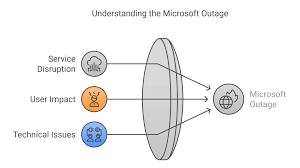
For early-stage companies, every hour matters. Sales pipelines, customer support, internal communication, development workflows, and even billing depend on cloud ecosystems. When Microsoft’s infrastructure faltered, founders realized a harsh truth: building entirely on third-party platforms means inheriting their vulnerabilities. The Microsoft Outage Impact on Startups revealed how fragile “always-on” really is.
Modern startups thrive on speed and scale, and cloud platforms make that possible. But this convenience hides a growing danger—Cloud Dependency Risks for Startups. When a single provider powers your email, CRM, storage, code repositories, and internal tools, one outage can paralyze the entire company.
What made this incident more alarming was the ripple effect. Teams could not access files. Support tickets piled up. Deliverables were delayed. Customers lost trust. For many founders, the Microsoft Outage Impact on Startups became a turning point in how they view technology.
The Illusion of Digital Invincibility
There is a widespread belief that big tech platforms are immune to failure. Startups often assume that if Microsoft or another global giant is hosting their systems, nothing can go wrong. Reality is different. Bugs, misconfigurations, cyber incidents, and cascading errors are part of complex systems.
This is where Cloud Dependency Risks for Startups become visible. The more deeply integrated your business is into one ecosystem, the higher the blast radius of a failure.
During the outage, startups faced:
- Complete loss of internal communication
- Inaccessible customer databases
- Broken automation workflows
- Paused development cycles
- Revenue leakage
For a bootstrapped or early-funded startup, even a few hours of downtime can mean lost leads, broken partnerships, and reputational damage.
Key Lessons for Founders
1. Redundancy Is a Survival Tool
Every critical system must have an alternative. This includes:
- Data backups outside your primary cloud
- Secondary communication channels
- Offline access for essential documents
- Fallback hosting for core services
Ignoring Business Continuity Planning for Startups is no longer an option. Redundancy is not about pessimism—it is about preparedness.
2. Map Your Dependencies
Most teams don’t know how many of their processes depend on one provider. Founders must ask:
- What stops working if this platform fails?
- Which departments are most vulnerable?
- What can continue offline?
Understanding Cloud Dependency Risks for Startups begins with visibility.
3. Reliability Is a Feature
In crowded markets, customers value consistency more than fancy features. A product that fails during stress loses credibility. This is why Digital Infrastructure Resilience must be treated as part of product design.
4. Digital Failures Create Physical Chaos
Cloud outages don’t stay in the digital world. They disrupt:
- Manufacturing schedules
- Warehousing systems
- Logistics coordination
- Field operations
This is where Business Continuity Planning for Startups becomes a core leadership responsibility, not an IT checklist.
Technology Must Be Designed Like Infrastructure
Roads, bridges, and factories are built with load limits, safety margins, and failure tolerance. Digital systems must be designed the same way. Startups often design for growth, not for breakdown.
The Microsoft incident proved that Digital Infrastructure Resilience is as important as innovation. Systems must assume that failure will happen—and be built to survive it.
A resilient startup is not one that never faces problems. It is one that continues operating when problems arise.
For product and hardware startups, the lesson is even deeper. Many rely on:
- Cloud-based CAD platforms
- Online PLM systems
- Digital BOM management
- Vendor portals
- Cloud-stored design data
When access disappears, development stops. Manufacturing schedules slip. Teams sit idle. The Cloud Dependency Risks for Startups directly affect physical production.
This convergence of digital and physical worlds demands a new mindset: products, processes, and systems must be designed holistically—with failure in mind.
The My Design Minds Perspective
At My Design Minds, we see the Microsoft Outage Impact on Startups as a powerful reminder that real-world success is built on thoughtful design—of systems as well as products. In manufacturing and product development, a single point of failure can stall an entire operation. That is why our design philosophy goes beyond appearance.
We design products and workflows that are practical, manufacturable, and resilient. From mechanical structures to production-ready CAD and tooling strategies, we think in terms of stress, uncertainty, and scale. Just as startups must now rethink Business Continuity Planning for Startups, manufacturers must rethink how products are designed for real environments.
Good industrial design prepares for reality, not perfection. It anticipates failure points and removes fragility. At My Design Minds, we don’t just design what looks good—we design what keeps working when conditions are tough. Because in business, and in manufacturing, success belongs to what endures through disruption.
If the Microsoft Outage Impact on Startups taught founders anything, it’s this: building a long-lasting business in India is not just about ideas and funding—it’s about resilience, systems, and design. Learning how to start a long business in India means thinking beyond launch day and planning for scale, failure, manufacturing, compliance, and continuity from the very beginning. A business that is designed to survive disruption is the one that truly lasts.