
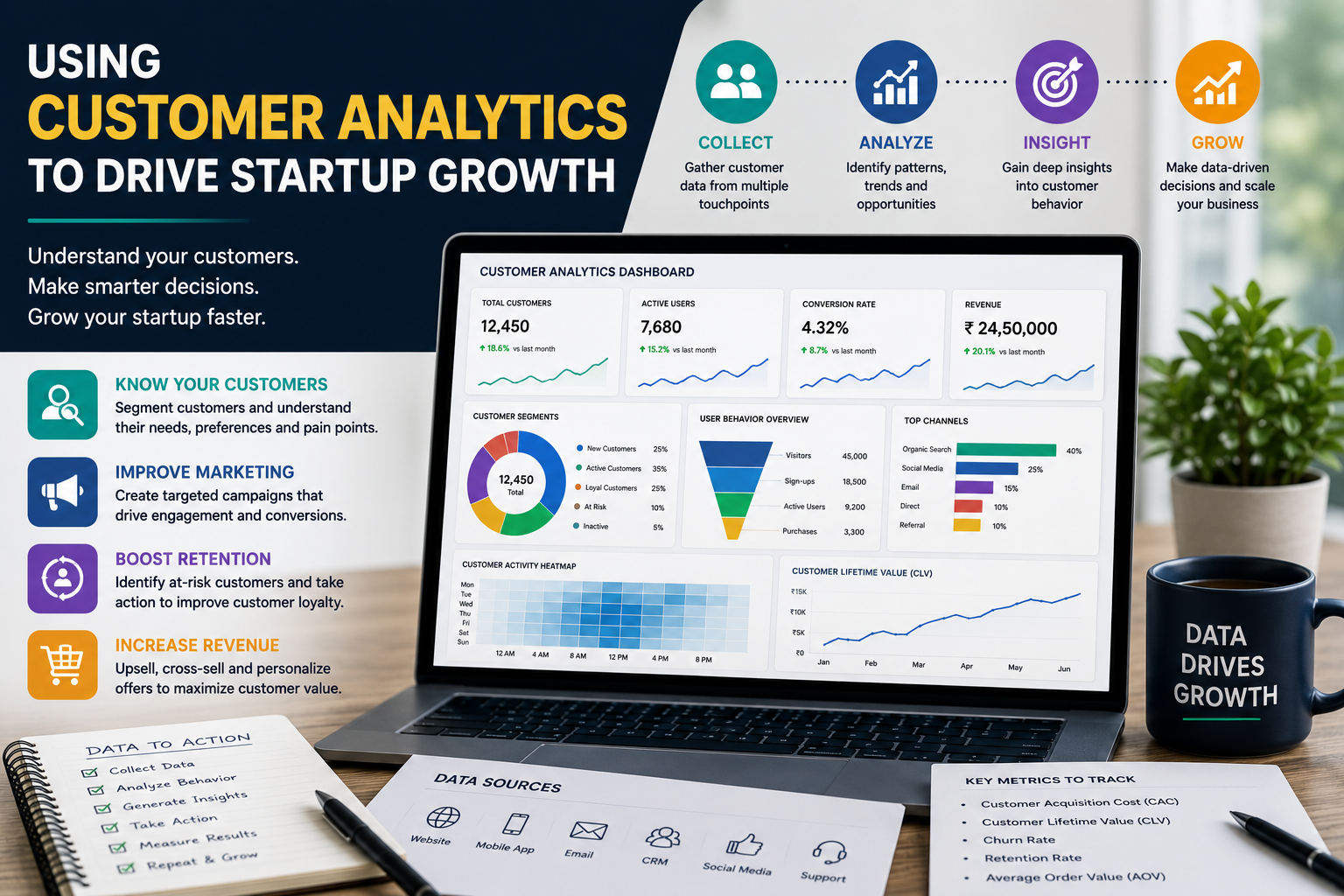
Customer data has become one of the most valuable assets for modern startups. Every interaction a customer has with your business generates insights that can improve products, marketing campaigns, and customer experiences. By leveraging Customer Analytics for Startups, founders can make smarter decisions, increase customer satisfaction, and accelerate business growth.
Rather than relying on assumptions, successful startups use data to understand customer behavior, identify market trends, and optimize business strategies. In this blog, we’ll explore how startups can use customer analytics to gain a competitive advantage and achieve sustainable growth.
Why Customer Analytics Matters
Customer analytics involves collecting, measuring, and analyzing customer data to understand purchasing habits, preferences, and engagement patterns.
Implementing Customer Analytics for Startups offers several benefits:
- Better understanding of customer needs
- Improved marketing performance
- Higher customer retention
- Increased sales opportunities
- Smarter business decisions
Businesses that rely on Data-Driven Business Growth are better equipped to adapt to changing customer expectations and market conditions.
Understand Your Target Audience
Every successful startup begins with a deep understanding of its customers.
Analyze data such as:
- Demographics
- Purchase history
- Website behavior
- Device usage
- Geographic location
- Customer interests
These Startup Customer Insights help businesses create products and marketing campaigns that resonate with their audience.
Track Customer Behavior
Understanding how users interact with your website or application helps identify opportunities for improvement.
Important Customer Behavior Analytics metrics include:
- Pages visited
- Time spent on site
- Bounce rate
- Conversion paths
- Feature usage
- Exit pages
Tracking these behaviors enables startups to optimize customer journeys and improve user experiences.
Personalize Customer Experiences
Modern customers expect personalized experiences.
Using Customer Analytics, businesses can:
- Recommend relevant products
- Personalize email campaigns
- Customize website content
- Deliver targeted promotions
Personalization improves engagement and supports Data-Driven Business Growth by increasing customer satisfaction and conversion rates.
Improve Marketing Campaigns
Marketing analytics helps startups understand which campaigns deliver the best results.
Track metrics like:
- Click-through rate (CTR)
- Conversion rate
- Customer acquisition cost (CAC)
- Return on ad spend (ROAS)
- Lead generation performance
These Startup Customer Insights help businesses allocate marketing budgets more effectively.
Reduce Customer Churn
Customer analytics can identify early warning signs that customers may stop using your product.
Examples include:
- Reduced login frequency
- Lower purchase activity
- Negative feedback
- Increased support requests
Analyzing Customer Behavior Analytics allows startups to take proactive steps that improve retention and customer satisfaction.
Improve Product Development
Customer feedback and usage data reveal which features customers value most.
Use analytics to identify:
- Popular features
- Frequently requested improvements
- Common user challenges
- Product adoption rates
These Customer Analytics support continuous product improvement and stronger customer loyalty.
Measure Customer Lifetime Value
Customer Lifetime Value (CLV) helps startups understand the long-term value of each customer.
This metric supports Data-Driven Business Growth by helping founders determine:
- Marketing investment limits
- Customer retention priorities
- Revenue forecasting
- Growth strategies
Higher CLV often indicates successful customer engagement.
Use Predictive Analytics
Predictive analytics uses historical data to forecast future customer behavior.
Benefits include:
- Sales forecasting
- Demand prediction
- Customer segmentation
- Personalized recommendations
- Risk identification
Advanced Startup Customer Insights enable startups to make proactive business decisions rather than reactive ones.
Choose the Right Analytics Tools
Several tools help startups collect and analyze customer data.
Popular options include:
- Google Analytics
- Mixpanel
- Hotjar
- HubSpot
- Microsoft Clarity
- Tableau
These platforms simplify Customer Behavior Analytics and provide valuable insights for decision-making.
Best Practices for Customer Analytics
To maximize results:
- Define clear business goals
- Track meaningful KPIs
- Protect customer data and privacy
- Review analytics regularly
- Turn insights into actionable improvements
Consistently applying Customer Analytics for Startups helps businesses improve customer experiences and maintain a competitive advantage.
Conclusion
Data is one of the most powerful growth drivers for modern startups. By implementing Customer Analytics for Startups, businesses can better understand customer needs, improve products, personalize marketing, and strengthen customer relationships. Leveraging Startup Customer Insights, embracing Data-Driven Business Growth, and analyzing Customer Behavior Analytics enable startups to make informed decisions that fuel long-term success.
If you’re planning to build a successful business, mastering customer analytics is another important step alongside learning how to start a small business in India and creating a scalable, customer-focused company.

My Design Minds empowers startups with expert product design, engineering, prototyping, and manufacturing solutions, helping businesses transform customer insights into innovative, market-ready products that drive sustainable growth.