
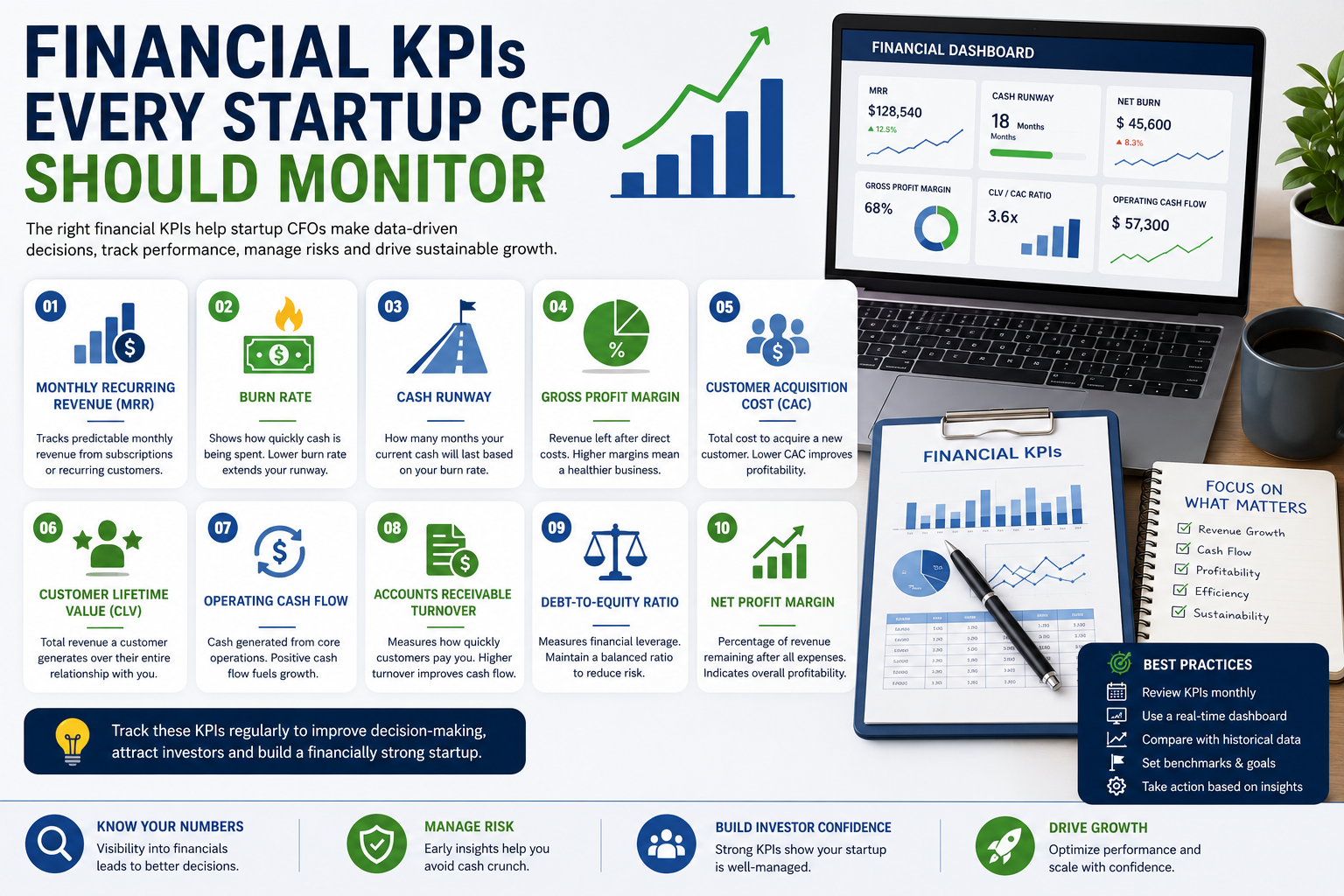
Financial management is one of the most important responsibilities of a startup Chief Financial Officer (CFO). While revenue growth often grabs the spotlight, sustainable success depends on understanding the numbers behind the business. Tracking the right Financial KPIs for Startups enables founders and CFOs to make informed decisions, optimize resources, improve profitability, and prepare for future growth.
Key Performance Indicators (KPIs) provide measurable insights into a company’s financial health. They help identify strengths, highlight potential risks, and support strategic planning. Whether you’re managing a bootstrapped startup or a venture-backed company, monitoring the right financial metrics is essential for long-term success.
In this blog, we’ll explore the most important Financial KPIs for Startups that every startup CFO should monitor.
Why Financial KPIs Matter
Financial KPIs measure how effectively a startup manages revenue, expenses, profitability, and cash flow.
Monitoring these indicators helps businesses:
- Improve financial decision-making
- Identify operational inefficiencies
- Manage business risks
- Increase investor confidence
- Support sustainable growth
Regular analysis of Startup Financial Metrics ensures startups remain financially stable while pursuing expansion opportunities.
Monthly Recurring Revenue (MRR)
For subscription-based startups, Monthly Recurring Revenue is one of the most valuable metrics.
MRR measures predictable monthly income generated from customers.
Benefits include:
- Revenue forecasting
- Business stability
- Growth measurement
- Investor reporting
Tracking MRR strengthens Financial KPIs for Startups by providing consistent visibility into recurring revenue.
Burn Rate
Burn Rate measures how quickly a startup spends available cash.
There are two types:
- Gross Burn Rate
- Net Burn Rate
Understanding burn rate helps founders determine:
- How long current funding will last
- When additional investment may be required
- Areas where expenses can be optimized
Monitoring this Startup Financial Dashboard metric helps avoid unexpected cash shortages.
Cash Runway
Cash Runway estimates how many months a startup can continue operating before running out of cash.
Formula:
Cash Runway = Available Cash ÷ Monthly Burn Rate
Maintaining a healthy runway is one of the most important Business Performance KPIs because it provides financial security during uncertain market conditions.
Gross Profit Margin
Gross Profit Margin measures the percentage of revenue remaining after direct production costs.
A higher margin indicates:
- Efficient operations
- Strong pricing strategy
- Better profitability
Tracking profitability is a core part of Financial KPIs for Startups.
Customer Acquisition Cost (CAC)
Customer Acquisition Cost measures how much a startup spends to acquire each new customer.
Include expenses such as:
- Advertising
- Sales salaries
- Marketing software
- Campaign costs
Reducing CAC while maintaining growth improves overall Startup Financial Metrics.
Customer Lifetime Value (CLV)
Customer Lifetime Value estimates the total revenue generated by a customer throughout their relationship with your business.
A high CLV indicates:
- Strong customer retention
- High customer satisfaction
- Sustainable revenue
Comparing CLV with CAC provides valuable insights into business profitability and supports a healthier Startup Financial Dashboard.
Operating Cash Flow
Operating Cash Flow measures the cash generated through regular business operations.
Positive operating cash flow allows startups to:
- Pay suppliers
- Cover salaries
- Invest in growth
- Manage unexpected expenses
This is one of the most critical Business Performance KPIs for maintaining financial stability.
Accounts Receivable Turnover
This KPI measures how quickly customers pay invoices.
Faster collections improve:
- Cash flow
- Working capital
- Business liquidity
Improving receivable management strengthens Financial KPIs for Startups by ensuring funds are available for daily operations.
Debt-to-Equity Ratio
Many startups rely on both loans and investor funding.
The Debt-to-Equity Ratio measures financial leverage.
Maintaining a balanced ratio:
- Reduces financial risk
- Improves investor confidence
- Supports long-term sustainability
Monitoring this Startup Financial Metrics indicator helps startups maintain healthy capital structures.
Net Profit Margin
Net Profit Margin measures the percentage of revenue remaining after all expenses, taxes, and operating costs.
A healthy profit margin demonstrates:
- Efficient financial management
- Cost control
- Sustainable business performance
This metric is a fundamental component of every Startup Financial Dashboard.
Budget Variance
Budget Variance compares actual business performance with planned budgets.
Tracking variance helps startups:
- Control expenses
- Improve forecasting
- Optimize resource allocation
Monitoring this KPI improves overall Business Performance KPIs and financial planning.
Financial Reporting Best Practices
Every startup CFO should establish a consistent reporting process.
Best practices include:
- Review KPIs monthly.
- Automate financial reporting.
- Maintain accurate accounting records.
- Compare historical performance.
- Share reports with leadership teams.
- Monitor trends instead of isolated numbers.
Consistent reporting strengthens Financial KPIs for Startups and supports data-driven decision-making.
Common KPI Mistakes
Avoid these common mistakes:
- Tracking too many metrics
- Ignoring cash flow
- Focusing only on revenue
- Using outdated financial data
- Not reviewing KPIs regularly
- Failing to act on financial insights
A focused approach helps CFOs prioritize the Startup Financial Metrics that truly impact business success.
Conclusion
Strong financial management is the foundation of every successful startup. Monitoring Financial KPIs for Startups, analyzing Startup Financial Metrics, improving Business Performance KPIs, and maintaining a reliable Startup Financial Dashboard enable founders and CFOs to make informed decisions, manage risks, and drive sustainable growth. By consistently tracking these indicators, startups can improve profitability, attract investors, and build a financially resilient business capable of long-term success.
If you’re planning to build a successful company, understanding financial KPIs is just as important as learning how to start a small business in India and creating a strategy for sustainable business growth.

About My Design Minds
My Design Minds empowers startups with end-to-end product design, CAD engineering, rapid prototyping, and manufacturing solutions. By helping businesses streamline product development, reduce costs, and accelerate innovation, My Design Minds enables startups to focus on growth while bringing high-quality, market-ready products to customers efficiently and confidently.
Leave a Reply