
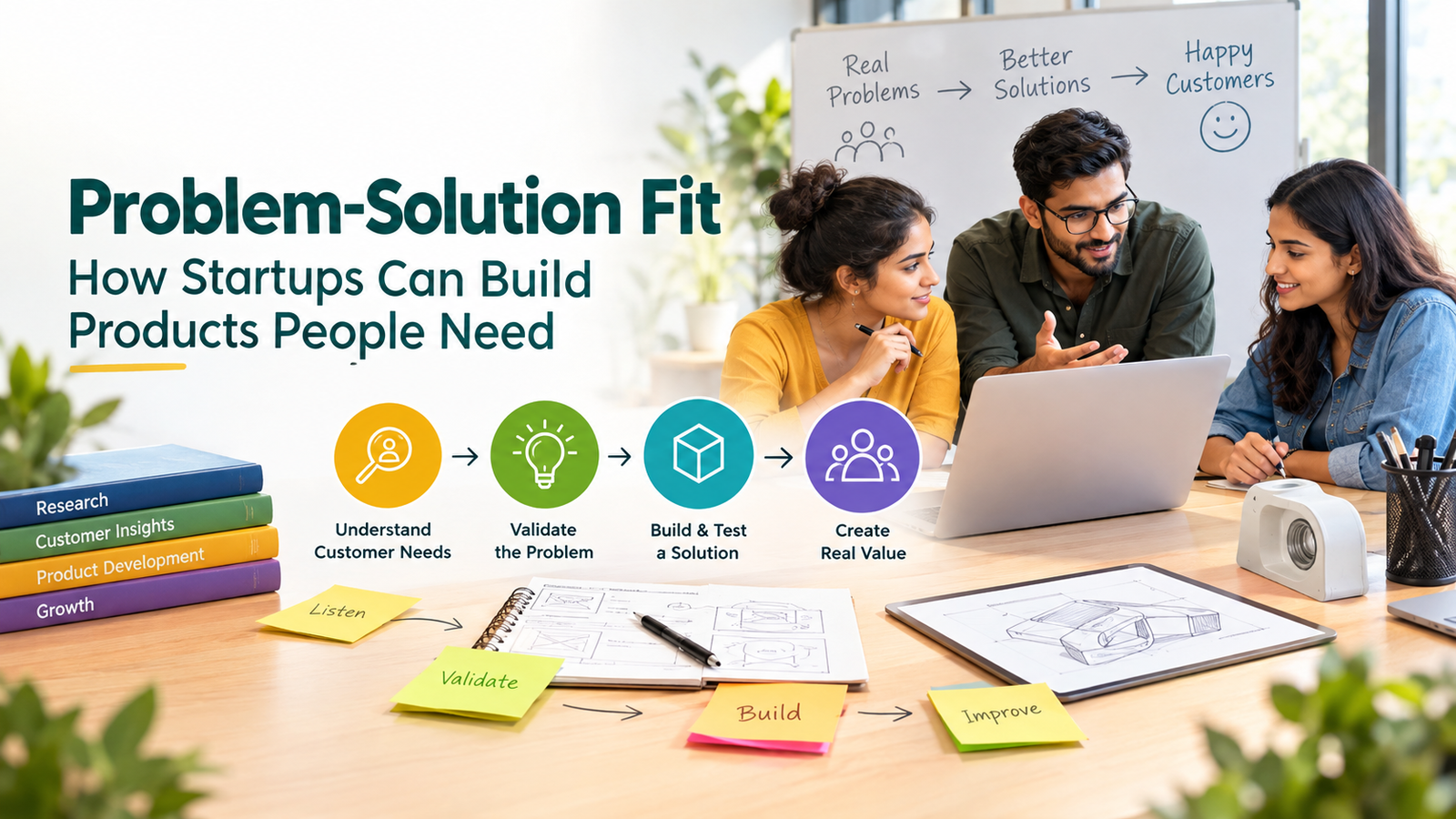
Problem-Solution Fit: How Startups Can Build Products People Need
Building a product is not simply about having a creative idea. A startup can have advanced technology, attractive features, and strong branding, yet still fail if the product does not solve a meaningful customer problem. This is why Problem-Solution Fit is an important stage in the startup journey. It helps founders determine whether their proposed solution addresses a genuine problem that customers experience and are willing to solve.
Understand the Problem Before Building the Product
The first step is to clearly identify the problem your target customers face. Founders should avoid starting with a solution and then searching for people who might need it. Instead, begin by understanding customer frustrations, inefficiencies, costs, and unmet needs.
Talk to potential customers through interviews, surveys, online communities, and direct conversations. Ask open-ended questions about how they currently handle the problem, what difficulties they experience, and what they would like to improve.
This process is also an important part of customer problem validation. The objective is to determine whether the problem is frequent, significant, and worth solving. A problem that customers consider inconvenient but not important may not create enough demand for a new product.
Define Your Target Customer
A startup cannot effectively solve everyone’s problems. Clearly defining the target market makes product development more focused and measurable.
Create a customer profile based on factors such as industry, business size, location, job role, purchasing behavior, and specific requirements. For example, a startup developing manufacturing software may target small and medium-sized manufacturers rather than attempting to serve every type of business.
A focused target audience makes it easier to understand customer expectations and develop features that provide genuine value. It also helps startups create more relevant marketing messages and sales strategies.
Match the Solution to the Problem
After understanding the problem, map your proposed solution to the customer’s actual needs. Every major product feature should have a clear reason for existing.
Ask questions such as:
- What specific problem does this feature solve?
- How does it improve the customer’s current process?
- Does it save time, reduce cost, improve quality, or increase convenience?
- Would customers consider paying for this benefit?
This is where Problem-Solution Fit becomes practical. Instead of developing a product based entirely on assumptions, startups can connect individual features to verified customer problems.
Build a Minimum Viable Product
Once the problem and proposed solution are reasonably clear, develop a Minimum Viable Product (MVP). The MVP should contain the essential functionality required to solve the primary customer problem.
The goal is not to create a perfect product immediately. It is to create something that customers can use and evaluate. Depending on the business, an MVP could be a basic software application, prototype, physical product, service workflow, or demonstration model.
For physical products, early prototypes can reveal usability, dimensions, functionality, manufacturing challenges, and design limitations before significant resources are committed.
Test With Real Customers
Customer feedback is one of the most valuable sources of information during early product development. Give potential users an opportunity to interact with your prototype or MVP and observe how they respond.
Do not focus only on positive comments. Pay attention to confusion, complaints, missing features, usability problems, and reasons customers hesitate to purchase.
This feedback supports customer problem validation by showing whether the solution actually addresses the customer’s situation. If users repeatedly identify the same weakness, consider modifying the product before moving toward large-scale development.
Measure Willingness to Pay
A product may solve a real problem without becoming a successful business. Customers must also see enough value to justify paying for the solution.
Test different pricing approaches and compare them with the customer’s existing costs. For B2B products, consider whether your solution can reduce operational expenses, improve productivity, minimize errors, or generate additional revenue.
Willingness to pay provides stronger evidence than simply asking customers whether they like an idea. Actual commitments, pre-orders, pilot projects, or paid trials can provide valuable market signals.
Improve Through Iteration
Product development should be treated as an ongoing learning process. Customer requirements can change as the market develops, and early assumptions may prove incorrect.
Collect feedback, analyze product usage, identify the most important improvements, and update the solution accordingly. This iterative approach also supports Product-Market Fit, because startups gradually refine their offering based on real customer behavior rather than relying entirely on assumptions.
Startups should also monitor metrics such as customer retention, repeat purchases, conversion rates, usage frequency, customer acquisition costs, and satisfaction. These indicators can reveal whether the product is creating sustainable value.
Connect Product Development With Business Goals
Successful products need more than technical functionality. The solution should also support the startup’s wider business model.
Consider manufacturing costs, distribution, pricing, customer support, scalability, and future product improvements. A product that customers want but cannot be produced or delivered profitably may still require significant changes.
Understanding Product-Market Fit becomes especially important as the startup moves from early validation toward growth. Strong alignment between customer needs, product value, and business economics creates a stronger foundation for scaling.
Final Thoughts
Building products people need requires startups to listen before they build, test before they scale, and improve based on evidence. By identifying genuine customer problems, developing focused solutions, testing prototypes, measuring willingness to pay, and continuously learning, founders can reduce unnecessary development risks.
For startups planning their journey, learning How to start a small business in India can provide a useful foundation for understanding business planning, customer research, funding, and early-stage execution before investing heavily in product development.
How My Design Minds Supports Startup Product Development
My Design Minds helps startups transform product ideas into practical design and manufacturing solutions. From concept development and 3D CAD modeling to prototyping, product visualization, design validation, and manufacturing support, the team can help founders evaluate and improve products before production. For startups looking to reduce development risks, early engineering input can identify design, functionality, and manufacturing challenges sooner. My Design Minds also supports businesses that need a reliable partner for product development and production planning. By connecting product design with manufacturing expertise, startups can move from an initial concept toward a more production-ready solution with greater confidence.
Leave a Reply