
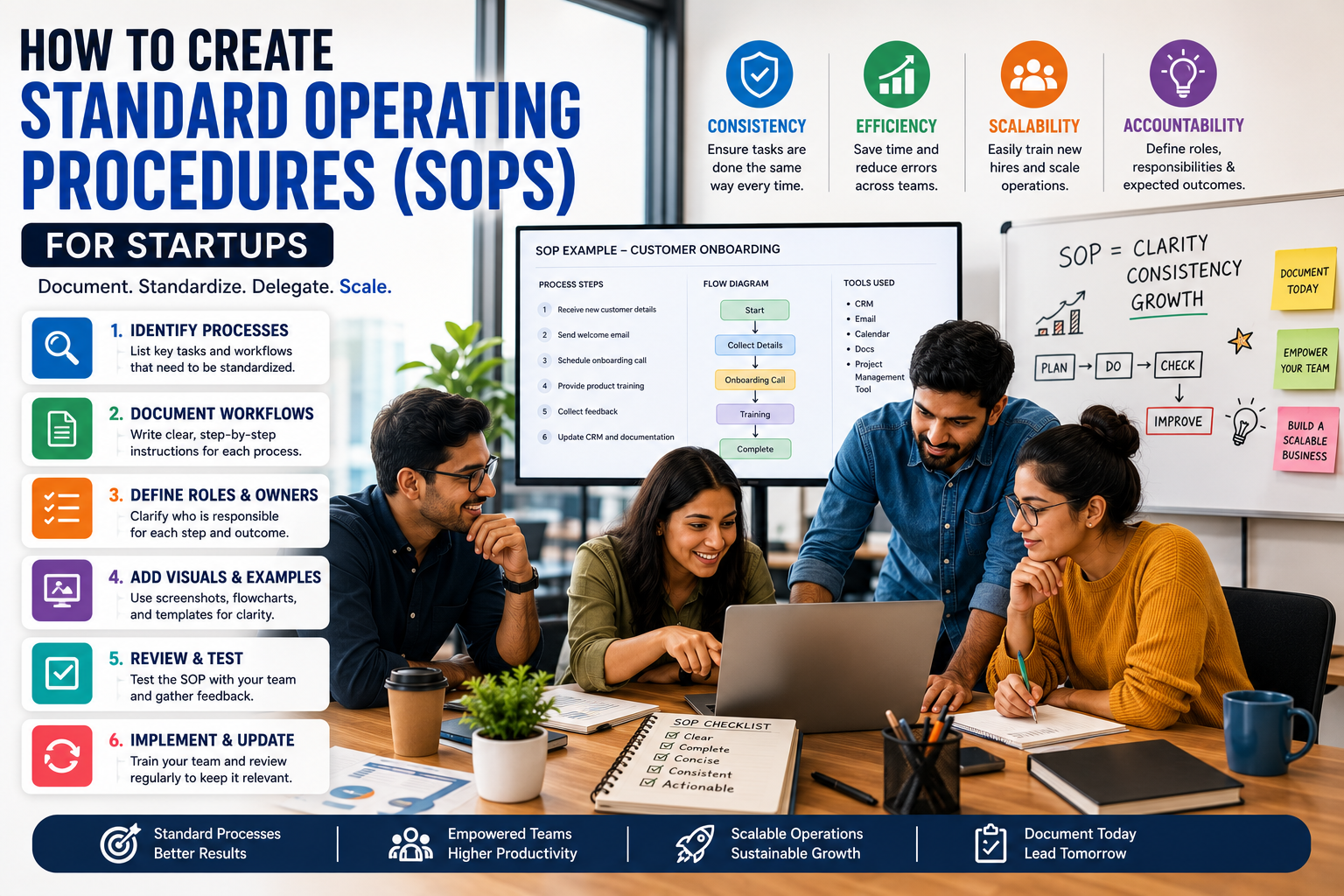
As startups grow, managing daily operations becomes increasingly complex. New employees join, responsibilities expand, and workflows evolve. Without proper systems in place, teams may face confusion, inefficiencies, and inconsistent results. This is where Startup SOP Development becomes essential.
Well-designed SOPs help startups maintain consistency, improve productivity, and prepare for sustainable growth. Whether you are managing customer support, sales processes, product development, or onboarding new employees, having documented procedures ensures everyone follows the same standards.
In this guide, you’ll learn how to create effective Standard Operating Procedures for Startups and build a strong operational foundation.
What Are SOPs?
Standard Operating Procedures (SOPs) are documented instructions that explain how specific business tasks should be completed. They provide step-by-step guidance for employees and help maintain consistency across the organization.
Effective Startup SOP Development ensures that important processes can be repeated accurately regardless of who performs the task.
Examples include:
- Employee onboarding
- Customer support workflows
- Sales processes
- Marketing campaign execution
- Product development procedures
- Financial reporting
Why SOPs Are Important for Startups
Many founders initially manage operations themselves. However, as teams grow, knowledge must be shared and standardized.
The benefits of Standard Operating Procedures for Startups include:
Improved Consistency
Employees follow the same process, reducing mistakes and ensuring reliable outcomes.
Faster Training
New hires can learn responsibilities more quickly through clear Startup Process Documentation.
Better Productivity
Teams spend less time asking questions and more time completing tasks efficiently.
Easier Scaling
A strong Business Operations Management system allows startups to grow without operational chaos.
Reduced Dependency on Individuals
Important business knowledge remains documented rather than stored in one employee’s memory.
Step 1: Identify Core Business Processes
The first stage of Startup SOP Development is identifying processes that occur repeatedly.
Focus on areas such as:
- Sales
- Marketing
- Customer service
- Product development
- HR and recruitment
- Finance and accounting
Prioritize processes that directly affect business performance and customer experience.
Step 2: Document Current Workflows
Observe how tasks are currently performed.
Interview team members and record:
- Each step involved
- Tools used
- Decision points
- Common challenges
Accurate Startup Process Documentation ensures SOPs reflect real-world operations rather than assumptions.
Step 3: Create Clear Step-by-Step Instructions
An effective SOP should be easy to understand.
Include:
- Purpose of the process
- Required tools and resources
- Step-by-step instructions
- Roles and responsibilities
- Expected outcomes
Strong Standard Operating Procedures for Startups eliminate ambiguity and improve execution.
Example SOP Structure
- Objective
- Scope
- Responsibilities
- Procedure Steps
- Quality Checks
- Review Process
Step 4: Use Visual Elements
Visual aids improve comprehension and reduce errors.
Consider adding:
- Flowcharts
- Screenshots
- Checklists
- Templates
- Process diagrams
These tools enhance Startup SOP Development and make procedures easier to follow.
Step 5: Test the SOP
Before implementing a new SOP, ask team members to follow the instructions.
Gather feedback on:
- Clarity
- Accuracy
- Missing steps
- Ease of use
Testing ensures your Business Operations Management processes work effectively in real situations.
Step 6: Train Your Team
Even the best SOPs require proper implementation.
Conduct training sessions to explain:
- Why the SOP exists
- How to follow it
- Expected performance standards
Effective training strengthens Standard Operating Procedures for Startups and increases adoption rates.
Step 7: Review and Update Regularly
Startups evolve quickly, and SOPs should evolve too.
Review procedures:
- Quarterly
- After major business changes
- Following new technology adoption
- When team structures change
Continuous improvement keeps Startup Process Documentation relevant and effective.
Common SOP Mistakes to Avoid
Overcomplicating Procedures
Keep instructions simple and actionable.
Ignoring Employee Feedback
Frontline employees often provide valuable insights for improvement.
Failing to Update SOPs
Outdated procedures can create confusion and reduce efficiency.
Lack of Ownership
Assign responsibility for maintaining each SOP within your Business Operation Management framework.
Best Tools for SOP Creation
Several tools can simplify Startup SOP Development:
- Notion
- Google Docs
- Confluence
- Process Street
- ClickUp
- Asana
These platforms help organize, update, and distribute Standard Operating Procedures for Startups efficiently.
Conclusion
Successful startups rely on systems, not just people. Effective Startup SOP Development creates consistency, improves productivity, simplifies training, and supports business growth. By implementing clear Standard Operating Procedures for Startups, maintaining accurate Startup Process Documentation, and strengthening Business Operation Management, startups can scale efficiently while maintaining quality and operational excellence.
If you’re planning to build a scalable company, creating SOPs is just one step toward learning how to start a small business in India and successfully managing long-term growth.

My Design Minds helps startups transform innovative ideas into successful products through expert product design, engineering, prototyping, and manufacturing solutions that support sustainable business growth.