
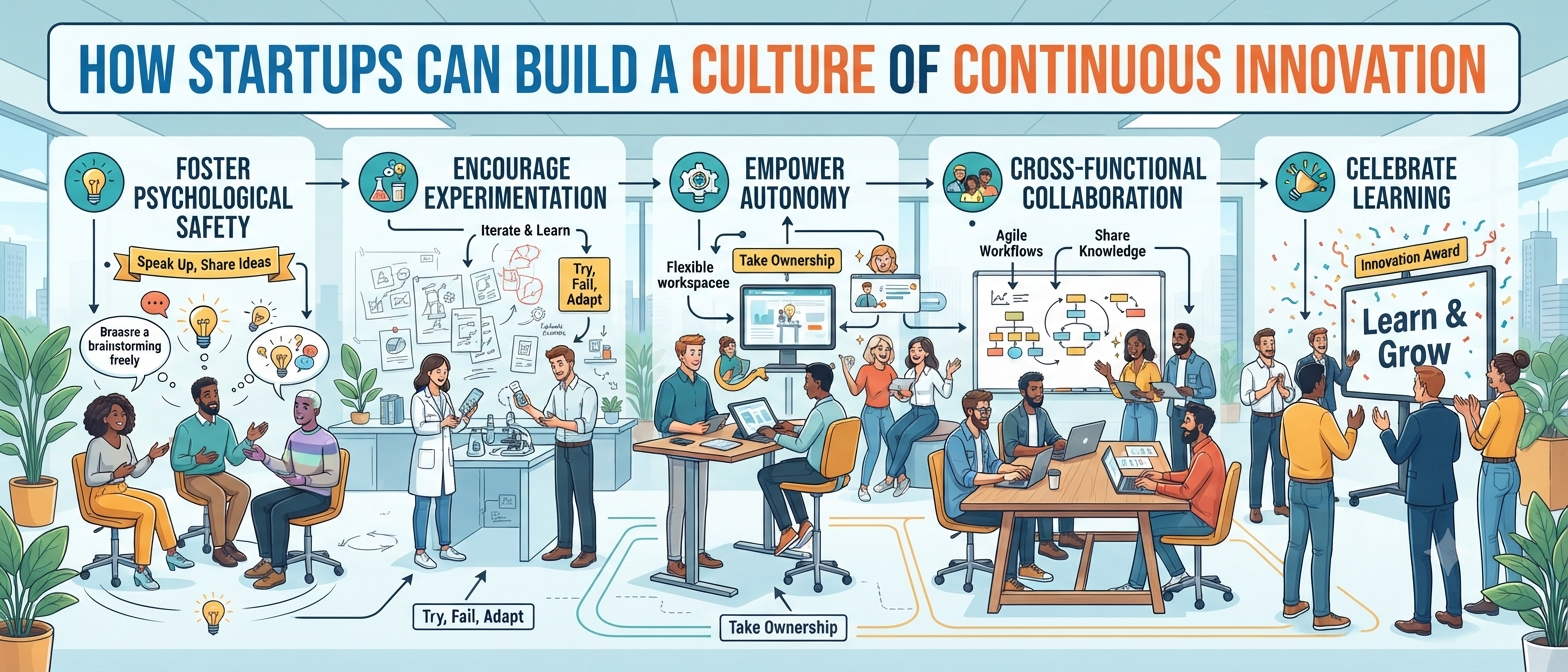
Continuous Innovation for Startups is essential for businesses that want to remain relevant, competitive, and responsive to changing customer needs. Startups often begin with a strong idea, but long-term success depends on their ability to keep improving products, services, processes, and customer experiences. Creating an environment where employees are encouraged to experiment, learn, and suggest improvements can turn innovation into an ongoing business practice rather than a one-time activity.
What Is Continuous Innovation for Startups?
Continuous Innovation for Startups means making regular improvements instead of waiting for major breakthroughs. These improvements can involve product features, manufacturing methods, customer service, technology, internal workflows, pricing models, or marketing strategies.
For startups, this approach is particularly valuable because resources are usually limited. Small improvements can reduce costs, improve efficiency, solve customer problems, and create new opportunities without requiring the company to completely redesign its business model.
A strong innovation culture also encourages employees to look at everyday challenges differently. Instead of accepting inefficient processes, teams can identify problems, test solutions, measure results, and make improvements.
Encourage Employees to Share Ideas
Innovation begins with people. Startup founders should create an environment where employees feel comfortable sharing ideas, even when those ideas are not immediately successful.
Regular brainstorming sessions, team discussions, suggestion boards, and innovation meetings can provide simple ways to collect ideas. Employees working directly with customers may identify problems that management does not see, while technical teams may discover opportunities for automation or product improvement.
An effective innovation strategy for startups should therefore include contributions from different departments rather than relying only on founders or senior management.
Make Experimentation Part of the Work Culture
A startup cannot build innovation into its culture if every experiment must be perfect. Teams need opportunities to test assumptions through small and controlled experiments.
Startups can begin with prototypes, minimum viable products, pilot programs, A/B testing, or limited customer launches. These approaches allow businesses to collect real-world feedback before investing significant time and money.
Failure should also be treated as a learning opportunity when an experiment is conducted responsibly. Teams should analyze what went wrong, document lessons, and use those insights to improve the next attempt.
Listen Closely to Customers
Customers are one of the most valuable sources of innovation. Their feedback can reveal gaps between what a startup offers and what users actually need.
Businesses can collect insights through surveys, reviews, support conversations, interviews, social media comments, and product analytics. Instead of simply collecting feedback, startups should identify recurring problems and convert them into opportunities for improvement.
For example, if customers repeatedly struggle with a particular feature, the company can redesign it to make the experience simpler. This customer-focused approach can make innovation more practical and measurable.
Use Technology to Accelerate Innovation
Technology can help innovation strategy for startups experiment faster and operate more efficiently. Cloud platforms, analytics tools, automation, artificial intelligence, digital collaboration systems, and prototyping technologies can support faster testing and decision-making.
Technology should not be adopted simply because it is new. Startups should first identify a business problem and then determine whether technology can provide a practical solution.
A structured startup innovation management approach can help businesses prioritize technology investments based on customer value, business impact, cost, and scalability.
Build Cross-Functional Teams
Innovation often happens when people with different skills work together. Developers, designers, marketers, engineers, sales professionals, and customer-support teams can bring different perspectives to the same problem.
Cross-functional teams can help startups identify opportunities from multiple angles. For example, a product improvement may look technically feasible but could create challenges for marketing or customer support. Bringing different teams into the discussion early can help identify such issues before implementation.
This collaborative approach also strengthens communication and encourages employees to understand how their work contributes to the larger business.
Measure Innovation Without Limiting Creativity
Startups should measure whether innovation efforts are producing meaningful results. Useful metrics can include customer satisfaction, product adoption, cost savings, process efficiency, conversion rates, retention, revenue generated from new offerings, and time taken to launch improvements.
However, innovation should not be judged only by the number of ideas generated. The quality, usefulness, and business impact of those ideas matter more.
An effective business innovation strategy combines creativity with measurable objectives. Teams should know what problem they are solving, what outcome they expect, and how success will be evaluated.
Make Learning a Continuous Process
A culture of innovation requires continuous learning. Employees should have opportunities to develop technical, creative, analytical, and problem-solving skills.
Startups can support learning through workshops, online courses, mentoring, industry events, internal knowledge-sharing sessions, and hands-on projects.
Leaders should also encourage employees to stay aware of customer trends, emerging technologies, competitor developments, and changes within their industry. This awareness can help teams recognize new opportunities before they become urgent challenges.
Leadership Sets the Example
Founders and managers play a major role in creating an innovative workplace. If leadership rejects new ideas, avoids experimentation, or focuses only on short-term results, employees are unlikely to take initiative.
Leaders should demonstrate curiosity, accept constructive feedback, support responsible experimentation, and recognize employees who contribute useful ideas.
Building Continuous Innovation for Startups is ultimately about creating a mindset where improvement becomes part of everyday work. Startups that encourage ideas, learn from customers, experiment thoughtfully, use technology strategically, and measure meaningful outcomes can create stronger foundations for sustainable growth.
Why We Choose My Design Minds
My Design Minds helps startups turn innovative ideas into practical product concepts through professional design and engineering support. From product ideation and 3D CAD modeling to prototyping, engineering analysis, design for manufacturing, and manufacturing support, the team can support effective startup innovation management and help businesses move from an early concept toward production.
By combining creative thinking with engineering expertise, My Design Minds supports startups in refining designs, identifying potential development challenges, and improving product readiness. This innovation strategy for startups makes innovation more practical, reduces development risks, and creates a stronger path from concept to market-ready solution.
Understanding innovation and product development can help aspiring entrepreneurs make better decisions when learning how to start a small business in India, from validating an idea to developing and improving a market-ready product.

Leave a Reply