
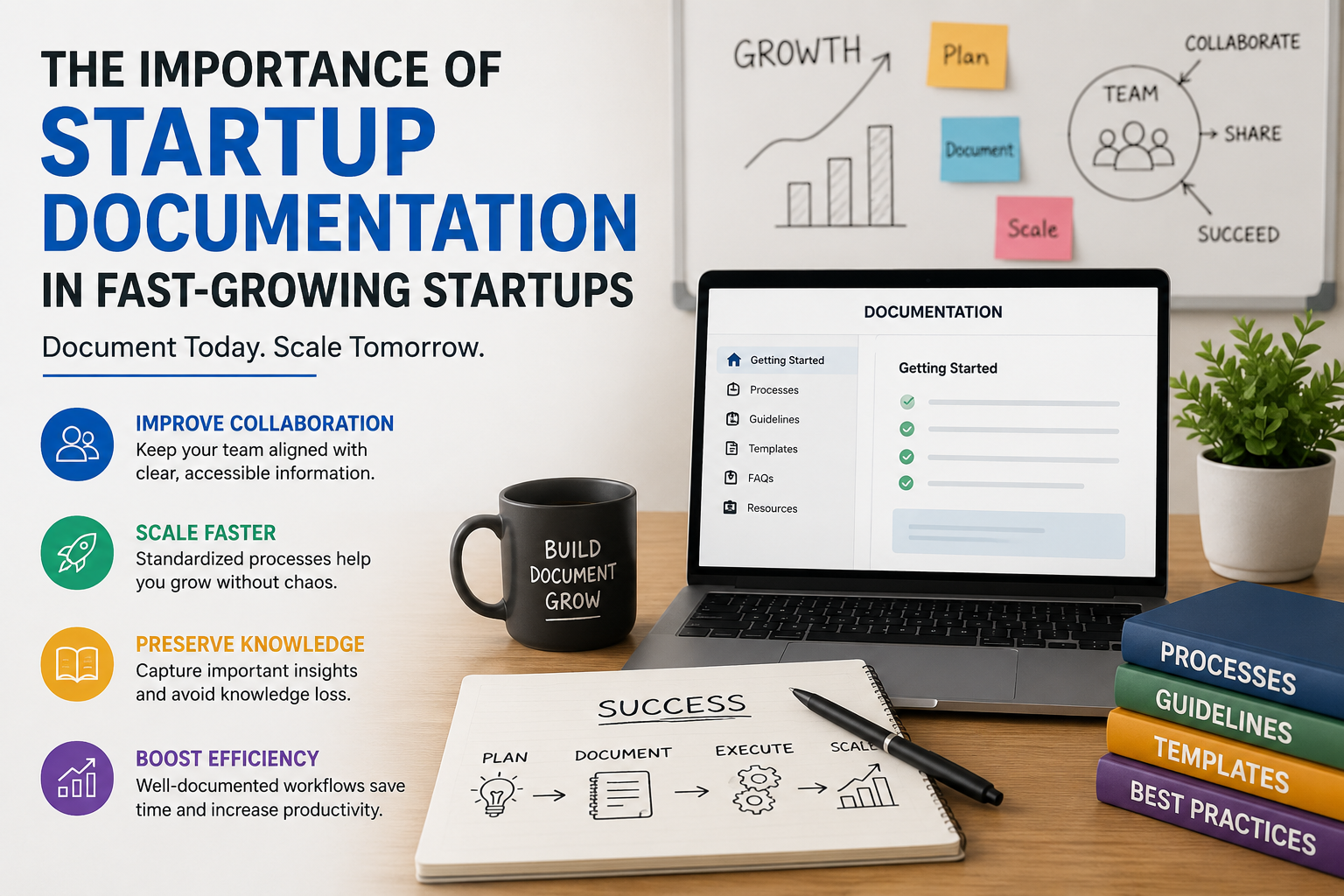
In the early stages of a startup, speed often takes priority over structure. Teams move quickly, decisions are made on the fly, and processes evolve daily. While this agility is essential for growth, it can also create confusion and inefficiencies if important knowledge is not recorded properly. This is where startup documentation becomes a critical asset.
As startups scale, documentation helps maintain consistency, improves collaboration, and ensures that valuable information is not lost when employees leave or teams expand. Organizations that invest in proper documentation early are better equipped to handle rapid growth and operational challenges.
Why Documentation Matters in Growing Startups
Fast-growing startups face unique challenges. New employees join frequently, product features evolve rapidly, and customer expectations continue to increase. Without a structured approach to knowledge sharing, teams can struggle to stay aligned.
Effective startup documentation serves as a central source of truth. It provides employees with access to processes, policies, workflows, and company knowledge, reducing dependency on individual team members.
Documentation also minimizes misunderstandings and ensures that everyone follows the same procedures, regardless of their location or department.
Enhancing Team Collaboration
One of the biggest advantages of maintaining detailed business process documentation is improved collaboration. Teams often work across different functions, including product development, sales, marketing, customer support, and operations.
When information is documented clearly:
- Team members can find answers independently.
- Communication becomes more efficient.
- Onboarding new employees is faster.
- Cross-functional projects run smoothly.
Instead of repeatedly explaining the same process, employees can refer to documented guidelines and focus on higher-value tasks.
Accelerating Employee Onboarding
Hiring is a common characteristic of fast-growing startups. However, onboarding new employees can become time-consuming if knowledge exists only in the minds of experienced team members.
Comprehensive knowledge management systems help new hires understand company workflows, tools, and expectations quickly. Structured onboarding documents, training materials, and process guides reduce learning curves and improve productivity.
When employees have access to accurate documentation from day one, they can contribute effectively much sooner.
Preserving Institutional Knowledge
Startups often rely heavily on a few key individuals who possess critical knowledge about products, customers, or operations. If those employees leave, valuable expertise can disappear with them.
This risk can be significantly reduced through proper startup documentation. By documenting workflows, decision-making frameworks, customer interactions, and technical processes, startups create a lasting repository of organizational knowledge.
This continuity ensures that business operations remain stable even during periods of transition.
Supporting Consistent Customer Experiences
Customers expect consistent service regardless of who handles their request. Documentation plays a major role in achieving this consistency.
Customer support teams can use documented procedures to resolve issues effectively. Sales teams can follow standardized messaging. Product teams can maintain quality standards throughout development cycles.
Strong operational efficiency depends on having repeatable and documented processes that employees can follow confidently.
Improving Operational Efficiency
As startups grow, informal communication becomes less effective. Processes that worked for a team of five may not work for a team of fifty.
Detailed business process documentation helps streamline operations by clearly defining responsibilities, workflows, and approval mechanisms. Employees spend less time searching for information and more time executing their tasks.
This efficiency becomes increasingly important as startups expand into new markets, launch additional products, or manage larger customer bases.
Enabling Better Decision-Making
Data-driven decisions require access to reliable information. Documentation creates transparency by recording previous decisions, project outcomes, lessons learned, and strategic initiatives.
Leaders can review documented insights to avoid repeating mistakes and identify successful approaches. Teams can understand the rationale behind past decisions and make informed choices moving forward.
A strong knowledge management systems strategy ensures that information remains accessible and useful across the organization.
Facilitating Compliance and Risk Management
Many startups eventually encounter regulatory requirements, customer audits, or investor due diligence processes. Proper documentation simplifies compliance efforts by providing evidence of policies, procedures, and operational controls.
Whether it involves data security, employee management, or financial reporting, documented processes reduce risks and demonstrate professionalism to stakeholders.
Investors and enterprise customers often view robust documentation as a sign of organizational maturity and readiness for growth.
Best Practices for Startup Documentation
To maximize the value of documentation, startups should follow a few key practices:
1. Start Early
Don’t wait until processes become complex. Document workflows from the beginning.
2. Keep It Simple
Use clear language and straightforward formats that employees can easily understand.
3. Centralize Information
Store documents in a shared platform where everyone can access updated information.
4. Review Regularly
Processes change frequently in startups. Update documentation to reflect current practices.
5. Encourage Team Contributions
Documentation should be a collaborative effort involving multiple departments.
Conclusion
Documentation is not just an administrative task – it is a strategic investment in long-term growth. By creating effective startup documentation, organizations can preserve knowledge, improve collaboration, accelerate onboarding, and enhance operational efficiency across teams. Well-maintained business process documentation and robust knowledge management systems provide the foundation needed to scale successfully while maintaining consistency and productivity.
If you’re planning to build and grow your own venture, understanding documentation is just one part of the journey. Read our guide on how to start a small business in India to learn the essential steps for launching and scaling a successful business.