
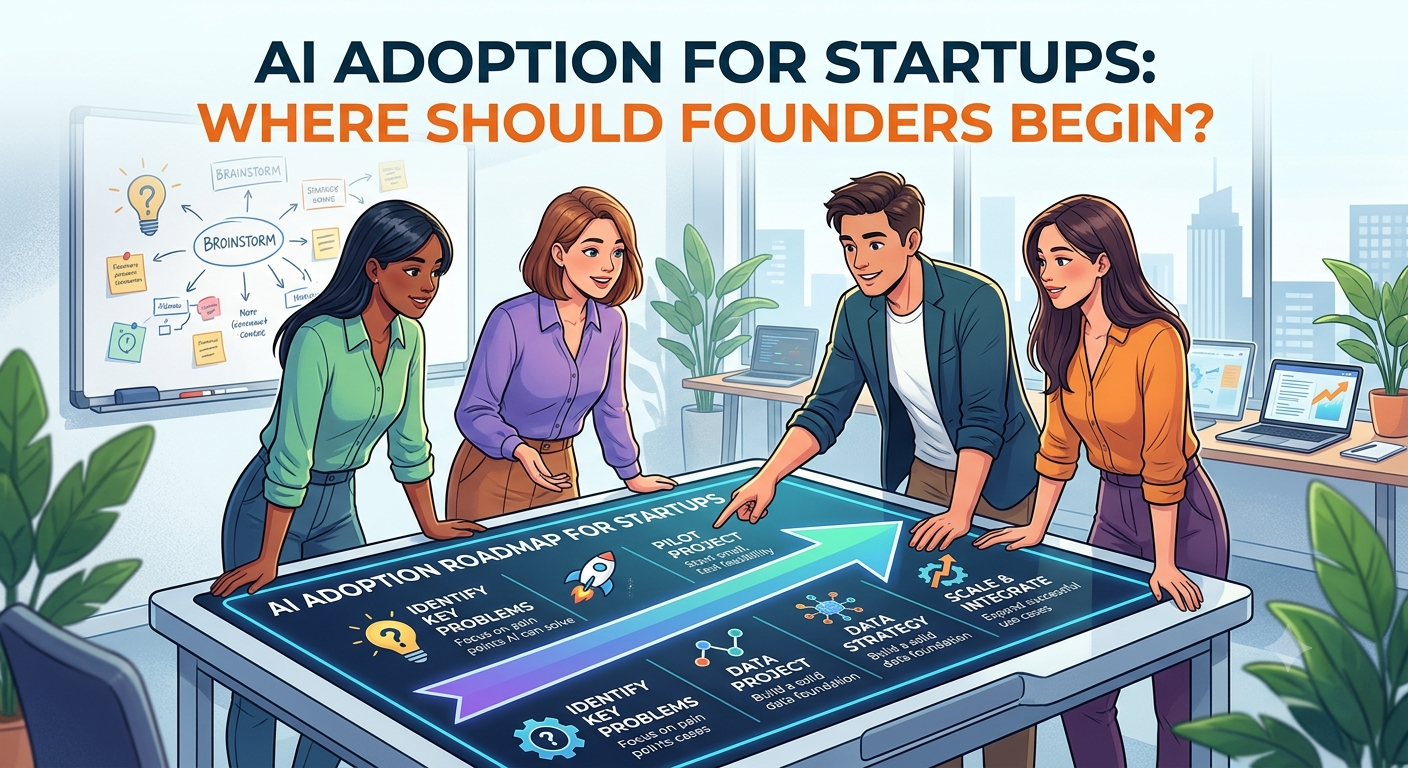
Startups today operate in a highly competitive environment where speed, efficiency, and innovation can determine long-term success. AI Adoption for Startups is no longer limited to large corporations with extensive technology budgets. Small businesses and early-stage companies can also use artificial intelligence to automate repetitive work, understand customers, improve decision-making, and create better products.
However, adopting AI without a clear strategy can result in unnecessary expenses and complicated systems. Founders should therefore begin with practical business problems rather than simply choosing the latest AI technology.
Identify Business Problems First
The first step is to identify areas where technology can deliver measurable value. Founders should examine daily operations and ask which tasks consume significant time, involve repetitive manual work, or frequently cause errors.
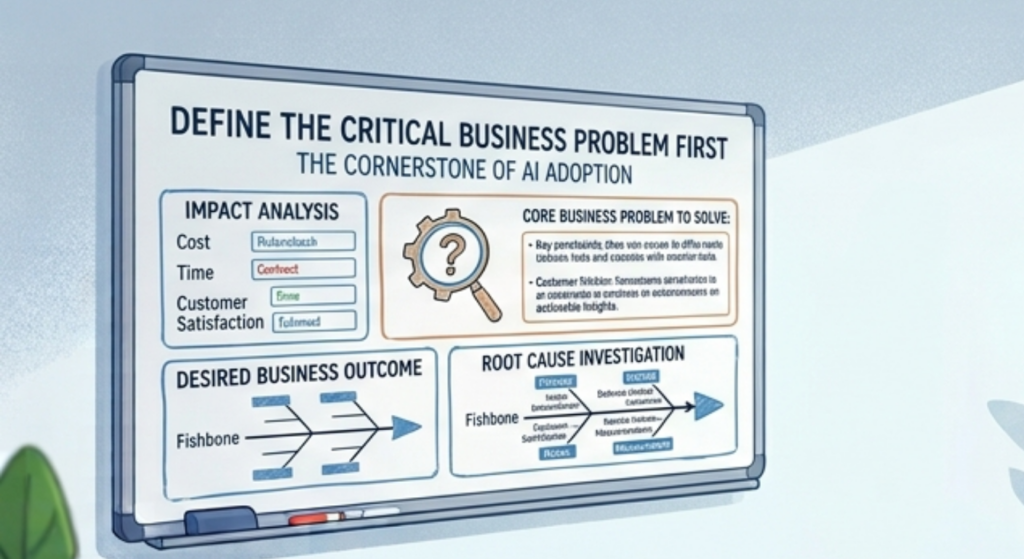
Common opportunities include customer support, marketing, sales research, document processing, data analysis, inventory management, and internal communication.
For example, a startup receiving hundreds of customer inquiries can use AI-based tools to categorize questions and provide automated responses. Similarly, a company spending hours preparing reports can use AI to summarize data and generate useful insights.
This problem-first approach ensures that AI for Startups becomes a practical business investment instead of an experimental technology project.
Start Small and Measure Results
Founders do not need to transform their entire organization immediately. A small pilot project is often the safest way to begin.
Choose one process with a clear objective and measurable outcome. A startup might initially automate lead qualification, generate marketing content, analyze customer feedback, or improve its support workflow.
Before implementation, establish a baseline. Measure how much time the existing process takes, how many employees are involved, and what it costs. After introducing AI, compare the results.
This approach allows founders to determine whether the technology is actually improving productivity and reducing operational costs.
Choose the Right AI Tools
The AI market offers thousands of tools, but startups should avoid selecting technology simply because it is popular. The right solution should match the company’s size, budget, technical capabilities, and business objectives.
Cloud-based AI platforms can be useful for startups because they generally require less infrastructure and technical investment. Founders can also consider specialized tools for content creation, customer relationship management, analytics, design, coding, and workflow automation.
When evaluating Artificial Intelligence for Startups, businesses should consider integration capabilities, pricing, data security, scalability, ease of use, and vendor support.
Protect Business and Customer Data
AI implementation also introduces data-related responsibilities. Startups frequently handle customer information, financial records, product specifications, and confidential business documents.
Before using an AI platform, founders should understand how the provider stores and processes data. Sensitive information should not be uploaded to tools without reviewing their privacy and security policies.
Companies should also establish internal guidelines covering who can use AI tools, what information can be shared, and when human approval is required.
Responsible AI adoption can help startups gain the benefits of automation while reducing unnecessary security and compliance risks.
AI Adoption for Startups : Train the Team
Technology alone does not create business value. Employees need to understand how to use AI effectively.
Founders should encourage teams to experiment with approved tools and learn how AI can support their existing responsibilities. Training can focus on writing effective prompts, reviewing AI-generated information, protecting confidential data, and identifying situations where human judgment is necessary.
When employees see AI as a productivity partner rather than a replacement, adoption is often smoother.
AI Adoption for Startups : Future Growth
Once an initial AI project delivers positive results, startups can gradually expand their use of technology. Customer data can support better personalization, analytics can improve forecasting, and automation can streamline multiple departments.
Over time, AI-Powered Business Solutions can become part of a startup’s broader digital strategy. However, every implementation should continue to serve a specific business objective.
Founders should regularly review performance and eliminate tools that fail to provide meaningful value. AI adoption should remain flexible because technology and business requirements can change quickly.
Connect AI With Product Development
For startups developing physical products, AI can also support design and engineering workflows. It can assist with research, concept development, documentation, design analysis, visualization, and manufacturing planning.
Combining AI with CAD and engineering capabilities can help teams move from an initial idea toward a manufacturable product more efficiently. This can be especially valuable for founders who need to validate concepts before committing significant resources to production.
For entrepreneurs exploring How to start a small business in India, understanding where AI can reduce costs and improve productivity can provide an important competitive advantage from the beginning.
My Design Minds: Supporting Startup Growth
My Design Minds helps startups and businesses transform product ideas into practical design and manufacturing solutions. From CAD design and 3D product visualization to product engineering, reverse engineering, prototyping, mould manufacturing, and other technical services, the company supports businesses at different stages of product development. For founders exploring AI-Powered Business Solutions, combining modern technology with professional design and engineering expertise can make product development more efficient.
By integrating AI for Startups into research, product development, and business workflows, founders can improve productivity and make faster decisions. Artificial Intelligence for Startups can also support innovation by helping teams identify opportunities, optimize processes, and improve customer-focused solutions. My Design Minds focuses on helping businesses convert concepts into technically sound, manufacturable products while reducing development challenges. This combination of innovation, engineering knowledge, and manufacturing support can help startups build stronger foundations for sustainable growth.