
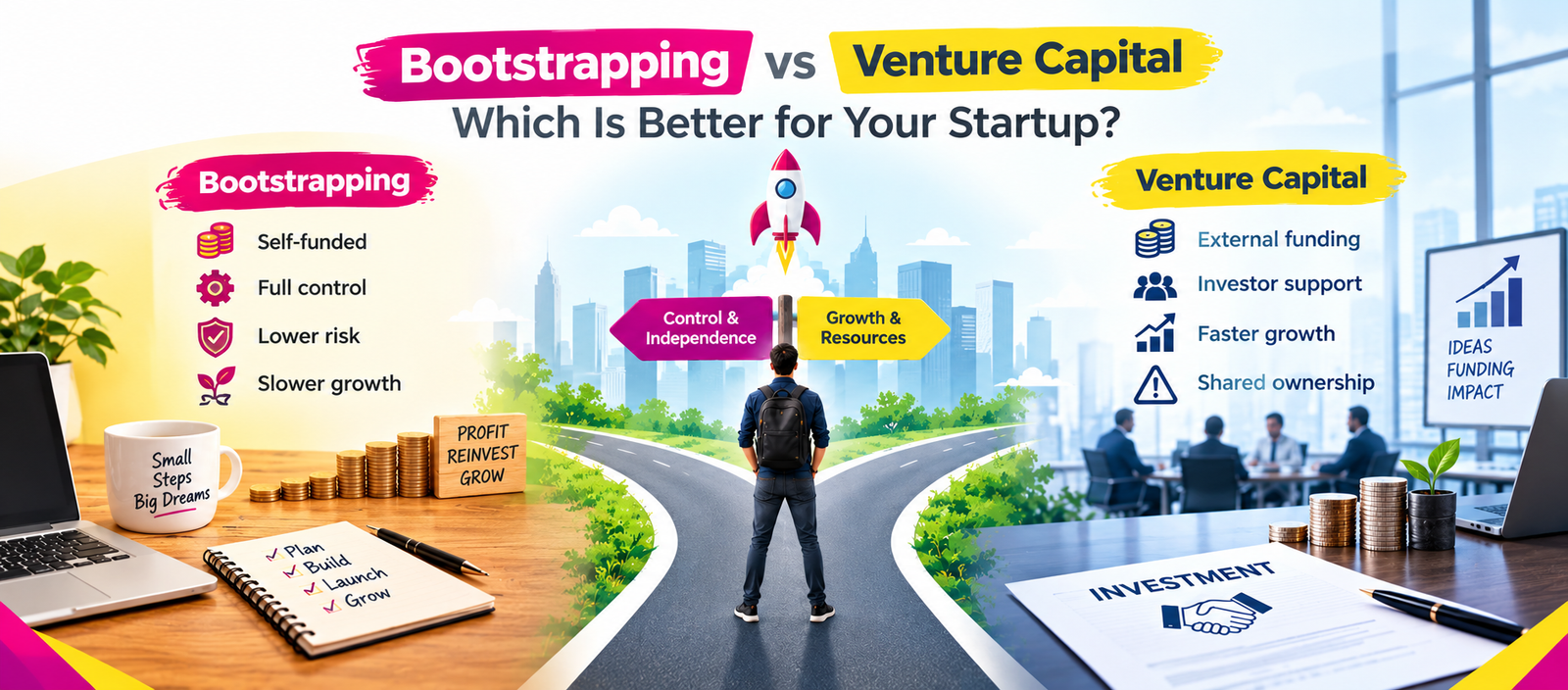
Starting a business requires more than a strong idea. Founders also need to decide how they will finance operations, product development, marketing, hiring, and future expansion. One of the biggest decisions is Bootstrapping vs Venture Capital, because the funding model can influence ownership, decision-making, growth speed, and long-term business strategy.
There is no universal answer for every entrepreneur. The right choice depends on the startup’s business model, financial requirements, growth expectations, and the founder’s willingness to share ownership and control.
What Is Bootstrapping?
Bootstrapping means building a company primarily with the founder’s personal savings, revenue generated by the business, or support from close sources without depending heavily on outside investors.
A Bootstrapped Startup generally grows according to its available cash flow. Instead of raising a large investment at an early stage, founders may begin with a smaller product, serve initial customers, reinvest profits, and gradually expand.
One major advantage is control. Founders usually retain greater ownership and have more freedom to make strategic decisions. They can experiment with pricing, products, hiring, and marketing without having to satisfy external investors.
However, bootstrapping can also limit growth. If a company needs expensive technology, specialized employees, manufacturing facilities, or aggressive marketing, limited capital may slow progress.
What Is Venture Capital?
Venture capital involves raising money from investors or investment firms that provide funding to startups with significant growth potential. In exchange, investors generally receive an ownership stake in the company.
Venture Capital Funding can give a startup access to substantial financial resources. This capital can be used to build teams, develop products, enter new markets, invest in technology, and increase customer acquisition.
Beyond money, investors may provide industry connections, strategic guidance, recruitment support, and business expertise.
The disadvantage is reduced ownership and control. Founders may need to make important decisions alongside investors and meet expectations concerning growth, revenue, valuation, and future returns.
Bootstrapping vs Venture Capital: Key Differences
When evaluating Bootstrapping vs Venture Capital, founders should consider several important factors.
Ownership: Bootstrapping generally allows founders to retain more equity, while venture capital requires giving investors a portion of the company.
Control: Bootstrapped businesses often provide greater decision-making independence. VC-backed companies may involve investors in major strategic decisions.
Growth Speed: External investment can accelerate hiring, marketing, product development, and expansion. Bootstrapped companies usually grow according to available revenue and resources.
Financial Risk: Bootstrapping can place more financial pressure on founders because personal savings or business revenue may fund operations. Venture capital shifts some financial risk toward investors but introduces expectations for significant growth.
Business Flexibility: Founders using their own resources may have greater freedom to pursue a sustainable business model. VC-backed startups may need to prioritize rapid expansion and measurable returns.
When Should You Choose Bootstrapping?
Bootstrapping can be suitable when a startup can begin with relatively low costs and generate revenue quickly. It may also work well for service businesses, consulting companies, niche products, and businesses that do not require significant upfront investment.
If maintaining ownership and independence is a major priority, bootstrapping may be attractive.
Founders should nevertheless maintain disciplined financial planning. Managing cash flow, controlling unnecessary expenses, and reinvesting revenue strategically are essential for sustainable growth.
When Is Venture Capital Better?
Venture Capital Funding can make more sense when a startup operates in a highly competitive market and needs significant capital to scale quickly.
For example, technology companies developing complex platforms, businesses requiring extensive research and development, and startups targeting large international markets may benefit from external investment.
VC funding can also help founders build teams and infrastructure faster than they could through organic revenue alone.
However, founders should understand the expectations before accepting investment. Funding is not simply free money; it represents an ownership exchange and usually comes with pressure to achieve substantial growth.
Can You Combine Both Approaches?
Founders do not always have to choose one approach permanently. A company can begin as a Bootstrapped Startup, validate its product, build an initial customer base, and later approach investors.
This approach can strengthen the company’s position during fundraising because founders may already have evidence of customer demand, revenue, or product-market fit.
Alternatively, a startup may raise a small amount of external capital while continuing to operate with strong financial discipline. The ideal funding strategy can therefore evolve as the company develops.
How to Make the Right Decision
Before choosing between these models, evaluate your business costs, expected revenue, growth timeline, market competition, and long-term objectives.
Ask yourself:
- How much capital does the business actually require?
- Can the company generate revenue quickly?
- How important is retaining complete ownership?
- Does the market require rapid expansion?
- Can the team manage financial pressure without outside funding?
- Would investor expertise provide meaningful strategic value?
The best decision is not necessarily the option that provides the most money. It is the funding strategy that supports sustainable growth while matching the founder’s vision and risk tolerance.
Conclusion
Ultimately, Bootstrapping vs Venture Capital is a decision about more than money. It is about ownership, control, growth, risk, and the future direction of your business. Bootstrapping can offer independence and financial discipline, while venture capital can provide resources and connections for rapid expansion.
Founders should carefully evaluate their business model and growth objectives before making a commitment. A thoughtful funding strategy can help transform an early-stage idea into a sustainable and scalable company.
For entrepreneurs exploring Startup Funding, understanding the fundamentals of starting and financing a business is an important first step. This also connects naturally with our guide on “How to start a small business in India”, which explains the key steps involved in turning a business idea into a structured venture.
My Design Minds
At My Design Minds, we understand that startups need practical support to transform ideas into market-ready products. Our expertise covers product design, CAD development, reverse engineering, 3D visualization, prototyping, and manufacturing support. We help businesses develop products with a focus on functionality, accuracy, manufacturability, and efficient development.
Whether you are launching a new product or improving an existing design, our team can support you from concept development through prototype and production planning. For founders comparing Bootstrapping vs Venture Capital and considering different Startup Funding options, having a reliable product development partner can help use resources efficiently, reduce avoidable development costs, and build a stronger foundation for sustainable business growth.