
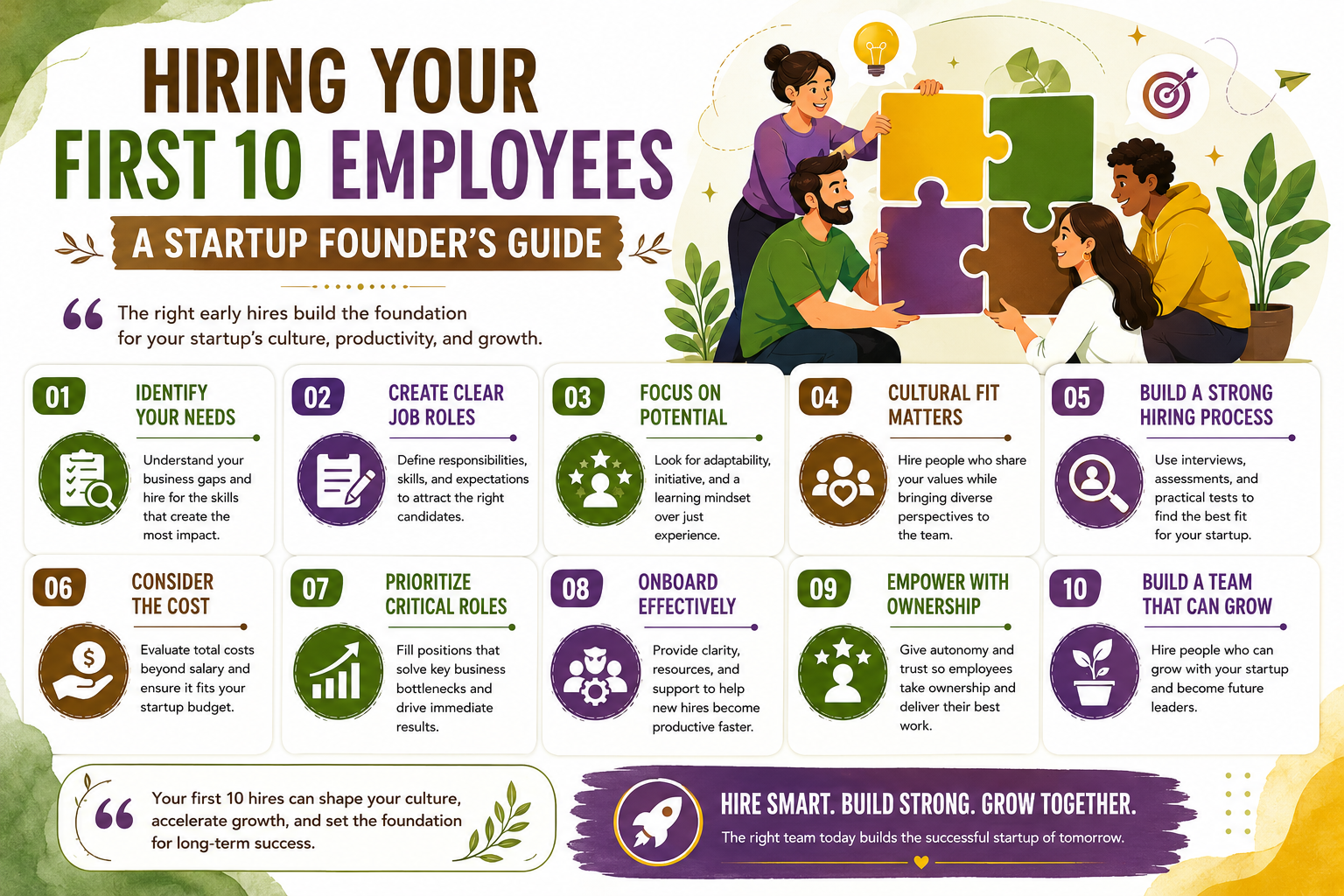
Hiring your first employees is one of the biggest milestones in a startup journey. Early team members do more than complete assigned tasksthey influence company culture, productivity, customer experience, and future growth. Choosing the right people at this stage can create a strong foundation, while poor hiring decisions can consume valuable time and resources.
Hiring First Employees requires founders to think carefully about business needs, responsibilities, skills, culture, and long-term goals. Instead of hiring simply because the workload is increasing, founders should identify which roles will create the greatest value for the business.
For founders navigating Hiring First Employees, understanding the Startup Hiring Strategy, selecting the right First 10 Employees, and adopting effective Hiring for Startups practices can help build a skilled team that supports productivity, innovation, and sustainable business growth.
1. Identify What Your Startup Needs
Before publishing job openings, understand where your business has the biggest gaps. Make a list of tasks that founders are currently handling and identify responsibilities that require dedicated expertise.
For example, a product-focused startup may initially need engineers, designers, sales professionals, and operations support. A technology startup may prioritize developers, customer support, marketing, and business development.
The first ten employees should complement the founders’ skills rather than duplicate them. This approach helps create a balanced team capable of handling different business functions.
2. Create Clear Job Descriptions
A clear job description helps attract suitable candidates and prevents misunderstandings after hiring. Each description should explain the role, responsibilities, required skills, experience level, reporting structure, and expected outcomes.
Avoid creating unrealistic job descriptions that demand expertise in too many unrelated areas. While startup employees often handle multiple responsibilities, Hiring First Employees should focus on giving each person a clear primary role and defined expectations.
Well-defined responsibilities also make performance evaluation easier once the employee joins the organization, helping founders measure performance, identify development needs, and ensure every new hire contributes effectively to the startup’s goals.
3. Hire for Potential, Not Just Experience
Experience is useful, but it should not be the only hiring criterion. Early-stage startups often need people who are adaptable, curious, proactive, and comfortable working in uncertain situations.
Candidates who demonstrate strong problem-solving skills and a willingness to learn can become valuable contributors as the company evolves.
Founders should consider how candidates approach challenges rather than focusing only on previous job titles. Someone with less experience but strong initiative may be a better fit than an experienced professional who struggles with a fast-changing environment.
4. Focus on Cultural Fit
Your first ten employees can strongly influence company culture. Founders should therefore identify the values they want to establish from the beginning.
Important qualities may include accountability, teamwork, transparency, innovation, customer focus, and continuous learning.
However, cultural fit should not mean hiring people who all think alike. A diverse team with different perspectives can improve creativity and decision-making.
The goal is to create a team that shares core values while bringing different skills and viewpoints to the business.
5. Build a Practical Hiring Process
A structured hiring process can help founders make better decisions. Start by reviewing applications against clearly defined criteria. Shortlisted candidates can then participate in interviews, skill assessments, or practical assignments where appropriate.
Ask questions that reveal how candidates solve problems, communicate, prioritize tasks, and handle challenges.
For technical roles, practical assessments can help evaluate real capabilities. For sales or customer-facing positions, role-playing exercises can provide useful insights into communication and decision-making.
6. Consider the Cost of Every Hire
Hiring employees involves more than salary. Founders should consider recruitment costs, equipment, software, benefits, training, office requirements, and other operational expenses.
Before making an offer, calculate whether the business can comfortably support the employee’s total cost.
This is particularly important for startups with limited cash flow. Strategic hiring can strengthen a business, but hiring too quickly can put unnecessary pressure on finances.
7. Prioritize Critical Roles
Not every position needs to be filled immediately. Founders should prioritize roles that directly address current business bottlenecks.
For example, if customer demand is growing faster than the team can respond, customer support or operations may be a priority. If product development is delayed, technical or engineering talent may be more important.
This approach makes Startup Hiring Strategy more focused and ensures that each new employee solves a meaningful business problem.
8. Create an Effective Onboarding Process
Hiring someone is only the beginning. New employees need proper onboarding to understand the company’s objectives, processes, tools, expectations, and culture.
Provide access to necessary systems and introduce new employees to relevant team members. A simple onboarding document can explain company policies, communication channels, workflows, and key responsibilities.
Good onboarding helps employees become productive faster and reduces confusion during their first few weeks.
9. Give Employees Ownership
Early employees should have opportunities to take responsibility for meaningful work. Micromanaging every activity can limit creativity and slow progress.
Founders should communicate expected outcomes and give employees reasonable freedom to determine how they accomplish their responsibilities.
When people feel ownership of their work, they are more likely to think about quality, efficiency, and business impact.
10. Build a Team That Can Grow
The first ten employees can become future leaders. Founders should therefore consider not only what candidates can contribute today but also how they could grow with the company.
Employees who demonstrate leadership, adaptability, and strong communication may eventually manage teams or important projects.
A strong Startup Hiring Strategy should therefore consider long-term organizational needs rather than focusing only on immediate vacancies.
Common Hiring Mistakes to Avoid
Founders should avoid hiring solely because a candidate is available, relying entirely on interviews, ignoring references where appropriate, or failing to define responsibilities.
Another common mistake is hiring too many people before establishing repeatable processes. Technology, outsourcing, or improved workflows may sometimes solve a problem more efficiently than adding another full-time employee.
The objective of Hiring First Employees is not simply to increase headcount. It is to build a capable team that helps the company execute its vision.
Make Your First Ten Hires Count
Your first employees can influence the direction of your startup for years. Take time to identify business needs, define roles, assess candidates carefully, and establish an environment where people can grow.
For entrepreneurs exploring How to start a small business in India, learning how to hire the right people early can help create a strong foundation for productivity, customer satisfaction, and sustainable business growth.

My Design Minds: Supporting Growing Startups
My Design Minds helps startups and businesses transform ideas into practical design, engineering, and manufacturing solutions. From CAD design and 3D product visualization to product engineering, reverse engineering, prototyping, and mould manufacturing, the company supports businesses across different stages of product development. For founders managing Hiring First Employees, access to reliable technical expertise can help new teams focus on their core responsibilities.
A strong Startup Hiring Strategy can combine skilled employees with trusted external expertise when specialized capabilities are required. My Design Minds provides professional design and engineering support that can complement growing startup teams. By helping businesses develop technically sound and manufacturable products, the company enables founders to focus on customers, operations, and long-term growth while receiving dependable product development support.