
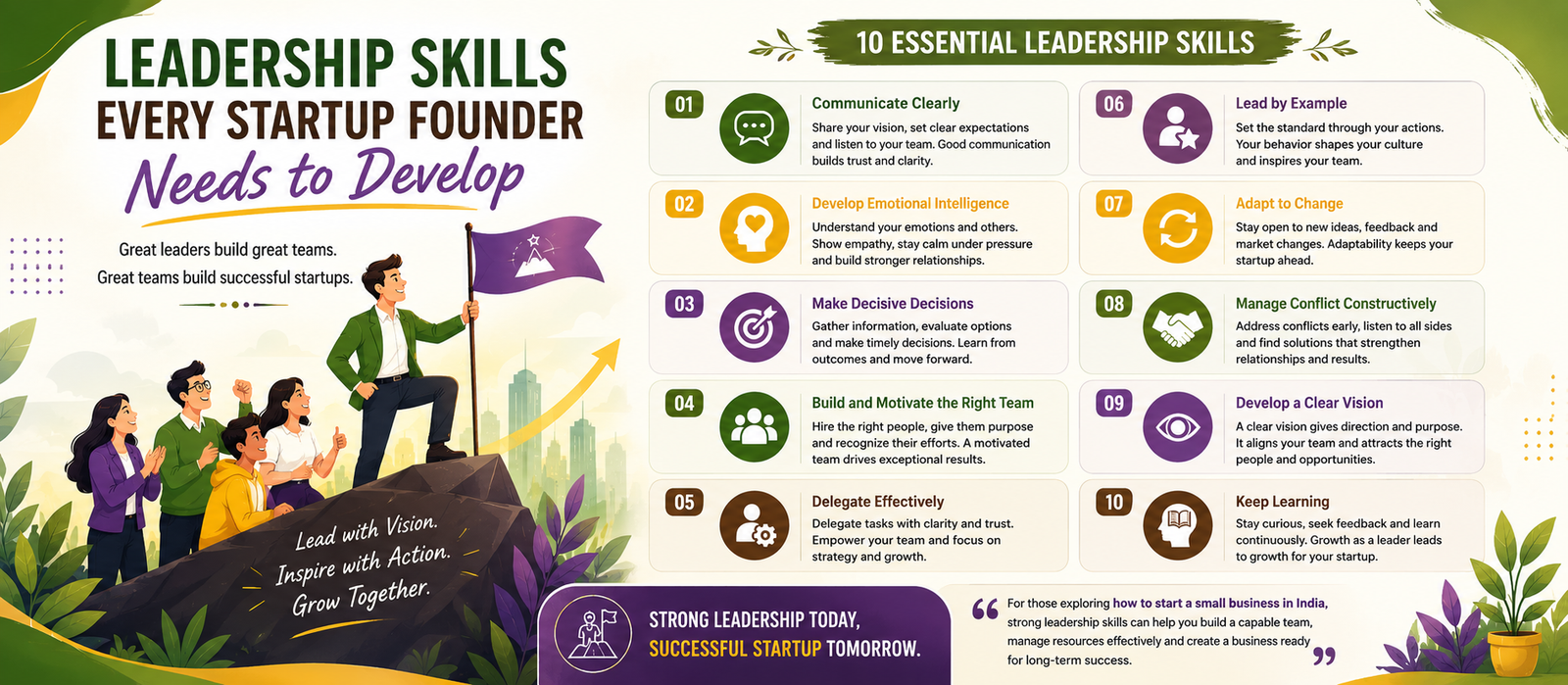
Starting a business requires more than a great idea, funding, or a strong product. Founders must also know how to lead people, make difficult decisions, manage uncertainty, and create a workplace where employees can perform at their best. Strong Leadership Skills for Startup Founders can make a significant difference in how a young company handles challenges and opportunities.
A startup environment is often fast-moving and unpredictable. Employees look to founders for direction, confidence, and clarity. By developing the right leadership abilities, founders can build stronger teams, improve productivity, and create a foundation for sustainable growth.
1. Communicate Clearly
Communication is one of the most important responsibilities of a founder. Employees need to understand the company’s goals, priorities, responsibilities, and expectations.
Founders should communicate openly and avoid assuming that employees automatically understand their vision. Regular team meetings, clear instructions, constructive feedback, and transparent discussions can reduce confusion and improve collaboration.
Good communication also means listening. Employees may have valuable ideas about products, customers, processes, and problems. Leaders who actively listen can discover opportunities that they might otherwise miss.
2. Develop Emotional Intelligence
Running a startup can be stressful, and founders often have to deal with pressure, uncertainty, and setbacks. Emotional intelligence helps leaders understand their own emotions while recognizing how their behavior affects others.
Effective Founder Leadership involves remaining calm during difficult situations, showing empathy toward employees, and responding thoughtfully instead of reacting impulsively.
A founder who understands different personalities and working styles can build stronger relationships with employees. This creates a healthier environment where team members feel respected and comfortable sharing their ideas and concerns.
3. Make Decisive Decisions
Startups rarely have complete information when important decisions need to be made. Founders may have to choose between different strategies, investments, technologies, or hiring options.
Strong leaders gather relevant information, evaluate risks, consider different viewpoints, and then make decisions without unnecessary delays. They should also accept that not every decision will produce the expected outcome.
Learning from mistakes is an essential part of leadership. Instead of blaming individuals when something goes wrong, founders should identify what happened, understand the underlying cause, and improve the process.
4. Build and Motivate the Right Team
A founder cannot build a successful company alone. Employees bring specialized knowledge, creativity, and execution capabilities that help transform ideas into results.
Developing effective Startup Leadership Skills means understanding what each team member does well and providing opportunities for them to contribute meaningfully. Leaders should establish clear responsibilities while giving employees enough independence to solve problems.
Recognition also matters. Appreciating good work, celebrating achievements, and providing constructive feedback can improve motivation and employee engagement.
5. Delegate Effectively
Many founders initially try to manage every task themselves. While this may work when a business is very small, it becomes a major limitation as the company grows.
Effective delegation allows founders to focus on strategy while employees take responsibility for operational activities. Delegation does not mean simply assigning tasks. Leaders should provide the necessary context, resources, authority, and expectations.
Trusting employees with meaningful responsibilities can also help develop future managers and leaders within the organization.
6. Lead by Example
Employees often observe what founders do more closely than what they say. If a founder expects punctuality, accountability, honesty, and professionalism, those qualities should be demonstrated consistently.
Founder Leadership becomes more effective when leaders practice the standards they expect from their teams. A founder who accepts responsibility for mistakes, respects employees, and remains committed during difficult periods can encourage similar behavior across the organization.
Leading by example helps establish company culture naturally rather than relying only on written policies.
7. Adapt to Change
Markets, customer expectations, technologies, and competitors can change quickly. Startups need leaders who can adapt without losing sight of their long-term objectives.
Strong Startup Leadership Skills include being open to new ideas, testing different approaches, learning from market feedback, and changing strategies when necessary.
Adaptability does not mean changing direction constantly. Instead, it means understanding when circumstances require a different approach and having the confidence to respond appropriately.
8. Manage Conflict Constructively
Disagreements are natural when people with different experiences and perspectives work together. Ignoring conflicts can reduce productivity and damage workplace relationships.
Founders should address problems early and encourage respectful conversations. Rather than immediately taking sides, leaders should listen to everyone involved, identify the real issue, and work toward a practical solution.
Constructive conflict management can turn disagreements into opportunities for better ideas and stronger teamwork.
9. Develop a Clear Vision
Employees need to understand where the company is going and why their work matters. A clear vision gives people a common purpose and helps them prioritize their efforts.
Founders should explain the company’s mission in simple and practical terms. They should connect individual responsibilities to broader business objectives so employees can see how their contributions support company growth.
A compelling vision can also help attract employees, partners, customers, and investors who believe in the company’s direction.
10. Keep Learning
Leadership is not a skill that founders master once and never need to improve. Successful entrepreneurs continuously learn from employees, customers, competitors, mentors, failures, and changing market conditions.
Reading, attending industry events, seeking feedback, and learning from experienced entrepreneurs can help founders improve their leadership approach.
The most effective Leadership Skills for Startup Founders develop through experience and reflection. Founders who remain curious and willing to improve are better prepared to guide their companies through different stages of growth.
My Design Minds – Supporting Growing Businesses
My Design Minds helps startups and growing businesses turn ideas into practical products through professional design, engineering, and manufacturing solutions. Our services include CAD design, product development, 3D printing, reverse engineering, product engineering, mould manufacturing, and other technical solutions. Strong Leadership Skills for Startup Founders are important when coordinating teams and developing innovative products. By combining Startup Leadership Skills with professional technical expertise, founders can make better decisions, encourage Founder Leadership, and create an effective path toward sustainable growth. My Design Minds supports businesses with the design and engineering capabilities they need to transform concepts into market-ready solutions.
For entrepreneurs researching How to start a small business in India, developing strong leadership skills from the beginning can help build a capable team, manage resources effectively, handle challenges, and create a business prepared for sustainable growth.