
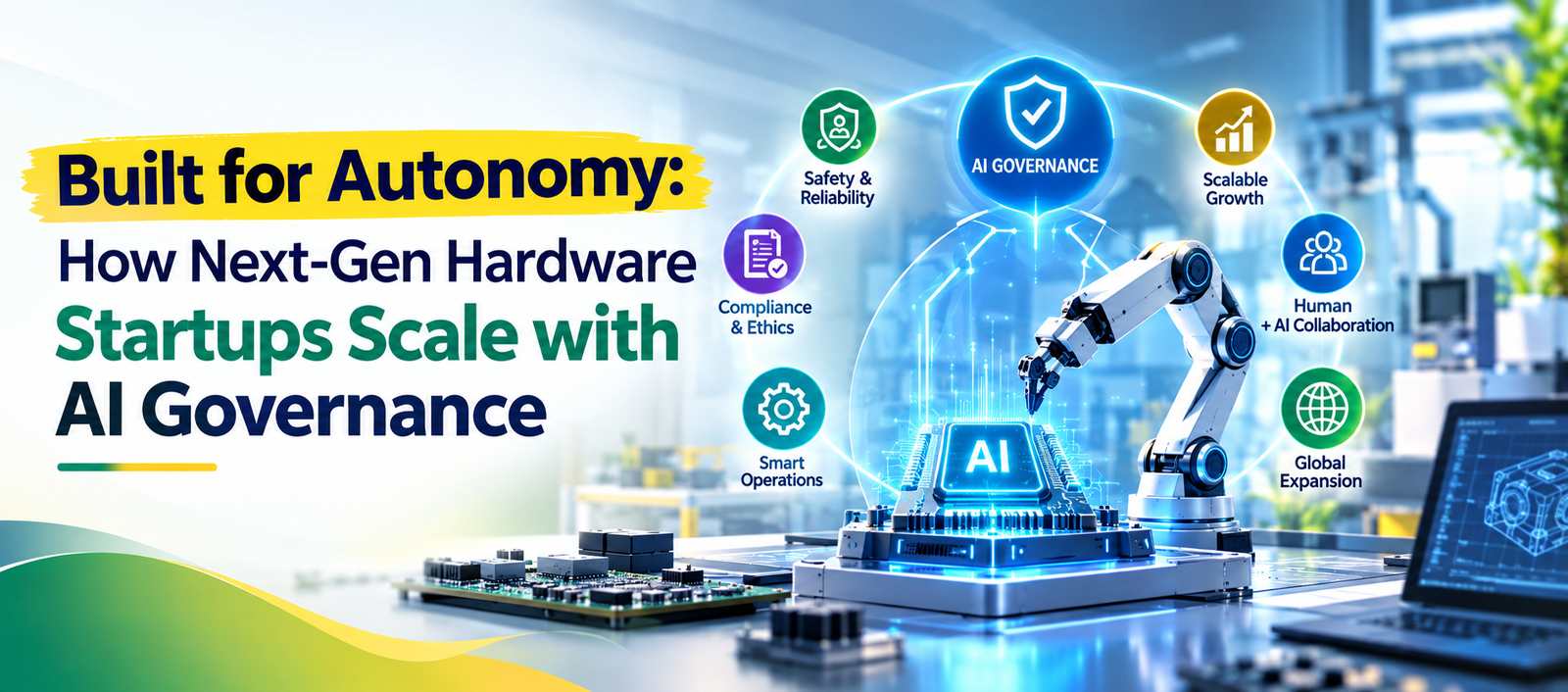
Developing a winning hardware startup AI strategy requires moving beyond pure software innovation to master physical production. By pairing generative design tools with strict governance and digital twin testing, early-stage founders can rapidly design, test, and manufacture cutting-edge physical products while keeping operational risks completely under control.
For an early-stage hardware startup, speed is survival. Traditionally, bringing a physical product to market required immense capital, massive engineering teams, and years of iteration. Today, the rapid advancement of autonomous AI agents is leveling the playing field, allowing lean startup teams to achieve what once required enterprise-level resources.
However, moving from simple AI tools to fully autonomous AI agents presents a unique founder’s dilemma. In the software world, a glitch means a quick patch. In physical hardware, an unvetted design or factory error can ruin inventory, trigger expensive recalls, or derail a funding round.
To win in the modern industrial landscape, startups must learn how to integrate autonomous AI into their design and manufacturing pipelines without sacrificing control.
The Hardware Startup AI Strategy Advantage: Compounding Speed with AI Autonomy
Legacy industrial companies are weighed down by rigid, decades-old workflows. Startups, unencumbered by technical debt, can integrate autonomous AI directly into their core operating model from day one.
       LEGACY HARDWARE STARTUP                      NEXT-GEN AI HARDWARE STARTUP
+------------------------------------+         +------------------------------------+
| • Manual CAD iterations            |         | • Generative AI Design Loops       |
| • Weeks of physical testing        |   VS    | • Rapid Digital Twin Simulations   |
| • Fixed-contract assembly lines    |         | • Autonomous Adaptive Production   |
| • Reactive quality control         |         | • Real-Time Predictive Telemetry   |
+------------------------------------+         +------------------------------------+
1. Accelerated Generative Design
Instead of spending months tweaking CAD models, startup engineering teams can deploy AI agents to run recursive design loops. By feeding target constraints – such as cost, weight, stress tolerance, and thermal limits – into an autonomous agent, founders can generate hundreds of production-ready, material-efficient designs in hours.
2. Flexible, Agent-Driven Manufacturing
Scaling physical production is typically the hardest hurdle for a hardware startup. Autonomous AI agents equipped with computer vision and IoT telemetry allow startups to utilize smart contract manufacturing efficiently. AI agents monitor third-party assembly lines in real time, detecting micro-defects during early production runs and automatically adjusting parameters before whole batches are ruined.
The Founder’s Trap: The Industrial AI “Control Problem”
While autonomy dramatically lowers the cost of innovation, it introduces a severe risk: The Control Problem.
When AI agents transition from suggesting code to autonomously optimizing structural designs or commanding factory equipment, a lack of alignment can lead to catastrophic physical failures:
- Over-Optimization Risk: An AI agent optimizing a drone chassis for weight might shave off critical structural wall thickness that passes software simulations but fails in real-world turbulence.
- Supply Chain Overreach: An autonomous sourcing agent might switch to an unverified material supplier to optimize unit economics, inadvertently introducing defective components into production.
For a venture-backed startup, a single unmonitored failure can kill the business before it reaches Series A.
The Startup Blueprint for AI Governance and Safety
Scaling an AI-driven startup doesn’t mean letting algorithms run wild. The most successful founders embed strict governance into their technology stacks to ensure every autonomous action remains aligned with company standards.
                  +-----------------------------------+
                  |      STARTUP FOUNDER & ENGINEERS  |
                  |     (Strategic Guardrails & Sign-Off)
                  +-----------------------------------+
                                    |
                                    v
+-----------------------+ +-------------------+ +-----------------------+
| Digital Twin Testing  | | Immutable Safety  | | Real-Time Telemetry   |
| (Virtual Validation)  | |    Thresholds     | |   & QA Monitoring     |
+-----------------------+ +-------------------+ +-----------------------+
1. Mandate Virtual Validation via Digital Twins
Never send an AI-generated model directly to physical tooling. Build a digital twin environment to stress-test autonomous design iterations across edge-case physical conditions before committing capital to hardware prototypes.
2. Implement Hard Safety Thresholds
Define unalterable physical parameters within your AI systems. Whether it’s minimum yield strengths in mechanical engineering or current limits in circuit design, hardcoded guardrails prevent autonomous agents from making dangerous trade-offs. Implementing strict AI governance for startups ensures these boundary conditions are strictly enforced before any design moves to physical production.
3. Retain Strategic Human-in-the-Loop Oversight
Use AI to generate options and execute tasks, but keep human engineers in charge of final approvals for critical milestones. Autonomous execution paired with human judgment yields speed without liability.
Building a Defensible Industrial Startup
The future belongs to agile teams that combine innovation with control. By deploying a strong hardware startup AI strategy, founders can scale autonomous AI manufacturing and industrial AI integration without unmanaged risk. Whether you run a generative design startup or are learning how to start a small business in India, embedding strict AI governance for startups ensures your physical products remain safe, compliant, and market-ready.
By combining radical execution speed with proactive control, modern founders can build better hardware faster – and establish a lasting competitive moat.
Understanding how to start a small business in India is essential for any modern founder looking to bridge the gap between initial innovation and sustainable commercial growth.

Leave a Reply