
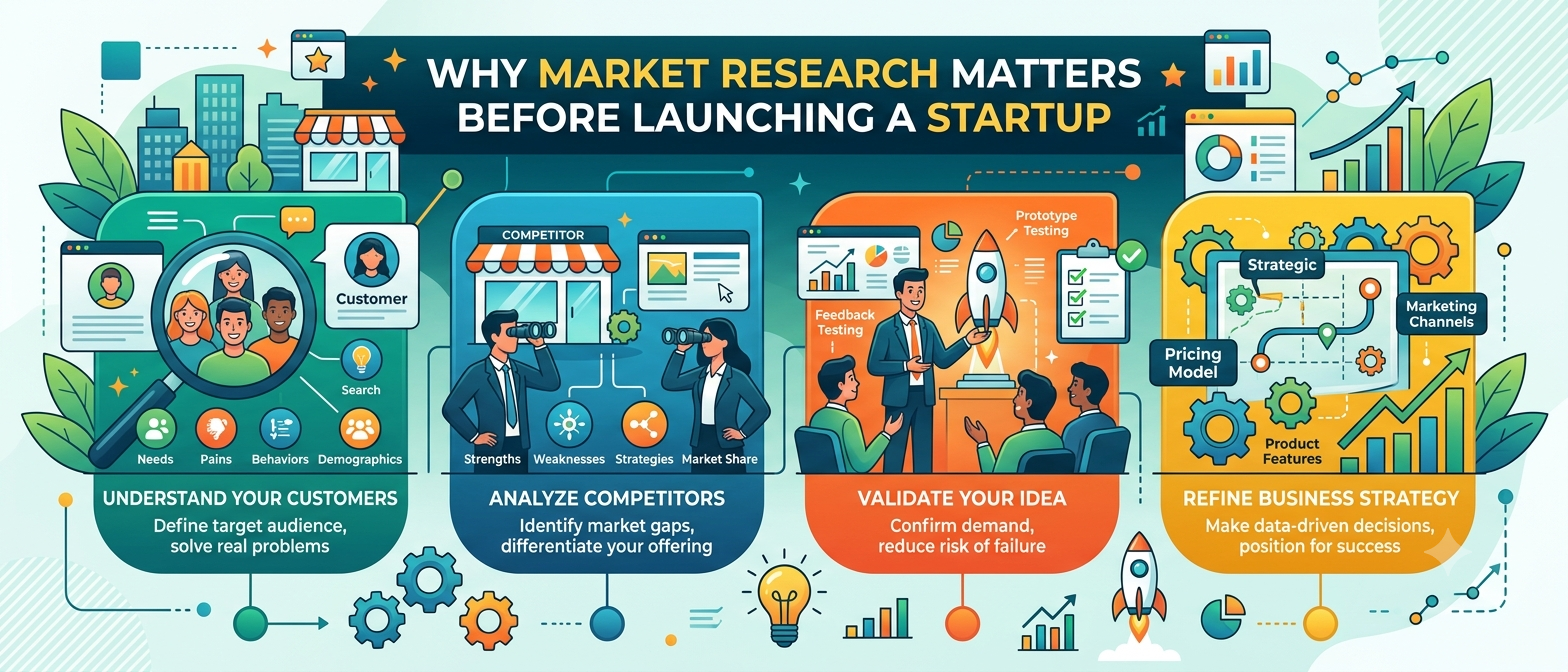
Starting a new business requires more than a good idea. Founders need to understand whether customers actually need the product or service, who the competitors are, what customers are willing to pay, and what challenges may affect growth. Startup Market Research helps entrepreneurs gather this information before investing significant time and money into a new venture.
A startup may have an innovative product, but innovation alone does not guarantee success. Research helps founders replace assumptions with useful information and make decisions based on customer needs, industry conditions, and competitive opportunities.
Understand Your Target Customers
One of the first steps in building a startup is identifying the people most likely to purchase the product or service. Founders need to understand customer demographics, preferences, problems, purchasing behavior, and expectations.
Target Market Research helps businesses define their ideal customer more clearly. Instead of trying to sell to everyone, startups can focus their marketing, product development, and sales efforts on specific customer groups.
Customer interviews, surveys, online reviews, social media discussions, and competitor feedback can provide valuable insights. These findings can also reveal problems that customers experience but existing solutions do not adequately address.
Validate the Business Idea
Many startup ideas sound promising during the planning stage. However, an idea that seems useful to the founder may not solve a sufficiently important customer problem.
Market Research for Startups can help validate whether there is genuine demand for the proposed solution. Founders can test their assumptions by speaking with potential customers, studying search trends, conducting surveys, or launching a simple prototype.
Early validation can help identify whether customers understand the product, whether they consider it valuable, and whether they would potentially pay for it. If research reveals weaknesses, founders can adjust the idea before committing substantial resources.
Study Competitors
Understanding competitors is another important part of preparing for a startup launch. Competitor research can reveal what products already exist, how businesses position themselves, what pricing models they use, and where customers are dissatisfied.
A Startup Market Analysis can help founders identify both direct and indirect competitors. Direct competitors may offer similar products, while indirect competitors may solve the same customer problem in a different way.
This information can help a startup identify opportunities for differentiation. For example, a business might compete through better customer support, faster delivery, specialized features, improved usability, or a more focused customer segment.
Understand Market Demand
A startup needs sufficient market demand to build a sustainable business. Even a well-designed product can struggle if the potential customer base is too small or demand is declining.
Target Market Research provides insights into the size and characteristics of a potential customer segment. Founders can examine industry reports, customer surveys, search behavior, sales data, and emerging trends to understand market conditions.
Startup Market Research should also consider whether demand is seasonal, location-specific, price-sensitive, or influenced by changing technology. These factors can affect product planning and revenue expectations.
Make Better Pricing Decisions
Pricing can significantly influence whether customers choose a new product. Setting the price too high may discourage potential buyers, while pricing too low can make it difficult to cover costs and communicate value.
Market Research for Startups can help founders understand competitor pricing and customer expectations. Surveys and interviews can provide indications of how much potential customers may be willing to pay.
However, pricing research should be combined with production costs, operational expenses, distribution costs, and desired margins. The goal is to develop a pricing strategy that is attractive to customers while supporting business sustainability.
Identify Risks Before Launch
Every startup faces uncertainty. Market conditions can change, competitors can introduce new products, customer preferences can shift, and regulatory or technological developments can create new challenges.
A detailed Startup Market Analysis can help founders identify potential risks before launch. Research may reveal barriers to entry, strong competitors, limited demand, supply challenges, or customer concerns that were not considered initially.
Recognizing these issues early gives entrepreneurs an opportunity to develop alternative strategies and reduce avoidable mistakes.
Improve Product Development
Market research should not stop once a business idea has been validated. Customer feedback can continue to influence product development throughout the startup journey.
Founders can use feedback to prioritize features, improve usability, remove unnecessary functions, and develop solutions that address real customer problems. This customer-focused approach can reduce the risk of spending resources on features that provide little value.
Research can also help businesses determine which customer problems should receive priority during the initial launch and which improvements can be introduced later.
Build a Stronger Marketing Strategy
Research also provides a foundation for marketing. Knowing the target audience makes it easier to create relevant messaging, select appropriate marketing channels, and communicate the benefits of a product.
Instead of using generic advertising, startups can create content around specific customer challenges and demonstrate how their solution addresses those challenges. Customer language discovered during interviews and surveys can also make marketing communication more relatable.
Turn Research Into Action
Market research is valuable only when its findings influence business decisions. Founders should organize research findings into clear insights and connect them to product development, pricing, positioning, sales, and marketing strategies.
The process does not require an enormous research budget. Startups can begin with customer interviews, competitor websites, online communities, surveys, industry publications, and small-scale product testing.
The key is to ask meaningful questions and remain open to findings that challenge the original business idea.
Final Thoughts
Launching a startup involves uncertainty, but founders can reduce some of that uncertainty through careful research. Startup Market Research helps entrepreneurs understand customers, evaluate competitors, assess demand, identify risks, and make more informed decisions before launch.
For businesses developing physical products, research should also connect customer requirements with practical product development and manufacturing considerations. My Design Minds supports startups and businesses with CAD design, 3D visualization, product development, prototyping, reverse engineering, and manufacturing-related solutions. By connecting business requirements with practical design and engineering expertise, My Design Minds can help turn validated product ideas into development-ready concepts. For founders planning to start a small business in India, understanding the market first and then developing a practical product strategy can create a stronger foundation for sustainable growth.

Startup Market Research and Target Market Research help founders understand customer needs, market demand, competition, and potential risks before launching a new business.
Leave a Reply