
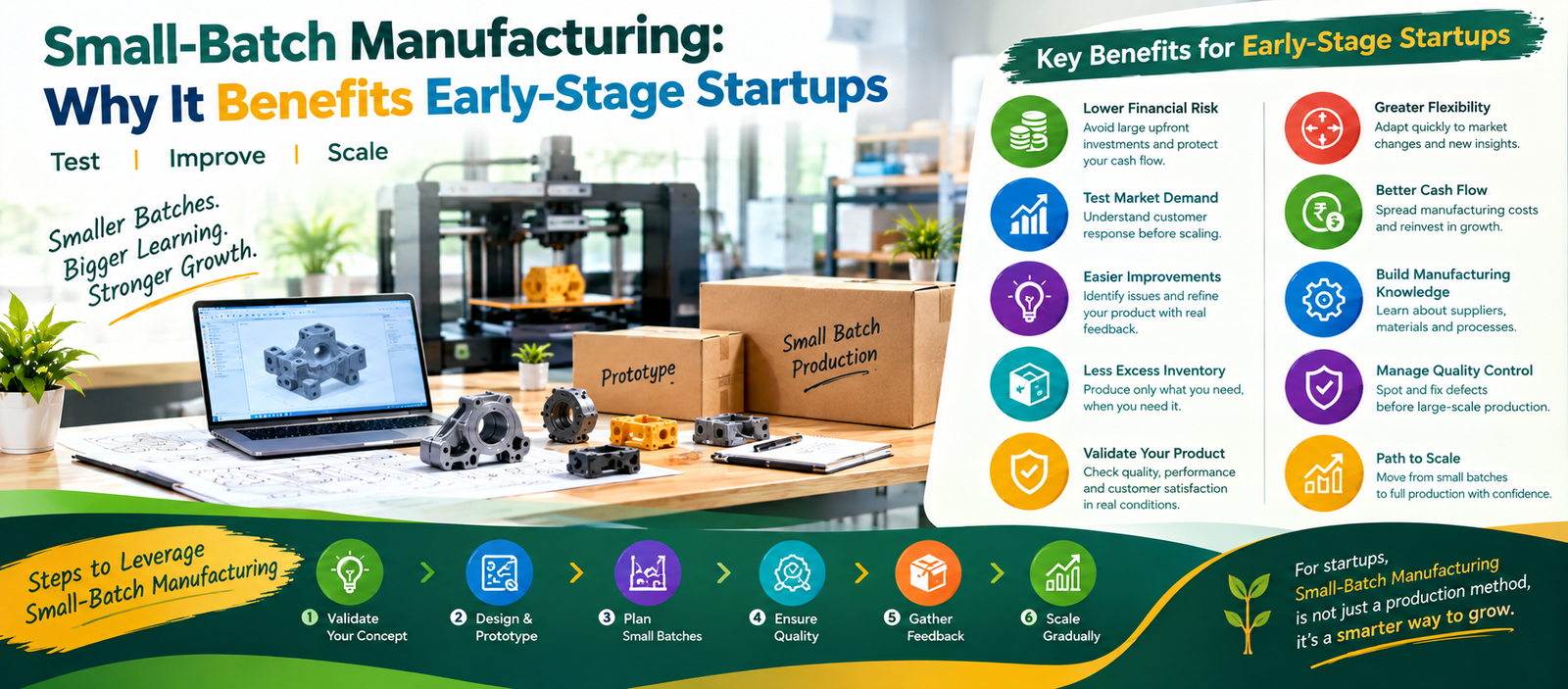
For an early-stage startup, moving directly into large-scale production can create significant financial and operational risks. Founders may still be testing customer demand, improving product designs, and learning which features customers actually value. Small-Batch Manufacturing provides an opportunity to produce a limited quantity before committing substantial resources to mass production.
Instead of investing heavily in inventory at the beginning, startups can manufacture smaller quantities, test their products in real market conditions, collect feedback, and make improvements. This approach can make the transition from product concept to commercial production more manageable.
1. Reduces Initial Financial Risk
Large production runs often require substantial investment in materials, tooling, inventory, packaging, and manufacturing capacity. For a startup with limited capital, committing to a large order before validating demand can create unnecessary financial pressure.
Low-Volume Manufacturing allows businesses to produce smaller quantities and allocate their available capital more carefully. If changes are required after testing, the startup has not already committed its entire budget to a large quantity of products.
This approach can be particularly useful for founders who are still validating their business model and customer demand.
2. Helps Test Market Demand
A product may look promising during development but perform differently once it reaches actual customers. Small production runs allow startups to introduce a product to a limited audience and observe customer responses.
Founders can evaluate sales, reviews, repeat purchases, customer complaints, and requests for improvements. These insights can help determine whether the product should be continued, redesigned, repositioned, or expanded.
Small-Scale Production therefore provides a practical bridge between product development and larger commercial manufacturing.
3. Makes Product Improvements Easier
Early versions of a product may contain design problems that are difficult to identify through CAD models or prototypes alone. Actual customers can reveal issues related to usability, durability, appearance, assembly, packaging, or functionality.
Producing a smaller quantity makes it easier to identify these problems before manufacturing volumes increase. Startups can make design modifications and test an improved version without dealing with large quantities of outdated inventory.
This creates a more flexible product development cycle and supports continuous improvement.
4. Reduces Excess Inventory
Inventory can become a major challenge for young businesses. If demand is lower than expected, unsold products can tie up capital and require additional storage.
Startup Manufacturing strategies based on smaller production quantities can help founders align inventory more closely with actual demand. Instead of producing thousands of units immediately, businesses can begin with a manageable quantity and increase production when sales provide stronger evidence of demand.
This can also reduce the risk of products becoming outdated when designs, technologies, or customer preferences change.
5. Supports Product Validation
Before scaling production, startups need to determine whether their product meets technical and customer expectations. A limited manufacturing run can provide valuable information about production quality, assembly processes, material performance, packaging, and customer experience.
Founders can use this information to improve product specifications and manufacturing processes. Testing products under realistic conditions can reveal challenges that may not become visible during early development.
6. Provides Greater Flexibility
Startups often operate in changing markets. Customer preferences, competitors, material prices, and product requirements can change quickly.
Smaller production quantities allow businesses to respond to these changes more easily. If demand shifts or a design needs modification, the startup can adjust its next production run without being burdened by a large existing inventory.
This flexibility is especially valuable during the early stages of a business when founders are still learning about their market.
7. Improves Cash Flow Management
Cash flow is one of the most important considerations for an early-stage company. Money invested in inventory cannot easily be used for marketing, hiring, product development, technology, or customer acquisition.
By controlling production quantities, startups can distribute their manufacturing expenditure over time. Revenue generated from an initial batch can potentially help finance subsequent production.
Low-Volume Manufacturing can therefore complement careful financial planning by reducing the amount of capital committed to inventory at one time.
8. Builds Manufacturing Knowledge
The first production run can teach founders how their product behaves in a real manufacturing environment. They can learn about supplier lead times, material availability, quality inspection, assembly requirements, packaging, shipping, and production costs.
These lessons become useful when the company eventually increases production volume. Instead of moving from a prototype directly to large-scale manufacturing, the startup gradually develops practical manufacturing knowledge.
9. Makes Quality Control More Manageable
Quality problems can become expensive when they affect thousands of products. A smaller production run makes it easier to inspect products and identify recurring defects.
Founders can establish quality checkpoints, review manufacturing tolerances, evaluate materials, and improve assembly processes before increasing production volumes.
A controlled production approach can therefore help startups establish consistent quality standards while they are still refining their processes.
10. Creates a Path Toward Scalable Production
The goal of producing small quantities is not necessarily to remain small forever. Instead, it can provide a structured path toward larger production.
Once a startup has validated demand, refined its product, improved manufacturing processes, and established reliable suppliers, it can gradually increase production quantities.
Small-Batch Manufacturing can therefore act as an intermediate stage between prototyping and full-scale commercial production, allowing startups to make decisions based on practical experience rather than assumptions.
My Design Minds
My Design Minds supports startups and businesses with CAD design, product engineering, 3D visualization, reverse engineering, prototyping, 3D printing, and manufacturing support. Its expertise can help businesses prepare products for Startup Manufacturing requirements by developing accurate designs and evaluating production considerations early. Through CAD modeling, prototyping, product development, and manufacturing support, My Design Minds can help businesses refine concepts before increasing production volumes. The team can also support Small-Scale Production requirements by connecting product design with practical manufacturing considerations such as materials, components, tolerances, tooling, and assembly. This integrated approach helps startups move from ideas and prototypes toward practical, production-ready products.
For entrepreneurs learning How to start a small business in India, beginning with limited production can help reduce financial risk, validate customer demand, control inventory, improve products through feedback, and gradually build a sustainable manufacturing process.
Leave a Reply