
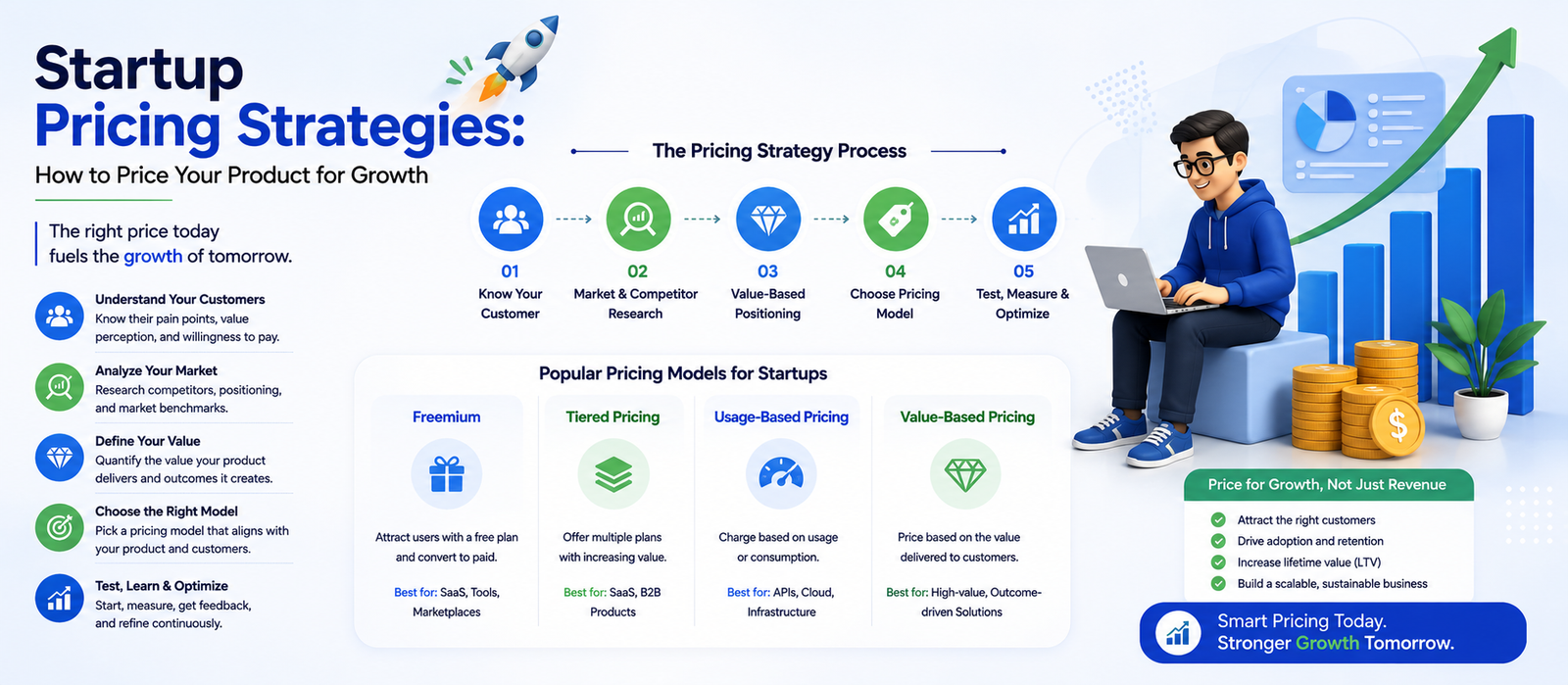
Introduction
Choosing the right price can determine whether a startup attracts customers, generates sustainable revenue, or struggles to grow. Pricing is not simply about covering production costs; it is about understanding customer expectations, communicating product value, and creating a business model that supports long-term growth. Effective Startup Pricing Strategies help founders balance profitability, customer acquisition, market positioning, and scalability.
For early-stage companies, pricing should remain flexible. As the product, customer base, and competitive environment evolve, founders should continuously evaluate whether their pricing still reflects the value being delivered.
Why Pricing Matters for Startup Growth
A startup can have an excellent product and strong marketing but still struggle if its pricing is poorly designed. Charging too much can discourage potential customers, while charging too little can reduce profitability and make the product appear less valuable.
A well-planned pricing approach can help startups:
- Improve revenue and profit margins
- Attract the right customer segments
- Strengthen market positioning
- Increase customer conversion rates
- Support sustainable business growth
- Create opportunities for future product expansion
Pricing should therefore be treated as a strategic business decision rather than an afterthought.
1. Understand Your Target Customers
Before setting a price, identify who your customers are and what they are willing to pay. Different customer segments may have different budgets, expectations, and purchasing motivations.
Conduct customer interviews, surveys, competitor research, and market analysis to understand pricing expectations. Focus on the problem your product solves and the financial or operational benefit customers receive.
For example, a business software product that saves employees several hours each week may justify a higher price than a tool offering only basic functionality.
2. Calculate Your Costs
Understanding costs is essential for establishing a sustainable pricing foundation. Calculate product development, manufacturing, employee salaries, marketing, technology, distribution, customer support, and other operational expenses.
Your price should provide enough margin to cover these expenses while leaving room for reinvestment and growth.
However, cost-based pricing alone is not always sufficient. Customers ultimately evaluate what your product is worth to them, not simply how much it costs your company to produce.
3. Use Value-Based Pricing
Value-Based Pricing focuses on the perceived benefits and outcomes customers receive rather than simply calculating production costs.
To apply this approach, determine:
- What problem does your product solve?
- How much money or time can customers save?
- What results can customers achieve?
- How does your solution compare with alternatives?
If your product creates significant measurable value, customers may be willing to pay more for it.
Value-Based Pricing can be particularly effective for SaaS companies, professional services, specialized technology, and innovative products.
4. Study Your Competitors
Competitive research provides useful pricing benchmarks. Analyze what similar businesses charge, what features they include, and how they position their products.
Avoid simply copying competitors. Instead, identify opportunities to differentiate your offering through better features, customer service, convenience, quality, or specialized solutions.
Your Product Pricing Strategy should communicate why customers should choose your product instead of a competing option.
5. Select the Right Pricing Model
Different businesses require different approaches. Common Pricing Models for Startups include:
- Subscription pricing
- Freemium pricing
- Tiered pricing
- Usage-based pricing
- One-time purchase pricing
- Per-user pricing
- Commission-based pricing
A SaaS startup, for example, may benefit from monthly or annual subscriptions, while a physical product company may prefer one-time purchases combined with accessories or service packages.
The right model should match customer behavior and make purchasing simple.
6. Create Multiple Pricing Tiers
Offering multiple pricing packages allows customers to select an option based on their needs and budget.
A common structure includes:
Basic: Essential features for individuals or small customers.
Professional: Additional features for growing businesses.
Enterprise: Advanced functionality, customization, and dedicated support.
Tiered pricing can increase average revenue while allowing startups to serve different customer segments.
7. Test Your Prices
Pricing should not be permanent. Startups should experiment with different price points, packages, discounts, and payment structures.
Track important metrics such as:
- Conversion rate
- Customer acquisition cost
- Average revenue per customer
- Customer retention
- Upgrade rates
- Profit margins
A/B testing can help identify which pricing approach produces the strongest results.
8. Avoid Excessive Discounting
Discounts can attract customers, but excessive discounting can damage profitability and brand perception. Customers may also become accustomed to waiting for promotions before purchasing.
Instead of constantly reducing prices, startups can offer additional value through:
- Limited-time bonuses
- Extended trials
- Bundled services
- Loyalty benefits
- Additional features
This approach protects the perceived value of the product while encouraging conversions.
9. Make Pricing Easy to Understand
Complex pricing can create confusion and increase purchase hesitation. Customers should quickly understand what they receive at each price level.
Use clear pricing pages with simple descriptions, visible features, transparent terms, and strong calls to action.
Avoid unnecessary fees or complicated conditions. Transparency builds trust and can improve conversion rates.
10. Review Pricing as Your Startup Grows
Pricing that works during the early stage may not remain appropriate after your startup expands. Increased brand recognition, improved product capabilities, stronger customer demand, and higher operating costs may justify pricing changes.
Review your Pricing Models for Startups regularly and adjust them according to customer feedback, market conditions, and business performance.
Building a Long-Term Pricing Strategy
Successful pricing requires continuous learning. Founders should combine customer research, competitive analysis, financial data, and experimentation to develop a sustainable approach.
The best Startup Pricing Strategies are flexible enough to evolve as the business grows. Instead of asking only, “What will customers pay?”, founders should ask, “What value are we creating, and how can our pricing capture that value fairly?”
A strong Product Pricing Strategy can improve revenue, strengthen positioning, and create a healthier foundation for expansion. By testing different approaches and listening to customers, startups can build pricing structures that support both customer satisfaction and business profitability.
How My Design Minds Supports Startup Growth
My Design Minds helps startups turn innovative ideas into market-ready products through industrial design, CAD engineering, product visualization, prototyping, and manufacturing support. A well-designed product combined with thoughtful Startup Pricing Strategies can help startups create stronger market positioning, improve customer value, and build a sustainable path toward long-term growth.
If you want to know about how to start a small business in India, setting the right price from the beginning is essential for attracting customers, covering costs, and achieving sustainable growth. For practical guidance on choosing the right pricing model, understanding customer value, and building a profitable business, read our blog “Startup Pricing Strategies: How to Price Your Product for Growth.”