Introduction
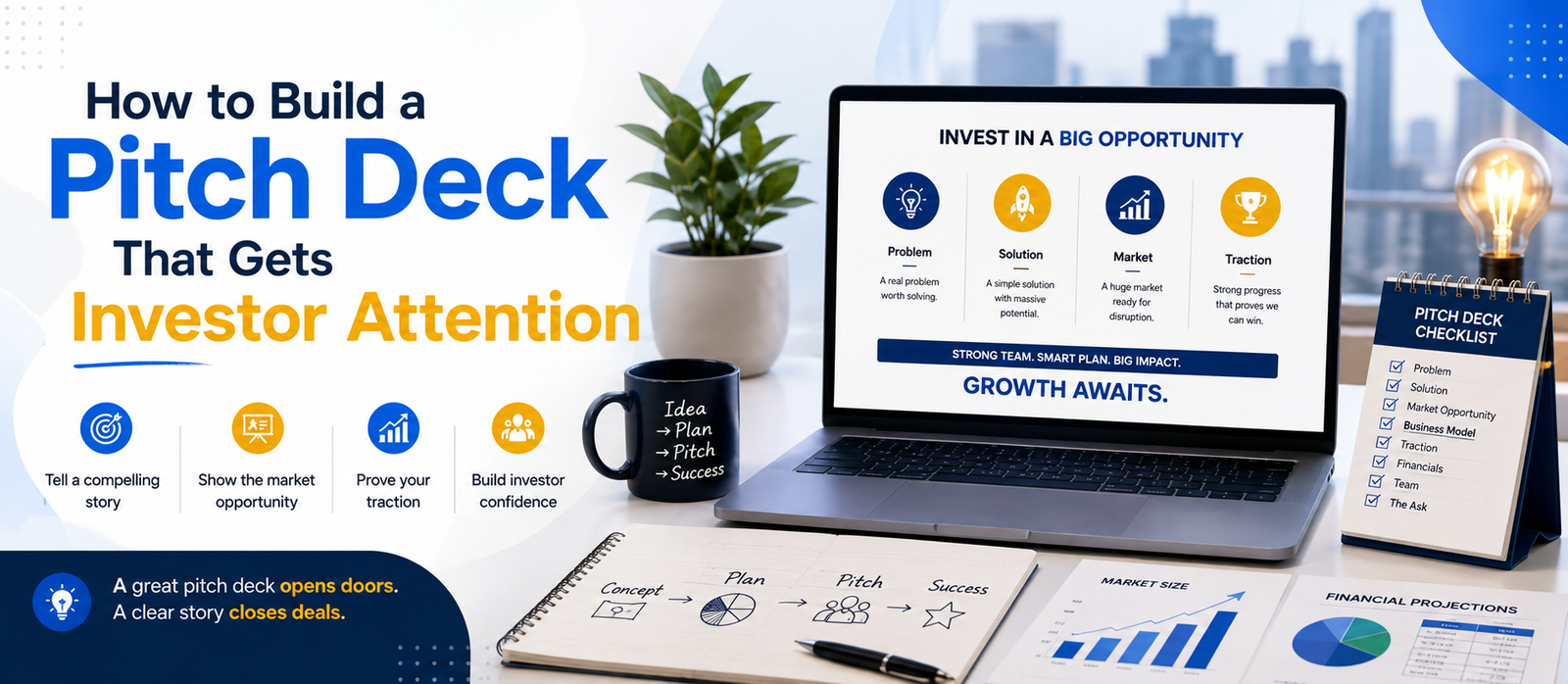
A strong startup pitch deck can make the difference between getting an investor meeting and being overlooked. For founders, the challenge is not simply creating attractive slides but communicating a business opportunity clearly, quickly, and convincingly. A successful Startup Pitch Deck should explain the problem, solution, market opportunity, business model, traction, competitive advantage, financial potential, and funding requirements without overwhelming investors.
For product-based Startup Pitch Deck, visual storytelling can make a pitch even more compelling. Using 3D Product Visualization Services can help founders present product concepts, prototypes, features, and future designs in a professional and easy-to-understand format, particularly when a physical product is still under development.
1. Start With a Strong Opening
The first slide should immediately communicate what your startup does and why it matters. Avoid filling the opening slide with excessive information.
Include:
- Startup name
- Short value proposition
- Product or service description
- Relevant visual
- Founder or company information
Your opening should create curiosity and encourage investors to continue through the presentation.
2. Clearly Define the Problem
Investors need to understand the problem your startup is solving. Explain who experiences the problem, why existing solutions are inadequate, and how significant the problem is.
Use customer research, market observations, or relevant business insights to make the problem credible. Avoid using vague statements such as “everyone needs our product.” Instead, identify a specific customer segment and explain its pain points.
A clearly defined problem creates a logical foundation for your solution.
3. Present Your Solution Visually
Once the problem is established, demonstrate how your product or service solves it. This is particularly important for startups developing physical products, hardware, machinery, consumer products, or innovative devices.
Product Visualization for Startups can help transform complex concepts into understandable visuals. Instead of relying entirely on technical descriptions, founders can show product shapes, components, functionality, and potential applications through professional visuals.
This makes the concept easier for investors to understand, especially when the final product has not yet entered mass production.
4. Explain Your Market Opportunity
Investors want to know whether your startup has enough market potential to generate meaningful returns.
Your market slide should explain:
- Target customers
- Market size
- Market growth opportunity
- Customer demand
- Geographic opportunity
- Relevant industry trends
Avoid presenting unrealistic market numbers simply to make the opportunity appear larger. Use logical assumptions and clearly explain how you calculated your opportunity.
5. Demonstrate Traction
Traction provides evidence that your business is moving beyond an idea. Depending on your startup stage, traction may include revenue, customers, partnerships, users, product trials, pre-orders, repeat purchases, or other measurable milestones.
Present important numbers using simple charts and graphics. Investors should be able to understand your progress within seconds.
For an early-stage product company, prototypes, successful testing, customer feedback, and pilot projects can also demonstrate meaningful progress.
6. Explain Your Business Model
Investors need to understand how your startup will make money. Clearly explain your revenue streams, pricing structure, customer acquisition approach, and expected margins.
Depending on the business, revenue may come from:
- Product sales
- Subscriptions
- Licensing
- Marketplace commissions
- Service contracts
- Recurring revenue
Keep the explanation straightforward. A complicated business model can create uncertainty and make investors question scalability.
7. Highlight Your Competitive Advantage
Your pitch should clearly explain why your startup can succeed against competitors. Identify direct and indirect competitors and compare your solution based on meaningful factors such as technology, price, design, distribution, intellectual property, customer experience, or operational efficiency.
Your Investor Pitch Deck Design should visually communicate these differences rather than presenting large blocks of text.
A simple comparison table or positioning graphic can make your competitive advantage easier to understand.
8. Showcase the Product With Professional Visuals
For product-focused startups, visual quality can strongly influence how investors perceive the opportunity. High-quality 3D Product Visualization Services can present realistic product concepts before manufacturing begins.
These visuals can demonstrate:
- Product appearance
- Materials and finishes
- Different configurations
- Product functionality
- Assembly concepts
- Potential use cases
Professional visualization also allows founders to communicate ideas that may be difficult to explain through photographs or early prototypes.
9. Introduce the Founding Team
Investors often evaluate the people behind the business as closely as the idea itself. Introduce key team members and explain the expertise each person brings.
Focus on relevant achievements, industry experience, technical knowledge, entrepreneurial background, and responsibilities.
Avoid including lengthy biographies. The objective is to demonstrate that your team has the skills required to execute the business plan.
10. Present Financial Projections
Your financial slide should provide a realistic picture of your expected growth. Include important figures such as revenue projections, operating costs, gross margins, customer acquisition costs, and expected profitability.
Make your assumptions transparent and avoid exaggerated forecasts. Investors understand that early-stage projections can change, but they expect founders to demonstrate thoughtful financial planning.
11. Clearly State Your Funding Ask
Never make investors guess how much money you need. Clearly state your funding requirement and explain how the capital will be used.
For example, funding may support:
- Product development
- Hiring
- Marketing
- Manufacturing
- Technology
- Market expansion
Explain how the investment will help the startup achieve specific milestones. This makes the funding request more practical and measurable.
12. Keep the Design Simple and Consistent
An effective Startup Pitch Deck should be visually consistent from beginning to end. Use a limited color palette, readable fonts, consistent spacing, and high-quality graphics.
Avoid:
- Crowded slides
- Tiny text
- Excessive animations
- Unnecessary statistics
- Low-quality images
- Long paragraphs
Every slide should communicate one primary idea.
13. End With a Memorable Vision
Your final slide should leave investors with a clear understanding of where the company is heading. Summarize your opportunity, competitive advantage, traction, and future vision.
The objective is not simply to finish the presentation but to create enough interest for the investor to ask, “What happens next?”
Using 3D Product Visualization Services, Investor Pitch Deck Design, Startup Pitch Deck, and Product Visualization for Startups helps founders present their product concepts, market potential, and business vision clearly to investors.
How My Design Minds Helps Startups Create Investor-Ready Products
My Design Minds helps startups transform innovative ideas into professional, market-ready products through industrial design, CAD engineering, prototyping, product development, and 3D Product Visualization Services. Our team helps founders communicate product concepts clearly and create compelling visuals for presentations, investor discussions, and product validation. From early-stage concepts to detailed prototypes and manufacturing-ready designs, My Design Minds supports entrepreneurs throughout the product development journey. Strong visuals combined with a well-structured pitch can help founders communicate their opportunity with greater clarity, build credibility, and make their startup more attractive to potential investors.
If you’re planning to turn your startup idea into a real business, explore our guide on how to start a small business in India to learn the essential steps for launching, managing, and growing your venture successfully.