
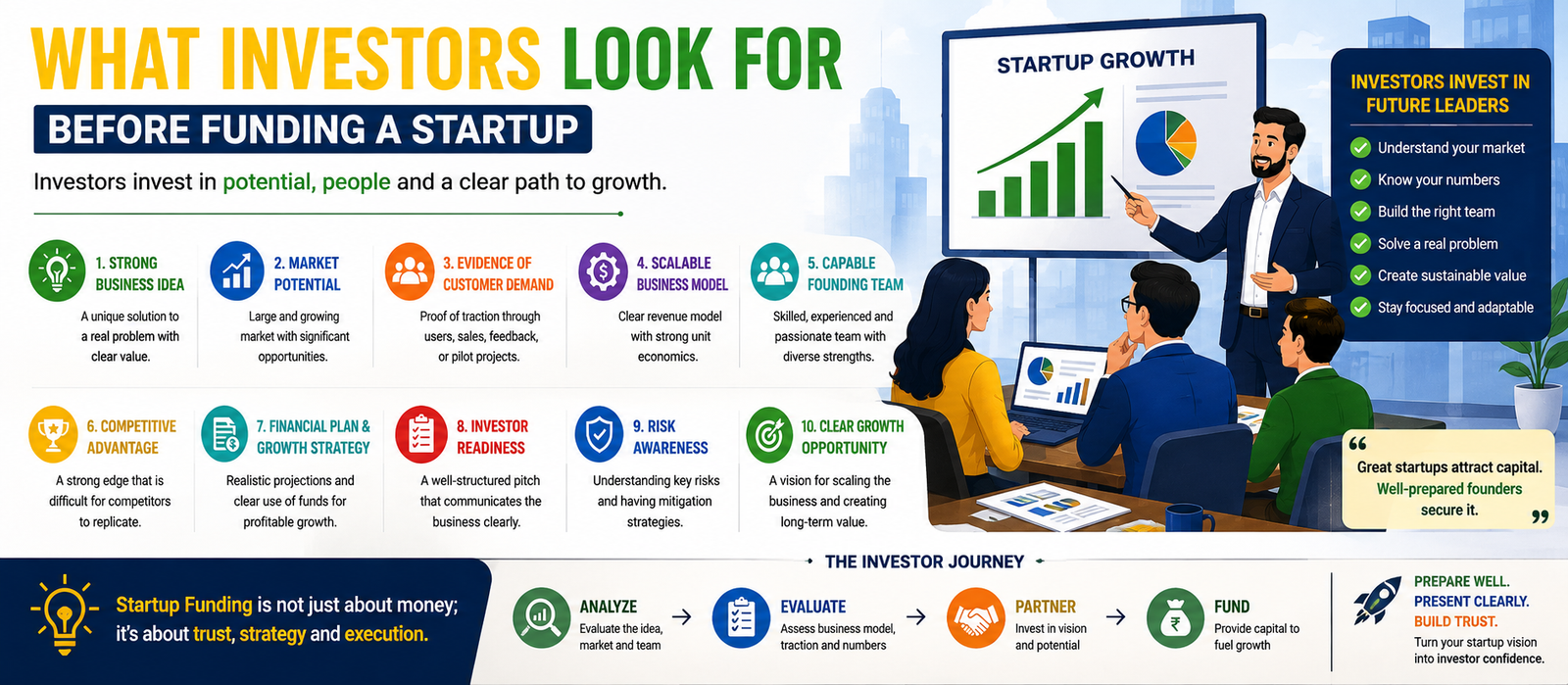
Getting investors to startup funding requires more than having a creative idea. Investors want to understand whether a business has the potential to generate sustainable returns while managing risks effectively. They evaluate the product, market, founders, financial model, growth potential, and competitive position before making an investment decision. Understanding these expectations can help entrepreneurs prepare stronger pitches and build greater investor confidence.
1. A Clear and Valuable Business Idea
The first thing investors want to understand is what the startup does and why it matters. A strong business idea should solve a genuine customer problem rather than simply introduce another product or service.
Entrepreneurs should clearly explain the problem, their proposed solution, target customers, and why their approach is different. A simple and compelling value proposition can make it easier for investors to understand the opportunity.
2. Strong Market Potential
Investors are interested in businesses operating in markets with meaningful growth opportunities. Even an excellent product may struggle if the target market is too small.
Founders should demonstrate their understanding of the market size, customer segments, industry trends, purchasing behavior, and future demand. Research-backed market information can make an investment proposal more credible.
Showing that the market is growing can also help investors understand how the startup could scale over time.
3. Evidence of Customer Demand
Investors generally prefer evidence over assumptions. Early sales, customer feedback, pre-orders, subscriptions, pilot projects, partnerships, or user growth can demonstrate that customers are interested in the solution.
Startup funding without significant revenue can still provide evidence through market validation. Surveys, interviews, prototype testing, waiting lists, and successful pilot programs can help demonstrate potential demand.
The stronger the evidence, the easier it becomes for investors to evaluate the business opportunity.
4. A Scalable Business Model
Investors want to know how the startup will make money. Founders should explain pricing, revenue streams, customer acquisition methods, operating costs, and expected margins.
A scalable model is particularly attractive because it allows revenue to grow without increasing costs at the same rate. Software subscriptions, digital platforms, marketplaces, licensing, and repeat-purchase models can offer different forms of scalability.
Entrepreneurs should also understand their unit economics and explain how acquiring and retaining customers contributes to profitability.
5. A Capable Founding Team
Investors often evaluate the people behind the business as closely as the business idea. A capable founding team can adapt when challenges arise and execute the strategy effectively.
Founders should demonstrate relevant industry knowledge, technical capabilities, leadership skills, communication abilities, and commitment to the business.
A balanced team can also be valuable. For example, a startup may benefit from combining expertise in product development, marketing, sales, finance, and operations.
6. Competitive Advantage
Investors need to understand why competitors cannot easily copy the startup’s success. A competitive advantage could come from technology, intellectual property, brand recognition, distribution, customer relationships, proprietary data, manufacturing capabilities, or specialized expertise.
Entrepreneurs should identify direct and indirect competitors and explain how their startup provides greater value.
Clear differentiation can strengthen the overall investment case and show that the company has a realistic path to gaining market share.
7. Financial Planning and Growth Strategy
Financial projections help investors understand how the startup expects to use capital and generate future returns. Founders should prepare realistic revenue forecasts, expense estimates, cash-flow projections, and funding requirements.
Instead of presenting unrealistic growth figures, entrepreneurs should support assumptions with market research and existing performance.
Investors also want to know exactly how the startup funding will be used. Capital may be allocated to product development, hiring, marketing, technology, equipment, inventory, or market expansion.
8. Investor Readiness and Business Planning
Strong preparation can significantly improve an entrepreneur’s chances of attracting funding. A professional pitch deck should communicate the problem, solution, market opportunity, business model, traction, competition, financial outlook, team, and funding requirement.
Startup Funding criteria should also clearly state how much capital is required and what percentage of the company, if applicable, the founders are willing to offer.
Investors may ask difficult questions about customer acquisition costs, profitability, competition, intellectual property, risks, and exit opportunities. Founders should be prepared with accurate and concise answers.
9. Risk Awareness
Every startup investment risk. Investors do not necessarily expect entrepreneurs to eliminate all risks, but they want founders to understand them.
Potential risks can include market changes, regulatory issues, technology challenges, supply-chain disruptions, competition, customer concentration, and financial pressure.
Entrepreneurs who identify these risks and present practical mitigation strategies can demonstrate stronger business judgment.
10. A Clear Growth Opportunity
Investors ultimately want to understand how their investment can increase in value. A startup should therefore present a realistic growth strategy.
This may involve entering new geographic markets, launching additional products, increasing customer retention, developing strategic partnerships, expanding distribution, or improving operational efficiency.
A clear growth roadmap helps investors see how the company could progress from an early-stage business into a larger and more valuable organization.
Conclusion
Startup Funding is not simply about asking investors for money; it is about demonstrating that the capital can be converted into measurable business growth. Entrepreneurs who understand investor expectations can create stronger pitches, answer questions confidently, and build long-term relationships with potential investors. For entrepreneurs exploring how to start a small business in india, understanding startup funding requirements, market validation, financial planning, and investor expectations can provide a stronger foundation for sustainable growth.

My Design Minds helps startups and businesses turn innovative ideas into practical, market-ready products through professional design and development support. For companies seeking Startup Funding, having a clearly developed product concept can strengthen their business proposition and demonstrate market potential. My Design Minds supports businesses with industrial design, CAD modeling, product visualization, prototyping, and manufacturing-focused solutions to help transform ideas into functional products ready for the market.