
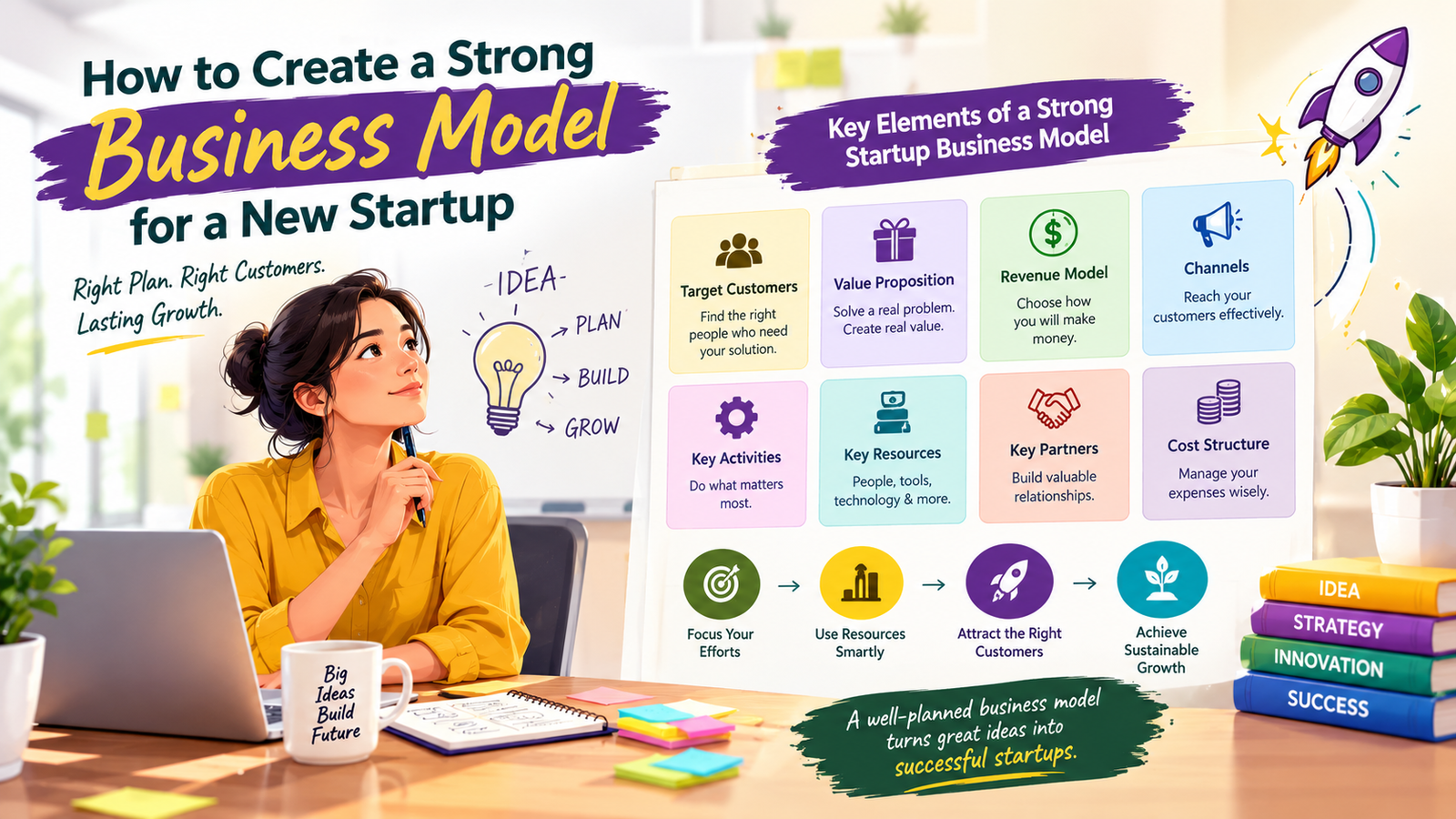
A startup can have an innovative idea, talented people, and an attractive product, but these elements alone do not guarantee long-term success. Founders also need a clear understanding of how the business will create value for customers and generate sustainable revenue. A well-designed Startup Business Model provides this foundation by connecting customers, products, operations, revenue, and costs into a practical business structure.
A business model is essentially a blueprint for how a company operates and makes money. Before investing significant resources, founders should understand who their customers are, what problem they are solving, how they will reach buyers, and whether the expected revenue can support business expenses.
1. Define the Problem You Want to Solve
Every strong business model starts with a real customer problem. Founders should clearly identify what customers are struggling with and why existing solutions may not fully satisfy their needs.
Instead of starting with the question, “What product can we sell?”, consider asking, “What problem can we solve better?”
For example, a startup may identify that small manufacturers struggle to access affordable product design and engineering support. This problem could create an opportunity for a specialized service business.
Understanding the problem helps founders build a solution that has genuine market relevance.
2. Identify Your Target Customers
The next step is to determine who will pay for your solution. Avoid defining your market too broadly in the beginning.
Consider customer characteristics such as location, age, industry, company size, purchasing behavior, budget, and specific requirements. For B2B businesses, identify the type of organizations and decision-makers who are most likely to need the offering.
A clearly defined Business Model for Startups makes it easier to focus marketing, sales, product development, and customer support on the right audience.
3. Create a Clear Value Proposition
Your value proposition explains why customers should choose your product or service instead of an alternative.
A strong value proposition should answer three questions:
- What problem do you solve?
- What benefit do customers receive?
- Why is your solution different?
For example, a startup could compete through lower costs, faster delivery, specialized expertise, better convenience, customization, or improved customer service.
The value proposition should be simple enough for potential customers to understand quickly.
4. Determine How You Will Make Money
Revenue is one of the most important parts of any startup model. Founders should decide how customers will pay for the product or service.
Possible approaches include:
- One-time product purchases
- Monthly subscriptions
- Annual subscriptions
- Service fees
- Commission-based revenue
- Licensing
- Freemium models
- Consulting or project-based fees
Your Startup Revenue Model should match customer expectations and the nature of the product. A recurring subscription may work well for software, while project-based pricing may be more appropriate for engineering or consulting services.
5. Calculate Your Major Costs
Revenue alone does not determine whether a startup is financially sustainable. Founders must understand their major expenses.
Common startup costs include:
- Employee salaries
- Technology and software
- Product development
- Manufacturing
- Marketing
- Office or infrastructure expenses
- Logistics
- Professional services
- Customer support
Separate fixed costs from variable costs where possible. This helps founders understand how expenses change as sales increase.
6. Decide How You Will Reach Customers
Even an excellent product can struggle if customers cannot easily discover or purchase it. Your business model should therefore include clear distribution and marketing channels.
Depending on the business, these could include:
- Company websites
- Search engines
- Social media
- Online marketplaces
- Direct sales
- Distributors
- Industry events
- Partnerships
- Referral programs
Choose channels based on where your target customers actually research and purchase products.
7. Understand Your Competitive Advantage
A startup needs a reason to exist in a market where other companies may already provide similar solutions.
Your competitive advantage could come from technology, intellectual property, specialized knowledge, customer experience, pricing, speed, customization, or operational efficiency.
Founders should identify advantages that are difficult for competitors to reproduce. Simply offering a slightly different feature may not provide a sustainable advantage.
8. Test the Business Model Before Scaling
Founders do not need to create a perfect business model before launching. Instead, they can test important assumptions with a minimum viable product, prototype, pilot service, or small customer group.
Talk to potential customers and determine whether they are willing to pay. Track feedback, sales, costs, and customer acquisition efforts.
Testing can reveal weaknesses early and prevent founders from investing heavily in an unproven idea.
9. Monitor Key Business Metrics
Once the business begins operating, founders should track metrics that reveal whether the model is working.
Useful metrics may include:
- Revenue
- Gross margin
- Customer acquisition cost
- Customer lifetime value
- Conversion rate
- Retention rate
- Monthly recurring revenue
- Cash flow
- Break-even point
The right metrics depend on the business model. The goal is to use reliable data to understand performance and make informed decisions.
10. Keep Improving the Business Model
Markets change, customer expectations evolve, and competitors introduce new solutions. A business model should therefore not be treated as a permanent document.
Founders should regularly review pricing, customer segments, operating costs, revenue sources, and distribution channels. Customer feedback can also reveal opportunities for new products or services.
A flexible Startup Business Strategy allows a company to adapt while maintaining a clear long-term direction.
My Design Minds – Supporting Startup Business Model
My Design Minds supports startups and businesses with professional product design, engineering, prototyping, and manufacturing solutions. From CAD design and 3D product visualization to reverse engineering, 3D printing, product development, and mould manufacturing, the company helps businesses turn concepts into practical products. A clear Startup Business Model is important when deciding how product development resources should be allocated and how a solution can create customer value. My Design Minds can support businesses implementing a Business Model for Startups through technical design and product development expertise, while a suitable Startup Revenue Model can help founders plan how their products or services generate sustainable income. By connecting product requirements with practical engineering and manufacturing capabilities, My Design Minds helps startups move from ideas toward market-ready solutions.
For entrepreneurs researching How to start a small business in India, creating a clear business model can help define customers, pricing, revenue sources, operating costs, and the resources needed to build a sustainable business.
Leave a Reply