
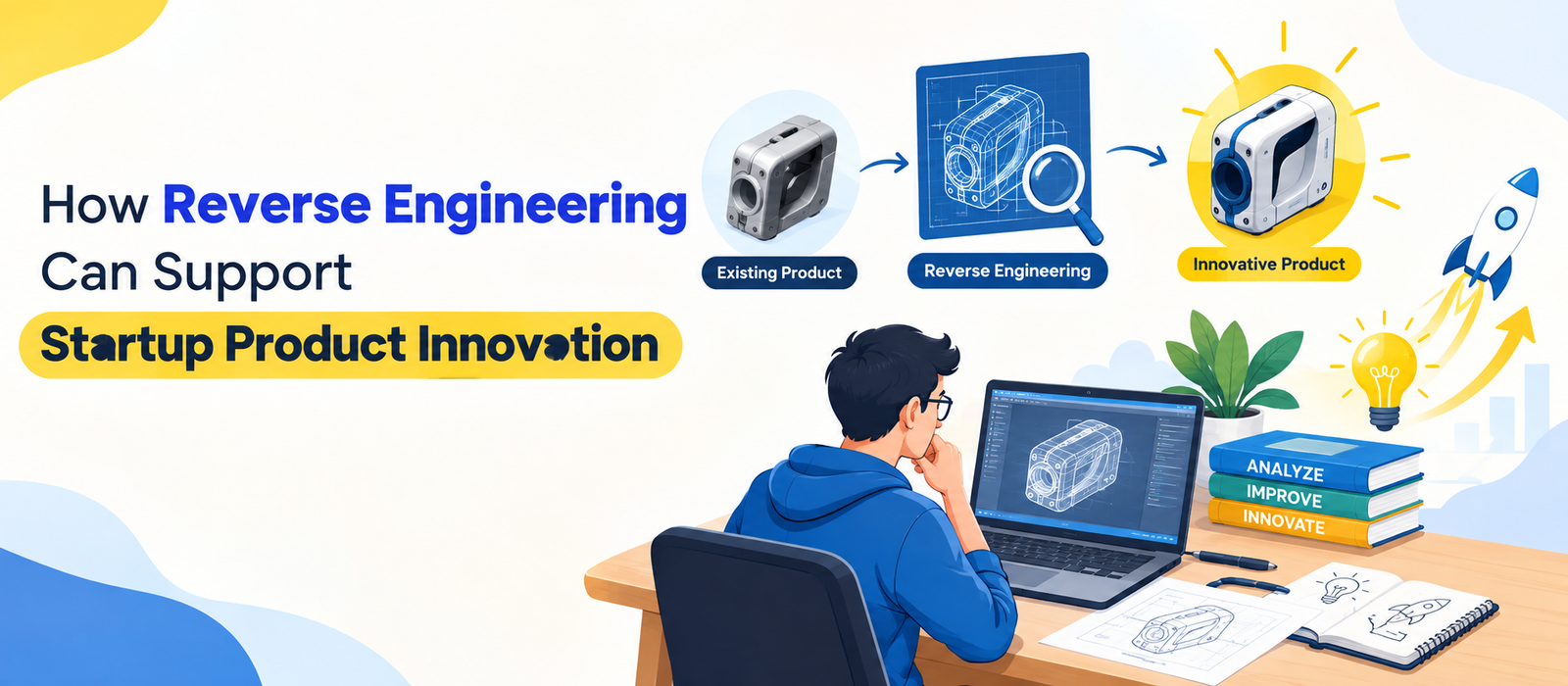
Startups often need to develop innovative products while working with limited budgets, small teams, and tight timelines. Creating a product from scratch can require significant research, engineering expertise, prototyping, testing, and manufacturing resources. Reverse Engineering for Startups can provide a practical approach for understanding existing products and developing improved or alternative solutions.
Reverse engineering involves examining an existing physical product, component, or assembly to understand its dimensions, geometry, materials, construction, and functionality. When performed appropriately and within legal and intellectual-property boundaries, this process can help startups learn from existing products and make informed decisions during product development.
1. Understand Existing Product Designs
One of the primary benefits of reverse engineering is gaining a deeper understanding of how an existing product has been designed.
A startup can analyze components, dimensions, assemblies, mechanisms, and overall construction to understand how different elements work together. This information can help engineers identify design characteristics that contribute to performance, usability, durability, or manufacturability.
Product Reverse Engineering can be especially useful when original CAD files or technical drawings are unavailable. By examining a physical component, engineers can recreate an accurate digital representation that can be used for further development.
2. Improve Existing Products
Innovation does not always require creating something completely new. Startups can also create value by improving products that already exist in the market.
Engineers can analyze an existing design and identify areas where improvements may be possible. These could include reducing weight, improving durability, simplifying assembly, increasing efficiency, improving ergonomics, or reducing manufacturing complexity.
Using Reverse Engineering Services, startups can understand an existing product before developing their own improved version. This approach can provide valuable technical insights while allowing the team to focus its innovation efforts on genuine improvements.
3. Recreate Missing or Outdated Components
Many industries use machinery and equipment that remain operational for years. Over time, original components may become unavailable because the manufacturer has discontinued them or stopped supporting older equipment.
Reverse Engineering can help recreate such components by capturing their physical dimensions and geometry. Engineers can then create detailed CAD models and manufacturing drawings for replacement parts.
This can be particularly valuable for startups offering maintenance, repair, industrial equipment, or specialized manufacturing solutions.
4. Reduce Product Development Time
Developing every component from the beginning can take considerable time. Reverse engineering can provide a starting point by allowing engineers to work from an existing physical reference.
The resulting digital model can then be modified according to the startup’s requirements. Engineers can make design changes, test alternatives, and prepare prototypes without having to recreate every aspect of the product manually.
This can make Reverse Engineering for Startups a useful strategy when speed-to-market is an important consideration.
5. Support Product Benchmarking
Startups need to understand how their products compare with existing solutions. Studying competing or reference products can provide useful information about dimensions, features, construction methods, usability, and design approaches.
However, benchmarking should focus on understanding the market rather than simply copying another company’s product. Founders and engineers should use the findings to identify opportunities for differentiation.
For example, a startup might discover that existing products are expensive, difficult to maintain, unnecessarily heavy, or complicated to manufacture. These observations can inspire the development of a more efficient alternative.
6. Create Accurate CAD Models
Physical products are not always accompanied by reliable digital documentation. Reverse engineering can bridge this gap by converting physical objects into digital CAD models.
Depending on the complexity and accuracy requirements, engineers may use measurement equipment, 3D scanning, point clouds, and CAD software to recreate the geometry.
These digital models can support design modifications, simulations, prototyping, documentation, and manufacturing planning. Accurate digital information also makes collaboration between designers, engineers, and manufacturers easier.
7. Support Customization
Startups frequently develop customized solutions for specific industries or customers. An existing component may provide a useful foundation, but modifications may be required to fit a particular application.
Product Reverse Engineering can help engineers capture the original geometry and then modify it according to new requirements. Dimensions, mounting points, interfaces, materials, or other characteristics can be adjusted during the redesign process.
This approach can help startups develop customized products more efficiently while maintaining an understanding of the original component.
8. Improve Manufacturing Decisions
A product may perform well but still be expensive or difficult to manufacture. Reverse engineering allows engineers to examine how components are constructed and identify opportunities for design-for-manufacturing improvements.
The redesigned product can potentially use fewer components, simpler manufacturing processes, optimized materials, or more efficient assembly methods.
These improvements can help startups control production costs while maintaining product quality.
9. Enable Faster Prototyping and Testing
Once a product has been recreated digitally, the CAD model can be used as a foundation for prototyping. Engineers can modify the design, create prototype components, evaluate fit and functionality, and identify potential issues before production.
This iterative process allows startups to test ideas more efficiently. Combining reverse engineering with rapid prototyping can help teams move from physical reference to improved product concept more quickly.
10. Follow Intellectual Property and Legal Requirements
Reverse engineering can provide valuable technical insights, but startups must understand the legal boundaries surrounding existing products.
Patents, copyrights, trademarks, design rights, contracts, and other intellectual-property protections may apply. Reverse engineering should therefore be used responsibly and should not be treated as permission to copy protected products.
Startups should seek appropriate legal advice when developing products based on existing commercial designs. The objective should be to understand technology, improve functionality, solve customer problems, and develop original solutions while respecting intellectual-property rights.
My Design Minds – Supporting Startup Product Innovation
My Design Minds helps startups and businesses transform physical product concepts into accurate digital designs and practical engineering solutions. Its capabilities include CAD design, 3D scanning, Reverse Engineering Services, product engineering, 3D visualization, prototyping, and manufacturing support. Reverse Engineering for Startups can help businesses recreate components, develop CAD models, improve existing designs, and prepare products for prototyping and manufacturing. Through Product Reverse Engineering and Reverse Engineering in Product Development, My Design Minds supports businesses in understanding existing products and developing optimized solutions while considering functionality, manufacturability, and production requirements. From an initial physical reference to an improved product concept, the team can support startups throughout the product development journey.
For entrepreneurs researching How to start a small business in India, reverse engineering can help identify product improvement opportunities, develop customized solutions, and reduce unnecessary product development time and costs when building innovative products.
Leave a Reply