
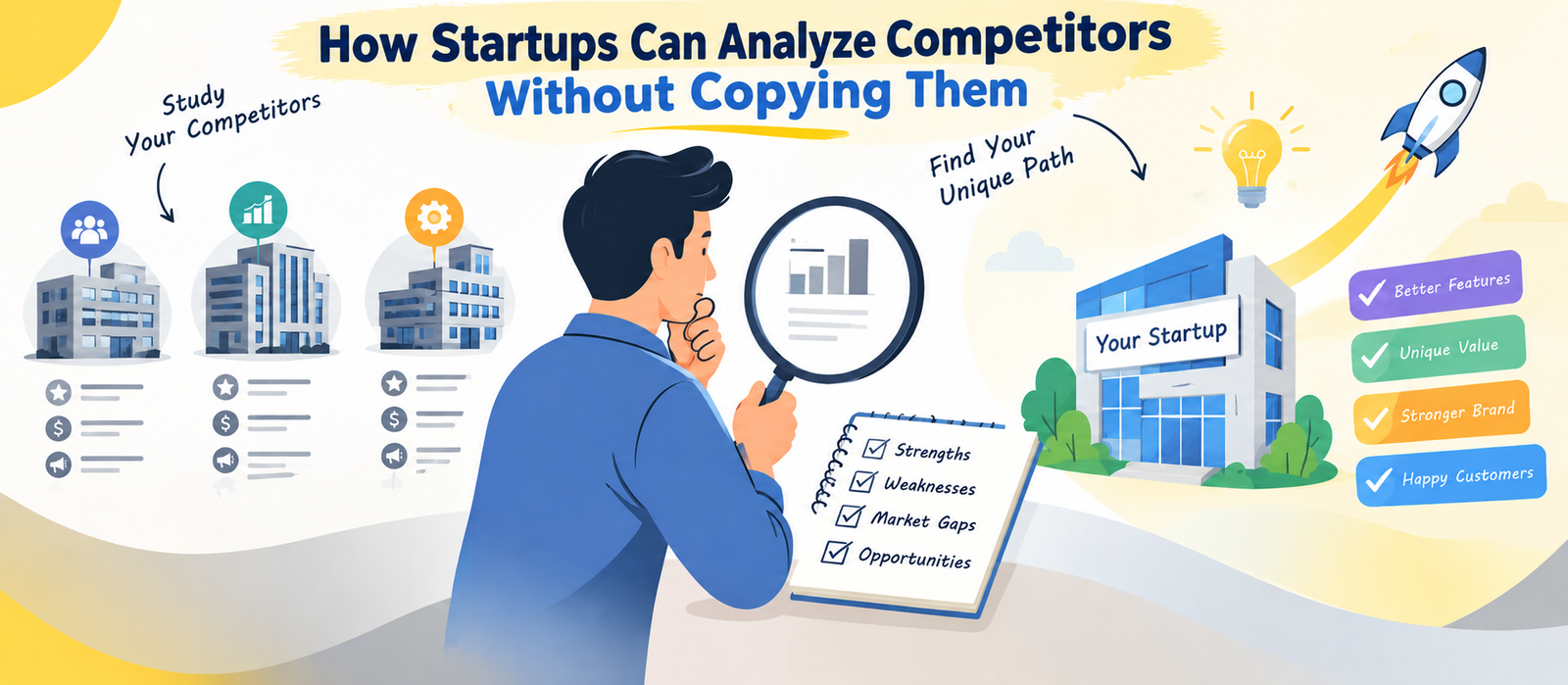
Starting a business does not happen in isolation. Every market has businesses solving similar problems, targeting similar customers, or offering alternative solutions. For founders, understanding these competitors can reveal valuable information about customer expectations, pricing, product features, marketing strategies, and market gaps. However, studying competitors should not mean copying everything they do. The objective is to learn from the market while creating a distinct business identity.
Why Competitor Analysis Matters for Startups
Competitor analysis for startups helps founders understand where their business fits within an existing market. Instead of making decisions based only on assumptions, entrepreneurs can examine what competitors offer and how customers respond to those offerings.
A structured analysis can reveal questions such as:
- What products or services are already available?
- Who are competitors targeting?
- What pricing models are being used?
- Which customer problems remain unresolved?
- What features receive positive or negative feedback?
- How do competitors communicate their value?
- Where are customers looking for better experiences?
The answers can help startups identify opportunities rather than simply reproduce existing ideas.
Start With the Customer, Not the Competitor
One common mistake is becoming too focused on competitors. A startup may spend so much time studying another company that it begins building a similar product.
Instead, founders should begin with customer problems. Identify the target audience, their frustrations, purchasing behavior, expectations, and unmet needs. Then examine competitors to understand how effectively those needs are being addressed.
This approach keeps the startup focused on creating customer value rather than becoming a follower.
Conduct Structured Startup Competitor Research
Effective startup competitor research should go beyond visiting competitor websites. Create a simple comparison framework covering products, services, pricing, target customers, features, distribution channels, customer support, branding, and online presence.
Public information such as websites, product pages, customer reviews, social media posts, industry reports, and advertisements can provide useful insights.
However, information should be interpreted carefully. A competitor’s marketing message may describe what the company wants customers to believe, while customer reviews may reveal actual experiences. Looking at multiple sources provides a more balanced understanding.
Identify Strengths and Weaknesses
The purpose of competitive analysis for startups is not to criticize competitors. It is to understand the market realistically.
For example, one competitor may have strong brand recognition but limited customization. Another may offer affordable pricing but provide slower customer support. A third may have advanced technology but a complicated user experience.
These differences can help founders identify areas where they can develop their own value proposition.
The key question should be:
“What can we do differently or better for a specific customer segment?”
The answer may involve convenience, personalization, pricing, service, technology, speed, design, accessibility, or another meaningful factor.
Look for Market Gaps
Competitors can sometimes reveal opportunities that are not immediately visible. Pay attention to repeated customer complaints, missing features, underserved audiences, complicated processes, or outdated experiences.
For example, if several customers complain that existing solutions are difficult to use, a startup could focus on simplicity. If products are designed primarily for large companies, there may be an opportunity to create a solution specifically for smaller businesses.
This is where competitor benchmarking becomes useful. Rather than copying a competitor’s entire offering, founders can compare important market standards and determine where their own business should establish a different position.
Analyze Pricing Without Automatically Matching It
Pricing is another area where startups often make the mistake of copying competitors.
Instead of simply choosing a lower price, analyze what customers receive at different price points. Consider product quality, service levels, customization, support, delivery, technology, and long-term value.
A startup might discover that competing primarily on price would make profitability difficult. It may instead choose to compete through better service, specialized expertise, faster delivery, or a more convenient experience.
Pricing should therefore support the startup’s business model and customer value rather than simply mirror another company’s price.
Study Marketing to Understand Positioning
Marketing analysis can show how competitors communicate with customers. Examine their website messaging, social media content, advertisements, blogs, email campaigns, and customer testimonials.
Startup competitor research can help identify commonly used messages and underserved communication opportunities.
For instance, if most competitors focus heavily on technical features, a startup could communicate outcomes and business benefits more clearly. If competitors use complex language, simpler communication could make the new brand more approachable.
The goal is not to reproduce their campaigns. It is to understand the conversation already happening in the market and find an authentic way to contribute to it.
Use Competitor Benchmarking as a Learning Tool
Competitor benchmarking works best when it becomes an ongoing process rather than a one-time activity. Markets change, new businesses enter, customer expectations evolve, and technologies introduce new possibilities.
Create a simple competitor dashboard and review it periodically. Track meaningful changes in pricing, product launches, positioning, customer feedback, and market activity.
At the same time, avoid measuring everything. Focus on factors that directly affect your target customers and business objectives.
Turn Insights Into Your Own Strategy
The final stage of competitor analysis for startups is translating observations into decisions. Create a list of market insights and separate them into three categories:
- Things worth learning from
- Problems your startup can solve differently
- Areas where your startup should deliberately stand apart
This prevents competitor research from becoming an exercise in imitation.
A strong startup does not need to be completely different from every business in the market. It needs a clear reason for customers to choose it. That reason can come from a specific audience, unique product experience, specialized service, innovative technology, stronger convenience, or a combination of factors.
Final Thoughts
Competitive analysis for startups should provide direction, not become a blueprint for copying another company. By studying customer needs, market gaps, competitor strengths, weaknesses, pricing, positioning, and feedback, founders can make more informed decisions while developing their own identity.
For entrepreneurs considering how to start a small business in India, understanding competitors can help identify underserved customer needs and opportunities before investing heavily in a new product or service.

My Design Minds
My Design Minds supports startups and growing businesses with design, engineering, prototyping, CAD modeling, and product development solutions that can help transform original ideas into practical products. Instead of copying existing products, businesses can use professional design and engineering support to explore concepts, refine functionality, evaluate manufacturability, and develop solutions aligned with their target customers. From early-stage product concepts to detailed CAD development and prototyping, My Design Minds focuses on helping businesses build differentiated products with a structured development approach. For founders researching how to start a small business in India, strong product thinking and informed design decisions can provide a foundation for developing solutions that address genuine market opportunities.
Leave a Reply