
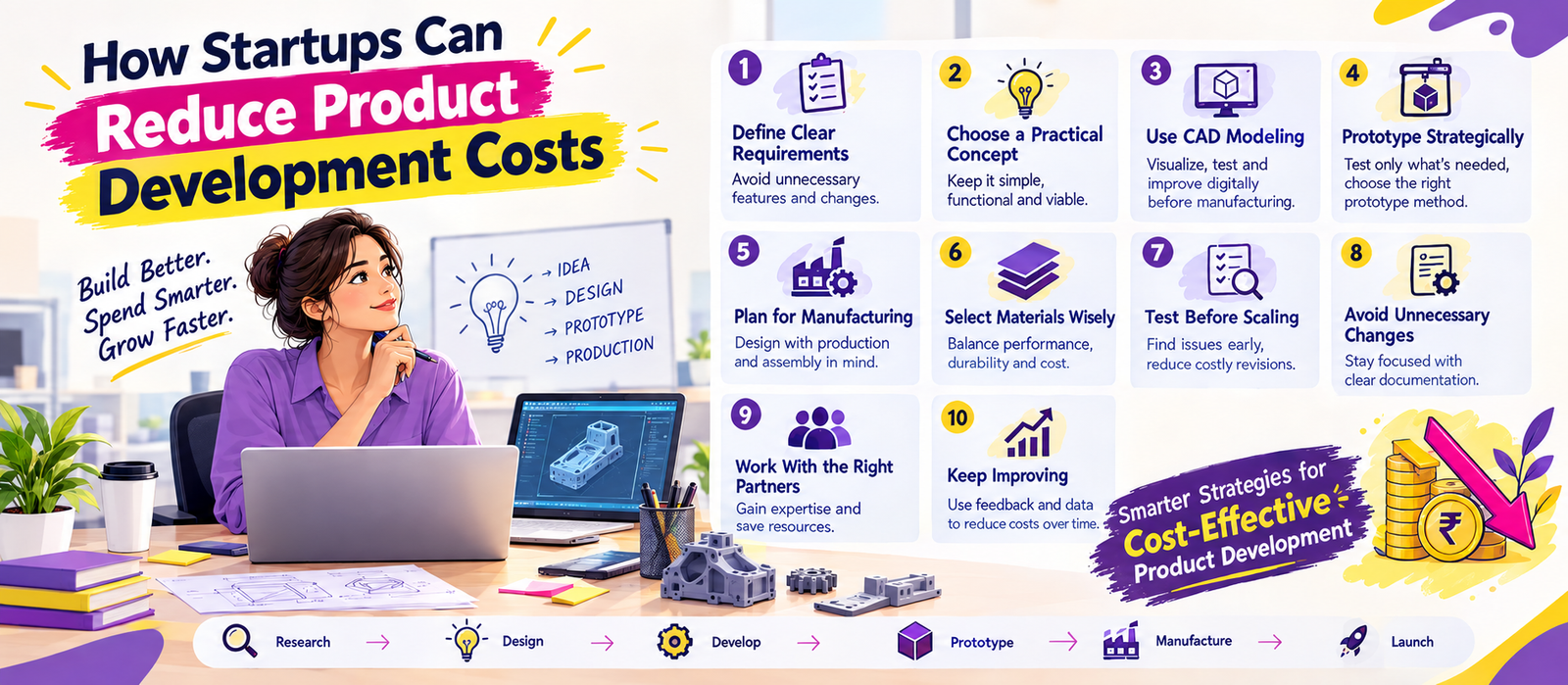
Reduce Product Development Costs is an important goal for startups working with limited budgets and resources. Product development can involve research, design, engineering, prototyping, testing, materials, tooling, and manufacturing. Without proper planning, small design changes or production problems can quickly increase expenses.
A structured approach to Startup Product Development can help founders identify potential problems early, use resources efficiently, and avoid unnecessary development cycles. The objective is not simply to spend less, but to make better decisions at every stage of product creation.
1. Define the Product Requirements Clearly
Unclear requirements can lead to repeated design changes, delays, and additional engineering costs. Before development begins, startups should clearly define the target customer, product functions, dimensions, materials, performance requirements, expected production volume, and budget.
A clear product brief gives designers and engineers a common direction. It also helps prevent unnecessary features that may increase complexity without adding meaningful customer value.
When requirements are defined early, teams can focus their resources on essential product functions and make informed design decisions.
2. Start With a Practical Product Concept
A complex product is not always a better product. Startups should evaluate whether every component and feature is necessary.
During the concept stage, compare different design approaches based on functionality, material requirements, manufacturing complexity, maintenance, and expected production volume. Simplifying a product before detailed engineering can prevent expensive modifications later.
This is one of the foundations of Cost-Effective Product Development, because early design decisions can influence material consumption, tooling requirements, assembly time, and manufacturing costs.
3. Use CAD Modeling Before Manufacturing
Creating accurate CAD models allows teams to visualize and evaluate a product digitally before physical manufacturing begins.
Engineers can examine dimensions, component relationships, assembly requirements, clearances, and potential interference issues. Changes made to a digital model are generally easier to manage than modifications made after manufacturing has started.
CAD modeling can therefore help startups evaluate multiple design options while reducing the need for unnecessary physical iterations.
4. Use Prototyping Strategically
Prototypes are valuable for testing product concepts, but startups should avoid producing expensive prototypes before identifying what actually needs to be tested.
Depending on the product, teams can use digital prototypes, 3D-printed models, functional prototypes, or small-batch samples. Each prototype should have a specific purpose, such as testing dimensions, usability, assembly, functionality, or customer response.
Strategic prototyping supports Product Development Cost Reduction by helping teams discover problems before investing in larger production runs.
5. Consider Manufacturing During Design
A product may look excellent in a CAD model but still be expensive or difficult to manufacture. Startups should consider manufacturing requirements during the design stage.
Designers can evaluate material availability, machining requirements, tolerances, tooling, assembly methods, production volume, and supplier capabilities.
Designing with manufacturing in mind can reduce production complications and help Reduce Product Development Costs by preventing avoidable redesigns and manufacturing changes.
6. Choose Materials Carefully
Material selection can significantly affect product cost. However, choosing the cheapest material is not always the most economical approach.
Startups should consider strength, durability, weight, availability, finishing requirements, manufacturing processes, and expected product life.
A material that costs slightly more but simplifies manufacturing or improves durability may provide better overall value. Comparing materials during the design stage can help balance performance and cost.
7. Test Before Scaling Production
Moving directly from a prototype to large-scale manufacturing can expose startups to significant financial risks. A product should be tested against its intended requirements before committing to large quantities.
Functional testing, dimensional checks, assembly testing, usability feedback, and manufacturing validation can reveal issues while changes are still manageable.
Small production batches can also help startups gather customer feedback and identify improvements before expanding manufacturing volumes.
8. Avoid Unnecessary Design Changes
Frequent changes can increase engineering hours, prototype costs, documentation work, and manufacturing delays. A structured review process can help teams identify important changes before the design reaches later development stages.
Founders should establish clear approval points for major design decisions. Collaboration between designers, engineers, manufacturers, and suppliers can also reduce misunderstandings.
Good documentation is equally important. Updated CAD files, drawings, specifications, and revision records help ensure that everyone works from the correct information.
9. Work With the Right Development Partners
Startups may not need to build every capability internally. Working with experienced product design and engineering partners can provide access to specialized skills without requiring permanent investments in expensive software, equipment, or technical teams.
When selecting a partner, startups should consider technical expertise, communication, development capabilities, manufacturing knowledge, turnaround time, and previous project experience.
The right external support can make Startup Product Development more organized while helping founders manage limited resources efficiently.
10. Focus on Continuous Improvement
Reducing costs should continue after the first product version reaches the market. Customer feedback, production data, supplier information, and maintenance experiences can reveal opportunities for improvement.
Startups can review component costs, assembly processes, material usage, packaging, and manufacturing methods over time. Small improvements across several areas can create meaningful savings as production grows.
A continuous improvement mindset helps businesses maintain Cost-Effective Product Development while adapting to changing customer and manufacturing requirements.
My Design Minds and Product Development
My Design Minds supports startups with CAD design, 3D product visualization, product engineering, prototyping, reverse engineering, 3D printing, and manufacturing support. Its product development capabilities can help businesses Reduce Product Development Costs by identifying design issues early, creating accurate digital models, and evaluating products before manufacturing. Through practical Startup Product Development support, businesses can explore design alternatives, develop prototypes, and prepare products for production. My Design Minds also helps connect product design with manufacturing considerations, supporting better decisions about materials, components, tolerances, tooling, and production requirements. This approach can help startups develop practical products while managing resources and development budgets more effectively.
For entrepreneurs learning How to start a small business in India, controlling product development expenses through careful planning, prototyping, CAD design, testing, and manufacturing evaluation can help make limited startup resources go further.

Leave a Reply