
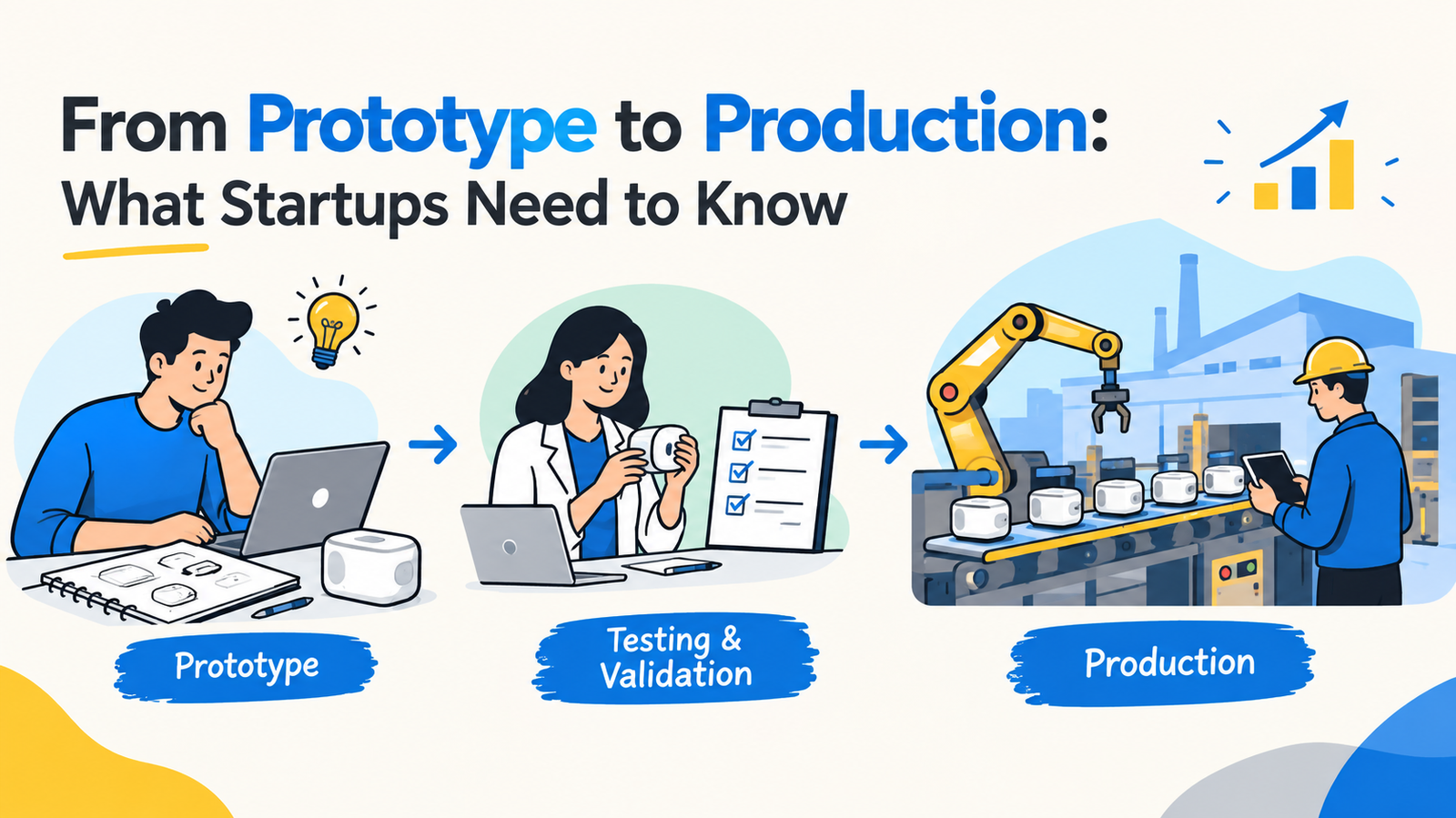
Moving a product idea from a working prototype to a manufactured product is an important stage for any startup. A prototype can demonstrate how a product looks or functions, but preparing it for manufacturing requires additional engineering, testing, documentation, and planning. The Prototype to Production process helps startups transform an early product concept into a reliable and manufacturable solution.
For startups, this transition should be planned carefully because decisions made during this stage can influence production costs, product quality, timelines, and customer satisfaction.
1. Evaluate the Prototype Thoroughly
Before beginning production planning, startups should evaluate whether the prototype actually meets the intended requirements. Testing should cover functionality, dimensions, usability, durability, safety, and other specifications relevant to the product.
The prototype should be tested under realistic conditions whenever possible. Problems discovered at this stage can usually be addressed more easily than problems found after large-scale manufacturing begins.
A structured testing process also helps teams determine whether the product is ready for further development or requires another design iteration.
2. Validate the Product Design
A prototype may work successfully while still containing design features that make manufacturing difficult or expensive. Engineers should review components, materials, tolerances, assembly methods, and overall product construction.
Prototype Development for Startups should therefore consider manufacturability from the beginning rather than treating manufacturing as a completely separate stage.
Design validation can identify unnecessary components, difficult geometries, excessive tolerances, and assembly challenges. Simplifying these elements can make the final product easier and more economical to manufacture.
3. Consider Manufacturing Requirements
Production involves different considerations than prototyping. The manufacturing process selected should match the product design, expected production volume, material requirements, quality standards, and available budget.
Possible processes may include injection moulding, CNC machining, sheet metal fabrication, casting, 3D printing, or other specialized manufacturing methods.
Startups should compare these options before committing to production. The right process depends on the product and its requirements rather than simply choosing the most familiar manufacturing method.
4. Review Materials and Components
Materials selected for prototypes may not always be suitable for final production. A prototype might use a material that is convenient for testing, while the final product requires a material with specific strength, durability, temperature resistance, appearance, or regulatory characteristics.
Components should also be evaluated for availability and consistency. If a critical component is difficult to source, production delays may occur.
During Prototype Development for Startups, teams should document material and component requirements clearly so that suppliers and manufacturers understand the expected specifications.
5. Prepare Detailed CAD Models and Drawings
Accurate engineering documentation is essential before manufacturing begins. Final CAD models should reflect approved product dimensions and component relationships.
Manufacturing drawings may need to include dimensions, tolerances, materials, surface finishes, assembly information, and other relevant specifications.
Good documentation reduces misunderstandings between designers, engineers, suppliers, and manufacturers. It also makes future design revisions easier to manage.
6. Test Manufacturing Feasibility
Before moving into larger production volumes, startups should determine whether the product can be manufactured consistently using the selected process.
This stage involves checking tooling requirements, production equipment, assembly procedures, material availability, tolerances, and quality-control methods.
Production Readiness means more than having a functional prototype. It involves confirming that the product, documentation, manufacturing process, suppliers, and quality requirements are sufficiently prepared for production.
7. Start With a Small Production Batch
Producing a smaller initial batch can help startups identify manufacturing problems without immediately committing to large quantities.
A pilot production run can reveal issues involving assembly time, component fit, material consistency, packaging, production efficiency, and quality control.
Feedback from the initial batch can then be used to improve the product or manufacturing process before larger-scale production begins.
This approach can reduce unnecessary financial risk and provide useful real-world information.
8. Establish Quality Control
Quality control should be planned before mass production rather than added after problems appear. Startups should define what needs to be inspected and how product quality will be measured.
Inspection may include dimensions, appearance, functionality, component fit, material properties, and packaging, depending on the product.
Clear quality standards help manufacturers maintain consistency across production batches. They also make it easier to identify defective products and determine where production problems are occurring.
9. Plan Costs and Production Volumes
Production economics can be very different from prototype economics. Startups should estimate tooling, materials, labor, packaging, transportation, quality control, and other manufacturing expenses.
Production volume also influences the choice of manufacturing process. A process that is appropriate for a small batch may not be the most practical solution for thousands of units.
Careful planning can help startups understand their expected unit economics before committing to major production investments.
10. Build a Reliable Manufacturing Partnership
Moving from Prototype to Production often requires collaboration between designers, engineers, manufacturers, suppliers, and quality teams.
Startups should select manufacturing partners based on relevant technical capabilities, communication, production capacity, quality systems, timelines, and experience with similar products.
A reliable partnership can make production coordination easier and help resolve technical issues more efficiently.
My Design Minds and Product Development Support
My Design Minds supports startups with CAD design, 3D product visualization, prototyping, reverse engineering, 3D printing, product engineering, and manufacturing support. The team can help businesses move toward Production Readiness by reviewing product designs, preparing CAD models, developing prototypes, and considering manufacturing requirements.
Its capabilities support Product Manufacturing for Startups through practical design and engineering solutions tailored to product requirements. From early concepts to production planning, My Design Minds helps businesses evaluate manufacturability, refine product designs, and prepare technical documentation. This integrated approach can support Prototype to Production development while helping startups create practical, reliable, and manufacturable products.
For entrepreneurs learning How to start a small business in India, understanding the journey from prototype development to manufacturing can help control costs, reduce production risks, validate product quality, and prepare a business for sustainable growth.
.
Leave a Reply