
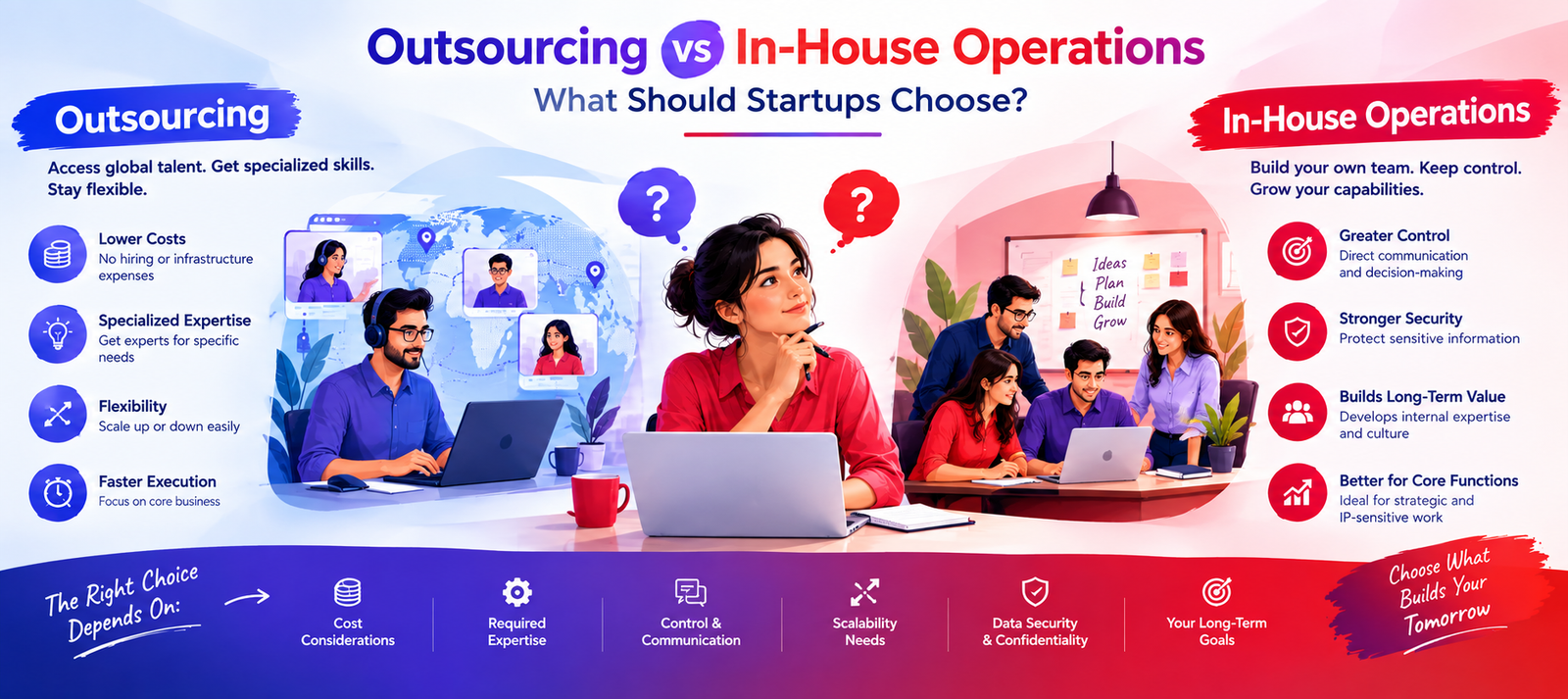
Outsourcing vs In-House Operations is an important decision for startup founders who need to manage limited budgets, small teams, and changing business requirements. Some activities may be better handled internally, while specialized or temporary tasks can sometimes be assigned to external professionals.
The right approach depends on the startup’s goals, available resources, required expertise, business stage, and long-term plans. Rather than choosing one approach for everything, founders can evaluate individual functions and determine which model fits each activity.
1. Understand What Outsourcing Means
Outsourcing involves hiring an external individual, agency, consultant, or service provider to perform specific business activities. These activities may include accounting, digital marketing, IT support, product design, manufacturing, customer service, or administrative work.
Startup Outsourcing can provide access to specialized skills without requiring a startup to hire a full-time employee for every function. It can be particularly useful when a business needs expertise for a specific project or does not yet have enough work to justify a permanent role.
However, startups should carefully evaluate the provider’s experience, communication, reliability, pricing, and ability to meet deadlines.
2. Understand In-House Operations
In-house operations involve assigning work to employees within the company. This approach can provide greater direct control over processes, communication, company knowledge, and daily decision-making.
In-House Operations may be particularly useful for activities closely connected to the startup’s core product, intellectual property, customer relationships, or strategic decisions.
For example, a technology startup may prefer to keep its core product strategy and key development knowledge within the organization while outsourcing accounting or specialized design work.
3. Compare Costs Carefully
Cost is one of the most important factors in the Outsourcing vs In-House Operations decision, but founders should look beyond salary or service fees.
Hiring employees can involve recruitment, salaries, benefits, software, equipment, training, office expenses, and other ongoing costs. Outsourcing may reduce some of these expenses, but external providers charge service fees and may require project-based or recurring payments.
Startups should calculate the total cost of each option based on expected workload, duration, expertise required, and business impact.
4. Consider Access to Expertise
Startups may need specialized knowledge that is difficult or expensive to develop internally. External professionals can provide experience in areas such as engineering, legal services, accounting, SEO, cybersecurity, design, or manufacturing.
Outsourcing for Startups can therefore help businesses access specialized capabilities without immediately building a large internal department.
At the same time, founders should consider whether the required skill is temporary or essential to the company’s long-term competitive advantage. If a capability becomes central to the business, developing internal expertise may become more relevant.
5. Evaluate Control and Communication
One potential advantage of internal teams is direct communication. Employees are usually more closely connected to company processes, priorities, and culture.
External providers can also work effectively, but clear communication, project documentation, timelines, and expectations become especially important.
Startups considering In-House Operations should determine whether a particular task requires frequent collaboration and immediate decision-making. If so, having the capability internally may simplify coordination.
6. Think About Scalability
Business requirements can change quickly during the startup stage. A company may need more support during a product launch and less support afterward.
Outsourcing can sometimes provide flexibility because startups can increase or reduce external support according to project requirements. This can be useful when demand is uncertain.
However, scaling an internal team can provide greater long-term control and help develop institutional knowledge. Founders should therefore consider whether they need temporary flexibility or permanent capability.
7. Protect Important Business Information
Data security and confidentiality should be considered whenever work is given to an external provider.
Before using Startup Outsourcing, founders should determine what information the provider will access and establish appropriate agreements, permissions, security practices, and access controls.
Sensitive customer information, proprietary technology, intellectual property, and strategic business information may require additional protection.
8. Identify Core and Non-Core Activities
A practical way to make the decision is to divide business activities into core and non-core functions.
Core activities directly contribute to the startup’s competitive advantage and may benefit from internal ownership. Non-core activities that require specialized expertise or occasional support may be suitable for external providers.
This approach allows founders to use both models strategically rather than treating Outsourcing vs In-House Operations as an all-or-nothing decision.
9. Review Quality and Long-Term Value
Cost savings should not be the only consideration. Founders should also evaluate quality, reliability, speed, expertise, flexibility, and the effect on customer experience.
An inexpensive provider may create additional costs if the work requires repeated corrections or causes delays. Similarly, an internal employee may provide valuable long-term knowledge that justifies the investment.
The best decision should be based on the overall value created by the chosen operating model.
10. Reassess as the Startup Grows
The right operational model can change as a startup develops. A function that is outsourced during the early stage may eventually become important enough to bring internally.
Likewise, a startup may continue outsourcing specialized services even after building a larger team.
Regularly reviewing costs, workload, performance, expertise, and strategic importance can help founders adjust their approach as business requirements evolve.
My Design Minds and Startup Support
My Design Minds supports startups and businesses with CAD design, product engineering, 3D visualization, reverse engineering, prototyping, 3D printing, and manufacturing support. Outsourcing for Startups can provide access to specialized product development capabilities without requiring businesses to build every technical function internally. My Design Minds can support businesses that need flexible engineering and design expertise for specific projects or development stages. From CAD modeling and product visualization to prototyping and manufacturing preparation, its services can complement existing In-House Operations. By combining internal business knowledge with external technical capabilities, startups can manage resources efficiently while focusing their internal teams on core business priorities and customer growth.
For entrepreneurs learning How to start a small business in India, evaluating which functions to handle internally and which to outsource can help manage startup costs, access specialized expertise, maintain flexibility, and allocate resources toward core business activities.

Leave a Reply