Design Thinking for Startups provides a practical approach to understanding customer problems, exploring ideas, and developing products that address real needs. Startups often work with limited budgets, small teams, and uncertain markets, making it important to validate product ideas before investing heavily in development.
Rather than beginning with a solution, design thinking encourages founders to first understand the people they want to serve. This approach can help startups reduce assumptions, identify meaningful problems, and develop solutions based on customer expectations.
Understanding the Design Thinking Approach
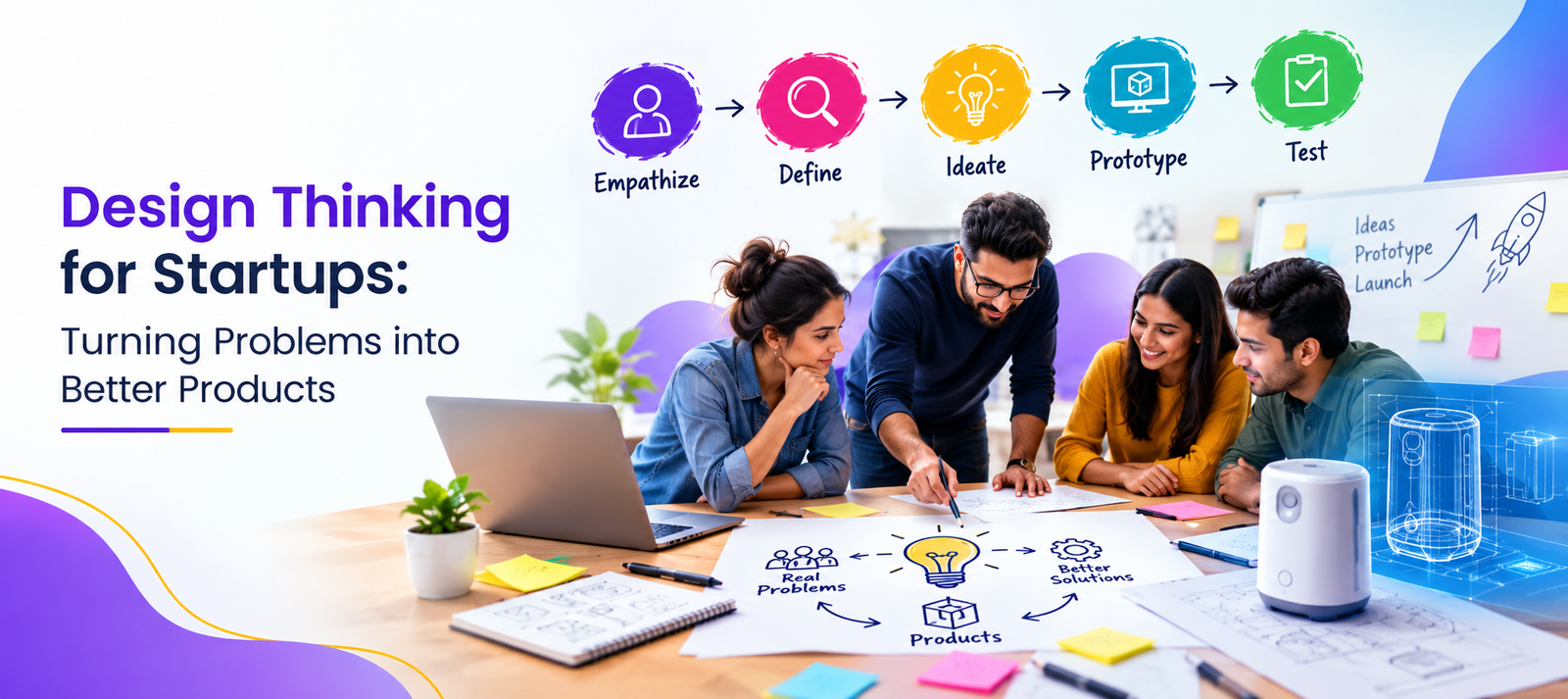
The Design Thinking Process generally focuses on understanding users, defining problems, generating ideas, creating prototypes, and testing potential solutions. These stages do not always have to follow a strict linear sequence. Startups can move between stages as they learn more about their customers and product concept.
The first step is understanding the target users. Founders can gather information through interviews, surveys, observations, reviews, and direct conversations. These insights help reveal customer frustrations and unmet needs that may not be obvious from initial assumptions.
After gathering information, startups can clearly define the problem they want to solve. A well-defined problem gives the team a focused direction and prevents unnecessary development work.
Turning Customer Problems into Ideas
Once the problem has been identified, teams can explore multiple possible solutions instead of immediately selecting the first idea. Brainstorming, competitor research, customer feedback, and technical discussions can help generate different approaches.
This stage is particularly useful for Startup Product Design because it combines customer needs with practical product considerations. A solution should not only appear attractive but should also be useful, technically achievable, and appropriate for the target market.
Startups can then prioritize ideas according to factors such as customer value, development complexity, cost, available resources, and potential business impact.
Creating Prototypes Before Full Development
A prototype allows a startup to represent an idea before committing significant resources to final production. Depending on the product, a prototype could be a sketch, wireframe, CAD model, 3D visualization, physical mock-up, or functional prototype.
Prototyping allows teams to identify design problems earlier. Users, engineers, and other stakeholders can review the concept and provide feedback before the product reaches a more expensive development stage.
For hardware startups, this can be especially valuable because changes made after tooling or manufacturing begins can become considerably more expensive. Early visualization and testing can therefore support more informed product decisions.
Testing and Learning from Feedback
Testing is an important part of the design process. A prototype should be evaluated by the people who represent the intended users whenever possible.
Feedback may reveal problems with usability, functionality, appearance, dimensions, materials, or overall customer value. Instead of treating negative feedback as failure, startups can use it to improve the concept.
This iterative approach supports User-Centered Product Development, where customer requirements remain an important part of product decisions throughout development.
For example, a startup developing a compact industrial device might initially focus on reducing its size. User testing could reveal that operators actually prioritize easy maintenance over compactness. The team could then modify the design to provide better access to components while maintaining an appropriate footprint.
Connecting Design Thinking with Business Goals
Design thinking should not operate separately from business strategy. A product may solve a real problem but still struggle if customers are unwilling to pay for it or if the company cannot produce it economically.
Startups should therefore consider market demand, pricing, production feasibility, competition, scalability, and available resources alongside customer feedback.
A strong concept balances desirability, feasibility, and business viability. This helps founders move beyond simply creating an interesting product and focus on developing something that can create sustainable value.
Benefits for Startup Product Development
Using design thinking can provide several practical benefits for early-stage companies:
- Better understanding of customer needs
- Earlier identification of product problems
- More focused product development
- Reduced dependence on assumptions
- Faster feedback through prototypes
- Improved collaboration between business and technical teams
- More informed decisions before manufacturing
- Greater opportunity to refine products before launch
For startups, these benefits can be particularly important because time and resources are often limited. Learning early can prevent teams from spending heavily on ideas that require major changes later.
Making Design Thinking Part of the Startup Process
Design Thinking for Startups works best when it becomes part of the overall product development workflow rather than a one-time exercise. Customer research can influence the initial concept, prototyping can support validation, and testing can guide design improvements.
Combining Design Thinking for Startups with CAD modeling, engineering analysis, prototyping, and manufacturing planning. This creates a connection between customer requirements and the technical development of the product.
The goal is not simply to make a product look better. It is to understand the problem, develop a relevant solution, test assumptions, and continuously improve the product based on evidence and feedback.
Understanding design thinking can also help entrepreneurs learn how to start a small business in India by identifying real customer problems and developing practical solutions.
How My Design Minds Supports Product Development
My Design Minds helps startups and businesses transform product concepts into practical development solutions through design and engineering support. Our services include CAD design, 3D visualization, product engineering, reverse engineering, prototyping, and manufacturing support. By combining technical expertise with a structured approach to product development, we help businesses evaluate concepts, refine designs, and prepare products for prototyping and production. For startups, this can support better decision-making from the early concept stage through development. Whether you need Startup Product Design, CAD modeling, prototype development, or manufacturing-oriented design support, My Design Minds can help turn an initial idea into a more structured and development-ready product concept.
Leave a Reply