
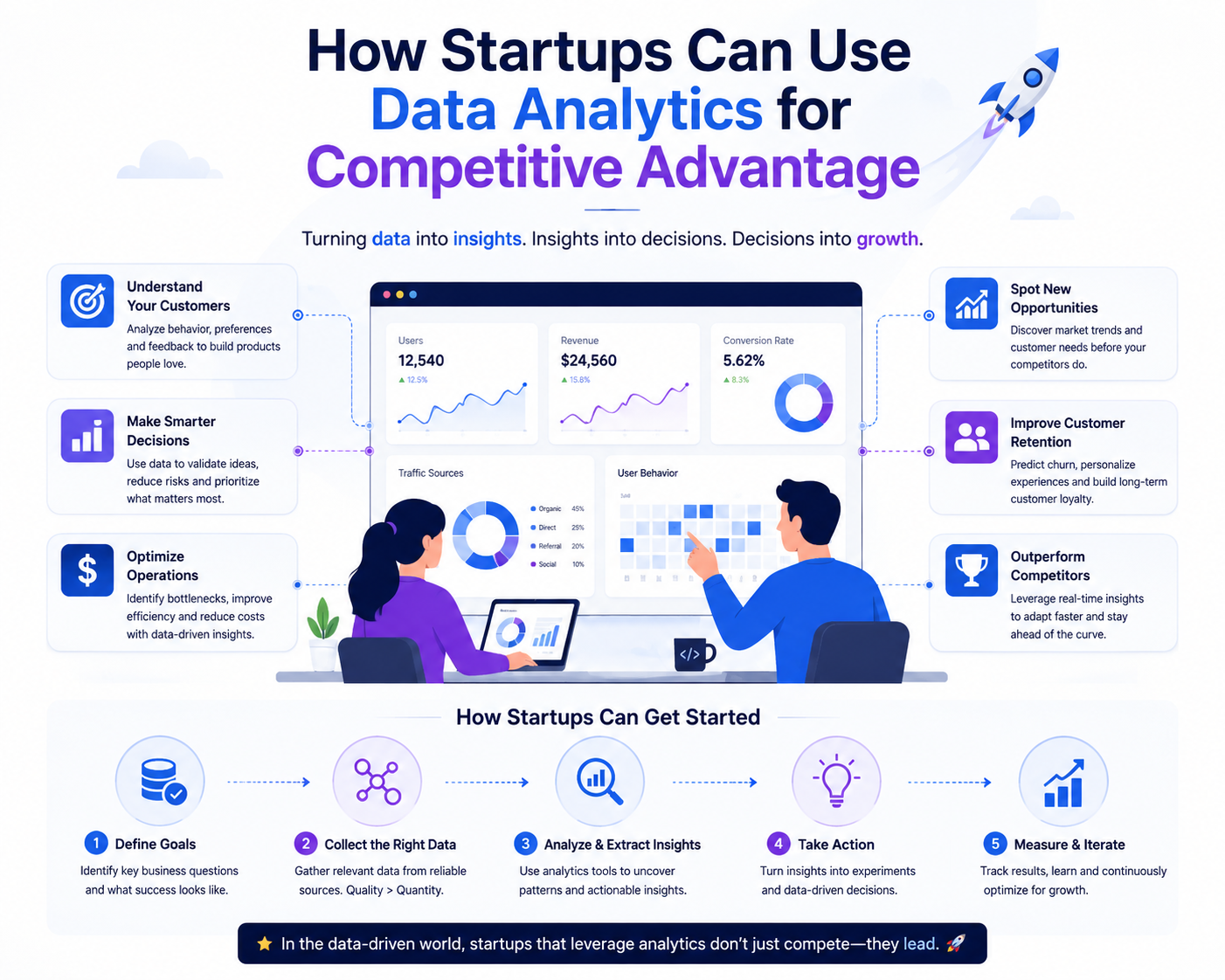
In today’s digital economy, data has become one of the most valuable business assets. Successful startups no longer rely solely on intuition when making strategic decisions. Instead, they use Data Analytics for Startups to understand customer behavior, optimize operations, improve marketing campaigns, and identify new growth opportunities. Businesses that effectively leverage data can make faster, smarter decisions while staying ahead of competitors.
Whether you’re launching a new startup or scaling an existing one, data analytics provides valuable insights that help reduce uncertainty and improve business performance. From tracking customer interactions to forecasting future trends, data-driven strategies allow startups to innovate confidently and maximize return on investment.
In this guide, we’ll explore how startups can use data analytics to build a sustainable competitive advantage.
Why Data Analytics Matters for Startups
Every interaction with customers generates valuable information. When properly analyzed, this data helps businesses understand what works, what doesn’t, and where improvements are needed.
Using Data Analytics for Startups enables businesses to:
- Make informed business decisions
- Improve customer experiences
- Increase operational efficiency
- Identify market trends
- Optimize marketing campaigns
- Reduce business risks
A strong Startup Data Strategy transforms raw data into actionable insights that drive long-term success.
Define Clear Business Objectives
Before collecting data, startups should identify what they want to achieve.
Common objectives include:
- Increasing sales
- Improving customer retention
- Reducing operational costs
- Optimizing marketing performance
- Enhancing product development
- Expanding into new markets
Clear goals ensure Data-Driven Decision Making focuses on measurable business outcomes.
Collect the Right Data
Not all data is equally valuable. Focus on information that directly supports your business objectives.
Useful data sources include:
- Website analytics
- Customer purchase history
- CRM systems
- Mobile applications
- Social media insights
- Email marketing campaigns
- Customer support interactions
High-quality data strengthens Business Data Analytics and improves decision accuracy.
Understand Customer Behavior
One of the biggest advantages of Data Analytics for Startups is understanding how customers interact with your business.
Analyze:
- Customer journeys
- Product usage
- Buying patterns
- Bounce rates
- Session duration
- Conversion paths
These insights help startups personalize experiences and increase customer satisfaction.
Improve Marketing Performance
Data analytics allows startups to measure marketing effectiveness in real time.
Track metrics such as:
- Website traffic
- Click-through rates (CTR)
- Cost per acquisition (CPA)
- Return on ad spend (ROAS)
- Lead conversion rates
- Customer acquisition cost (CAC)
Continuous analysis supports better Startup Data Strategy by allocating marketing budgets more effectively.
Optimize Product Development
Customer data reveals which product features users value most.
Monitor:
- Feature usage
- User feedback
- Product engagement
- Customer requests
- Support tickets
These insights support Data-Driven Decision Making and help prioritize product improvements based on actual customer needs.
Forecast Business Growth
Predictive analytics helps startups prepare for future opportunities and challenges.
Businesses can forecast:
- Sales trends
- Customer demand
- Inventory requirements
- Revenue growth
- Seasonal fluctuations
Forecasting reduces uncertainty while improving Business Data Analytics planning.
Monitor Financial Performance
Financial analytics helps startups maintain healthy operations.
Track important KPIs such as:
- Monthly Recurring Revenue (MRR)
- Gross Profit Margin
- Cash Flow
- Burn Rate
- Customer Lifetime Value (CLV)
- Churn Rate
Monitoring these metrics strengthens Data Analytics for Startups by supporting better financial decisions.
Enhance Customer Retention
Retaining existing customers is often more cost-effective than acquiring new ones.
Use analytics to identify:
- Customers at risk of leaving
- Purchase frequency
- Satisfaction trends
- Repeat buying behavior
- Engagement levels
Retention-focused insights improve Startup Data Strategy while increasing long-term profitability.
Use Real-Time Dashboards
Business dashboards provide instant visibility into company performance.
Popular dashboard tools include:
- Google Looker Studio
- Microsoft Power BI
- Tableau
- Google Analytics 4
- HubSpot
- Zoho Analytics
Dashboards simplify Business Data Analytics by presenting important KPIs in one place.
Leverage Artificial Intelligence
Modern analytics platforms increasingly use AI to generate deeper insights.
AI can help startups:
- Predict customer behavior
- Detect market trends
- Automate reporting
- Personalize recommendations
- Identify sales opportunities
Combining AI with Data-Driven Decision Making enables startups to respond more quickly to changing market conditions.
Common Mistakes to Avoid
Many startups fail to realize the full value of analytics because of poor implementation.
Avoid these common mistakes:
- Collecting too much unnecessary data
- Ignoring data quality
- Tracking irrelevant metrics
- Failing to act on insights
- Not protecting customer data
- Making assumptions without evidence
Avoiding these issues improves the effectiveness of Data Analytics for Startups.
Best Practices for Data Analytics
To maximize business value:
- Define measurable goals.
- Collect accurate and relevant data.
- Monitor KPIs regularly.
- Use visualization dashboards.
- Protect customer privacy.
- Continuously test and optimize strategies.
- Make decisions based on evidence, not assumptions.
These practices strengthen Business Data Analytics and support sustainable business growth.
Conclusion
Data is one of the most powerful competitive advantages available to modern startups. Effective Data Analytics for Startups, combined with strong Business Data Analytics, a well-defined Startup Data Strategy, and consistent Data-Driven Decision Making, enables businesses to improve customer experiences, optimize operations, and accelerate growth. By using data to guide every major business decision, startups can reduce risks, identify new opportunities, and build a sustainable competitive edge in today’s dynamic marketplace.
If you’re planning to build a successful startup, mastering data analytics is just as important as learning how to start a small business in India and creating a long-term strategy for innovation and growth.

About My Design Minds
My Design Minds empowers startups with innovative product design, CAD engineering, rapid prototyping, tooling, and manufacturing solutions. By combining engineering expertise with data-driven design processes, My Design Minds helps businesses develop high-quality, market-ready products, reduce development costs, accelerate time-to-market, and confidently transform innovative ideas into successful commercial products.