
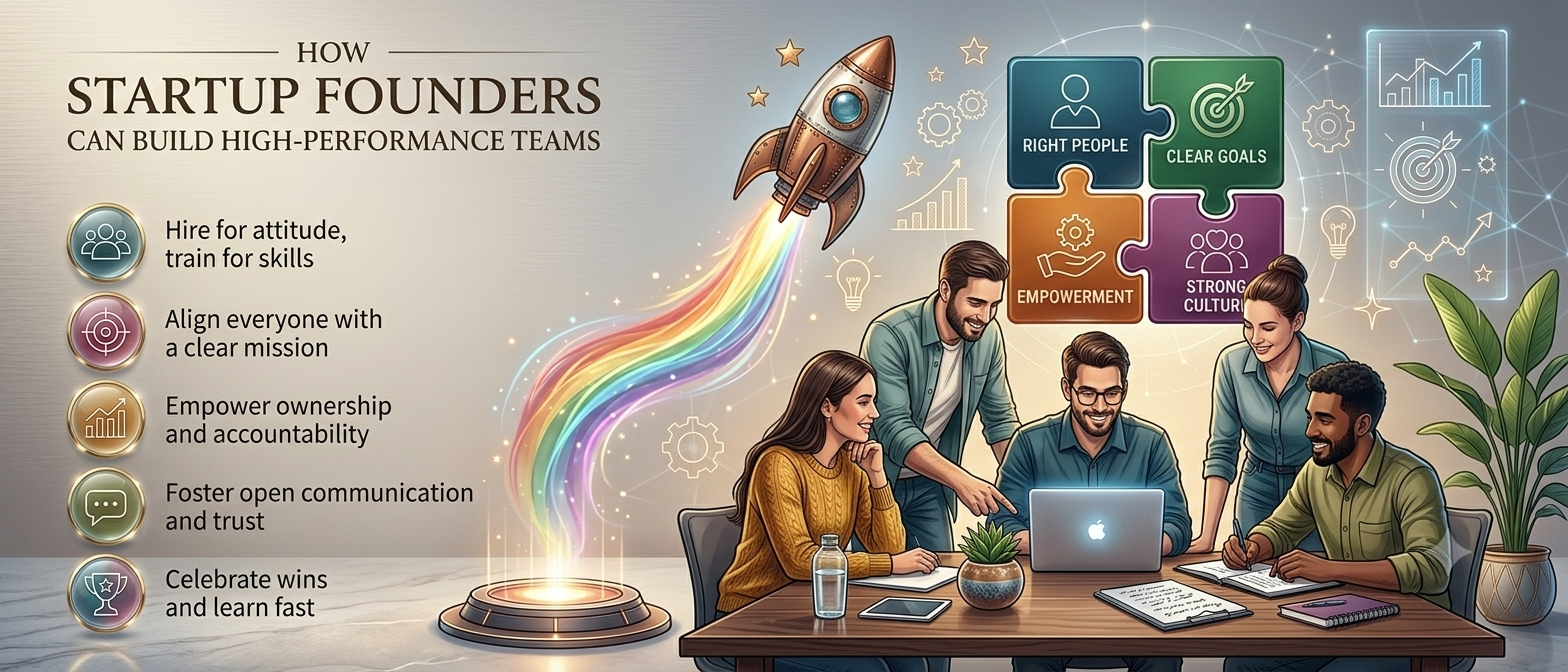
Building a successful startup requires more than a great idea, strong funding, or innovative technology. The people behind the business play a major role in determining whether a company can overcome challenges and achieve sustainable growth. High-Performance Startup Teams bring together skilled professionals who understand the company’s vision, communicate effectively, take ownership, and work toward measurable goals.
For founders, creating a strong team requires more than hiring talented employees. It involves establishing clear responsibilities, encouraging collaboration, developing leadership, and creating a workplace where people can perform at their best.
Hire People Who Fit the Startup
The foundation of effective Startup Team Building is hiring the right people. Startups often operate with limited resources, so every employee can have a significant impact on business performance.
Founders should consider technical skills, problem-solving ability, adaptability, communication, and willingness to learn when evaluating candidates. Experience is valuable, but attitude can be equally important.
Startup environments can change quickly. Employees may need to manage multiple responsibilities, learn new technologies, and respond to unexpected challenges. Hiring adaptable people can help the organization remain flexible as it grows.
Define Roles and Responsibilities
Unclear responsibilities can result in duplicated work, missed deadlines, and workplace frustration. Every team member should understand their responsibilities and how their work contributes to the company’s overall objectives.
Founders should create clear job descriptions, performance expectations, reporting structures, and measurable goals. When responsibilities are well defined, employees can make decisions confidently and take ownership of their work.
This becomes especially important when a startup grows from a small founding team into a larger organization.
Build a Positive Company Culture
Company culture influences how employees communicate, collaborate, and handle challenges. Founders should create an environment where people feel comfortable sharing ideas, asking questions, and discussing problems.
A positive culture does not mean avoiding accountability. Instead, it combines trust, respect, transparency, and responsibility. Employees should understand that their contributions are valued while also recognizing the importance of meeting expectations.
Recognizing achievements and encouraging teamwork can help create a workplace where talented employees want to stay and grow.
Encourage Open Communication
Communication is one of the most important elements of Startup Leadership. As a company grows, information can easily become fragmented between departments.
Regular team meetings, project management platforms, shared documentation, and one-on-one discussions can help employees remain aligned. However, communication should not become unnecessarily complicated.
Founders should also listen to their employees. Team members who interact directly with customers, products, and daily operations may identify valuable opportunities that management does not immediately notice.
Set Clear and Measurable Goals
Employees perform better when they know what they are expected to achieve. Founders should establish realistic goals for both individuals and teams.
Objectives can focus on sales, customer satisfaction, product development, project completion, productivity, or operational efficiency. Breaking larger objectives into smaller milestones makes progress easier to monitor.
Regular performance discussions can help founders understand what is working, identify obstacles, and provide support where necessary.
Invest in Employee Development
Startups operate in rapidly changing markets. New technologies, customer expectations, and industry trends can require employees to develop new skills.
Training programs, workshops, mentoring, and practical learning opportunities can improve employee capabilities. They can also increase engagement by showing employees that the company is interested in their professional growth.
Continuous learning is particularly valuable for technical startups, where design software, engineering methods, digital platforms, and business processes can evolve quickly.
Use Technology to Improve Teamwork
Technology can make collaboration faster and more organized. Project management platforms, communication tools, cloud-based documentation, analytics systems, and automation can reduce administrative workloads.
However, founders should avoid adopting too many tools. Technology should solve real business problems rather than create additional complexity.
For example, a project management platform can help teams assign responsibilities, track deadlines, share updates, and monitor project progress from one location.
Give Employees Ownership
One of the defining characteristics of High-Performance Startup Teams is ownership. Employees should not have to seek approval for every small decision.
Founders can give capable team members responsibility for projects and encourage them to develop solutions independently. This improves confidence and allows founders to concentrate on strategic priorities.
Ownership also creates accountability. When employees feel responsible for outcomes rather than simply completing assigned tasks, they are more likely to think about quality, efficiency, and customer impact.
Encourage Collaboration Across Departments
As startups expand, different departments must work together effectively. Sales, marketing, product development, engineering, finance, and operations should understand how their responsibilities affect one another.
Developing Collaborative Startup Teams can improve information sharing and reduce delays. Cross-functional meetings and shared objectives can help employees understand the bigger picture.
Collaboration is particularly important when developing physical products because designers, engineers, manufacturers, and business teams must coordinate throughout the development process.
Build Trust and Recognize High-Performance Startup Teams
Trust allows employees to work independently while remaining accountable for their responsibilities. Excessive micromanagement can slow decision-making and reduce employee confidence.
Founders should establish expectations clearly and then give employees appropriate freedom to complete their work. Recognition is equally important. Celebrating successful projects, innovative ideas, customer wins, and individual contributions can motivate employees.
Constructive feedback should also be provided when performance does not meet expectations. A healthy combination of recognition and accountability helps employees continuously improve.
Develop a Scalable Team Structure
The organizational structure that works for five employees may not work for fifty. As the startup grows, founders should gradually introduce team leaders, documented processes, performance metrics, and defined reporting structures.
Effective Startup Team Building means creating a structure that supports growth without making the organization unnecessarily bureaucratic. Leaders should maintain flexibility while ensuring everyone understands who is responsible for important decisions.
A scalable team structure allows founders to delegate effectively and gives employees opportunities to develop leadership capabilities.
My Design Minds: Supporting Growing Businesses
My Design Minds helps startups and businesses transform product ideas into practical design and manufacturing solutions. From CAD design and 3D product visualization to product engineering, reverse engineering, prototyping, and mould manufacturing, the company supports businesses across different stages of development. For High-Performance Startup Teams, reliable technical expertise can help employees focus on strategy, customer requirements, and business growth. Strong Collaborative Startup Teams can also work more effectively when design and manufacturing activities are properly coordinated.
Through professional engineering, design, and manufacturing support, My Design Minds helps businesses address technical challenges and develop manufacturable products. By supporting the journey from concept to production, the company provides growing businesses with practical expertise that can strengthen their product development capabilities and support long-term success.
For entrepreneurs learning how to start a small business in India, effective Startup Team Building, strong Startup Leadership, and Collaborative Startup Teams can help create High-Performance Startup Teams that drive productivity, innovation, and sustainable business growth..