
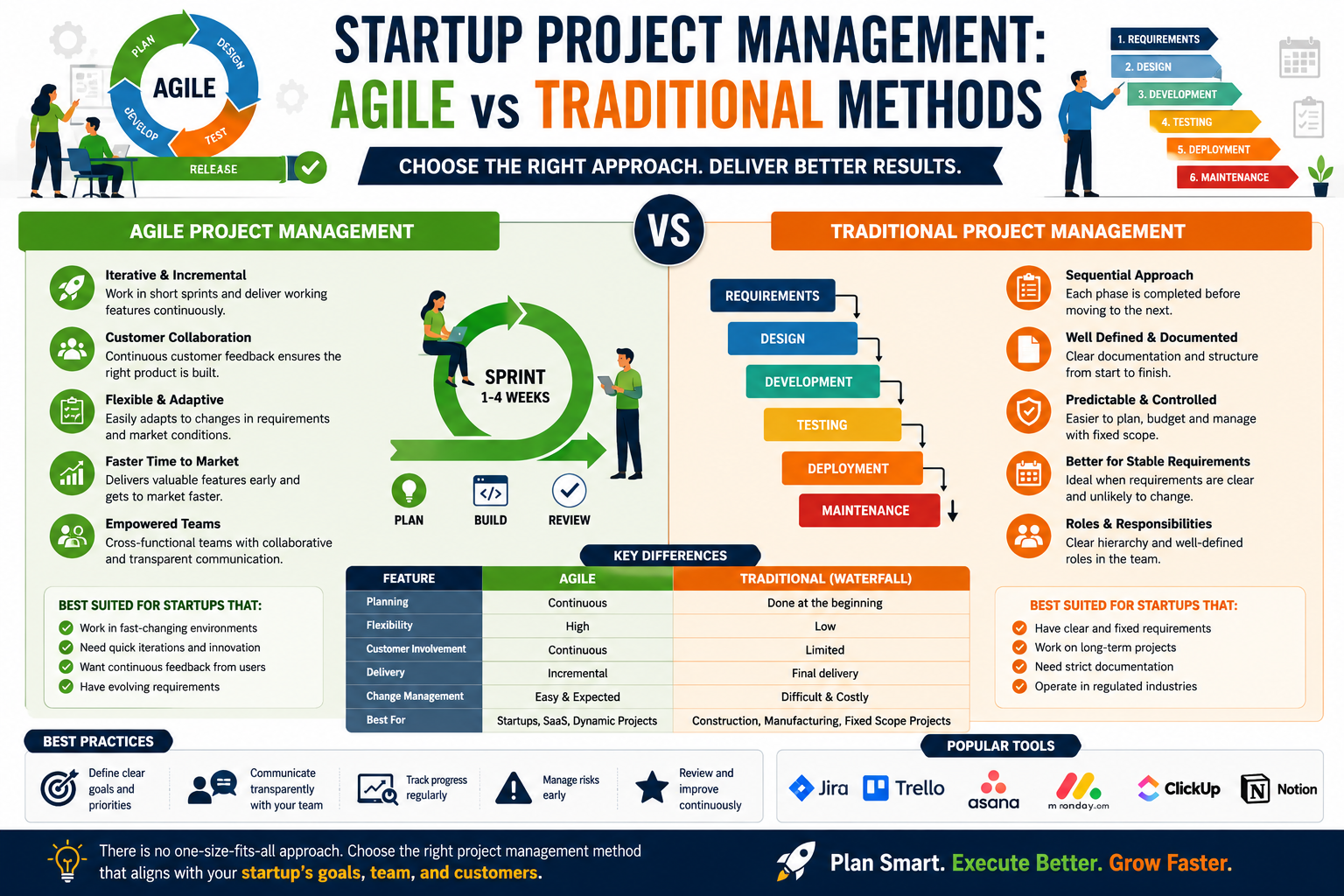
Managing projects effectively is one of the biggest challenges startups face. Whether you’re developing a new product, launching a marketing campaign, or scaling operations, choosing the right project management approach can significantly impact your success. Startup Project – Management is not just about completing tasks – it is about delivering value, managing resources efficiently, and adapting to changing business needs.
Two of the most widely used project management approaches are Agile and Traditional (Waterfall). While both have their strengths, choosing the right methodology depends on your startup’s goals, project complexity, team structure, and customer expectations.
In this guide, we’ll compare Agile and Traditional project management methods to help startup founders make informed decisions.
Why Project Management Matters for Startups
Startups often operate with limited budgets, small teams, and tight deadlines. Without a structured project management system, businesses may experience delays, budget overruns, and communication gaps.
Effective Management for Startup Project helps businesses:
- Improve team collaboration
- Meet project deadlines
- Optimize resource utilization
- Reduce project risks
- Increase customer satisfaction
- Support business scalability
Using the right Project Management for Startups strategy creates a strong foundation for sustainable growth.
What is Agile Project Management?
Agile is an iterative approach where projects are divided into smaller phases called sprints. Teams continuously plan, build, test, and improve products based on customer feedback.
Agile focuses on:
- Continuous improvement
- Customer collaboration
- Rapid development
- Flexibility
- Frequent product releases
This method is especially popular among software startups and technology companies.
Benefits of Agile Project Management
Implementing Agile offers several advantages:
- Faster product development
- Better adaptability to market changes
- Improved customer feedback integration
- Higher team collaboration
- Reduced project risks
- Continuous product improvement
Startups operating in rapidly changing industries often benefit from Agile’s flexibility.
Challenges of Agile
Despite its advantages, Agile has some limitations.
Common challenges include:
- Frequent scope changes
- Continuous stakeholder involvement
- Difficult cost estimation
- Less predictable timelines
- Requires experienced teams
For startups without structured processes, Agile may initially seem difficult to implement.
What is Traditional Project Management?
Traditional Project Management, often called the Waterfall model, follows a sequential process.
Each project phase is completed before moving to the next:
- Planning
- Design
- Development
- Testing
- Deployment
- Maintenance
This approach works well when project requirements are clearly defined from the beginning.
Benefits of Traditional Project Management
Many industries continue to rely on Project Management in Traditional way because of its structured approach.
Advantages include:
- Clear project documentation
- Well-defined timelines
- Predictable budgets
- Easier resource planning
- Strong process control
- Better compliance management
Manufacturing, construction, healthcare, and government projects commonly use this methodology.
Challenges of Traditional Methods
Traditional approaches may struggle in rapidly changing markets.
Limitations include:
- Limited flexibility
- Slow response to customer feedback
- Higher change management costs
- Longer development cycles
- Delayed product delivery
For innovative startups, these challenges may reduce competitiveness.
Agile vs Traditional Project Management
| Feature | Agile Project Management | Traditional Project Management |
|---|---|---|
| Planning | Continuous | Fixed at project start |
| Flexibility | High | Low |
| Customer Feedback | Continuous | Limited |
| Delivery | Incremental | Final delivery |
| Risk Management | Ongoing | Mostly upfront |
| Documentation | Lightweight | Extensive |
| Best For | Software, SaaS, Startups | Manufacturing, Construction |
Understanding these differences helps startups choose the most suitable Startup -Project Management approach.
Which Method is Better for Startups?
There is no universal answer.
Choose Agile Project Management if:
- Requirements change frequently.
- Customer feedback is essential.
- You are building digital products.
- Innovation is a priority.
- Fast product releases are important.
Choose Management for Traditional Project if:
- Project scope is fixed.
- Regulatory compliance is critical.
- Budget predictability is required.
- Detailed documentation is necessary.
Some startups successfully combine both approaches using a hybrid model.
Popular Project Management Tools
Modern startups use project management software to improve collaboration.
Popular tools include:
- Trello
- Asana
- Jira
- Monday.com
- ClickUp
- Notion
- Microsoft Project
These platforms simplify Project Management by organizing tasks, timelines, and team communication.
Best Practices for Startup Project Management
To improve project success:
- Define clear project goals.
- Prioritize important tasks.
- Maintain transparent communication.
- Track project progress regularly.
- Encourage team collaboration.
- Monitor project risks.
- Review performance after every project.
These practices improve both Agile Project Management and Traditional Project Management implementation.
Common Mistakes to Avoid
Many startups encounter project failures because of avoidable mistakes.
Avoid:
- Poor planning
- Unclear project scope
- Lack of communication
- Ignoring customer feedback
- Unrealistic deadlines
- Poor resource allocation
- Failure to monitor progress
Avoiding these issues strengthens Startup Project Management and increases project success rates.
Conclusion
Choosing the right project management methodology is critical for startup success. Effective Startup Project Management, supported by Agile Project Management, Traditional Project Management, and structured Project Management for Startups, enables businesses to improve productivity, reduce risks, and deliver better customer experiences. While Agile offers flexibility and rapid innovation, Traditional methods provide stability and predictability. The best choice depends on your startup’s goals, industry, and project requirements.
If you’re planning to build and scale your business successfully, selecting the right project management approach is just as important as learning how to start a small business in India and creating a strong operational foundation.
About My Design Minds
My Design Minds supports startups with innovative product design, CAD engineering, rapid prototyping, tooling, and manufacturing solutions. By combining technical expertise, efficient project execution, and collaborative development processes, My Design Minds helps businesses transform ideas into high-quality products while reducing development time, optimizing costs, and accelerating time-to-market for long-term success.