
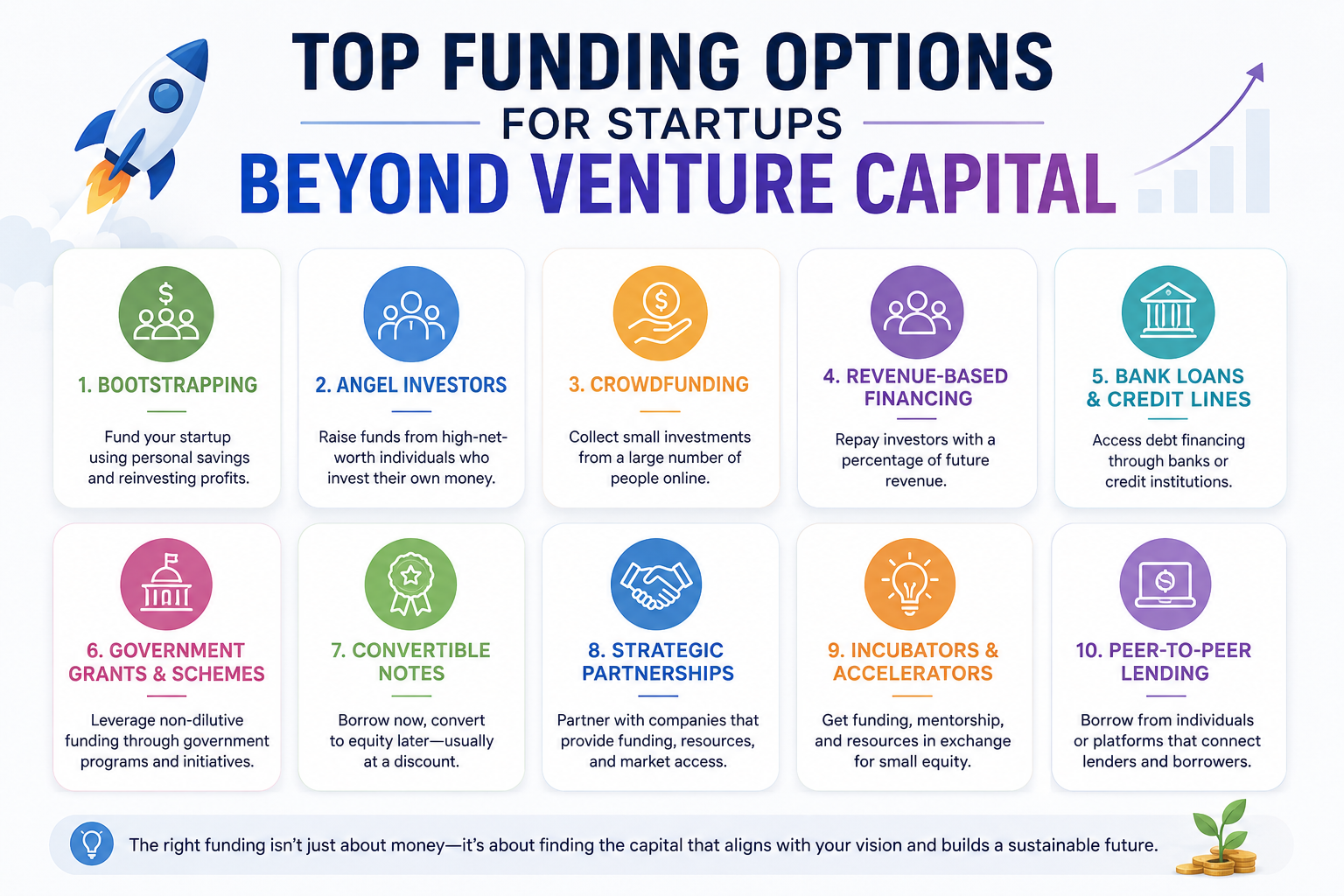
Securing funding is one of the biggest challenges faced by startups. While venture capital often receives the most attention in the startup ecosystem, it is not the only path to business growth. Many founders successfully build and scale companies using alternative financing methods that offer greater flexibility and control.
Understanding different startup funding options can help entrepreneurs choose the right financial strategy based on their business model, growth stage, and long-term objectives. From angel investors to crowdfunding and government grants, startups today have access to a wide range of funding opportunities beyond traditional venture capital.
Why Look Beyond Venture Capital?
Venture capital can provide significant capital, but it often comes with equity dilution and investor influence over business decisions. Not every startup is designed for rapid, venture-backed growth, making alternative financing methods attractive for many entrepreneurs.
Exploring alternative startup financing allows founders to maintain greater ownership while securing the resources needed to expand operations, develop products, and enter new markets.
Businesses that understand multiple funding pathways are often better prepared to navigate economic uncertainties and changing market conditions.
Angel Investors
Angel investors are among the most popular alternatives to venture capital. These individuals invest their personal funds in promising startups in exchange for equity or convertible debt.
Unlike large venture capital firms, angel investors often provide mentorship, industry expertise, and valuable business connections. They typically invest during the early stages of a company’s development when access to funding can be limited.
For many entrepreneurs, angel investments serve as an important stepping stone before pursuing larger funding rounds.
Crowdfunding Platforms
Crowdfunding has transformed the way startups raise capital. Instead of relying on a small group of investors, businesses can secure funding from hundreds or even thousands of supporters through online platforms.
Crowdfunding offers several benefits:
- Market validation before launch
- Increased brand visibility
- Customer engagement
- Reduced dependence on institutional investors
Many startups use crowdfunding campaigns to test product demand while generating initial revenue. This approach has become a valuable form of non venture capital funding for innovative products and consumer-focused businesses.
Government Grants and Startup Schemes
Governments worldwide actively support entrepreneurship through grants, subsidies, and startup development programs. In India, several initiatives encourage innovation, technology development, and small business growth.
Government grants are particularly attractive because they usually do not require founders to give up equity. These programs often focus on sectors such as technology, manufacturing, healthcare, renewable energy, and research-based innovation.
Accessing small business funding sources such as grants can significantly reduce financial pressure during the early stages of business development.
Revenue-Based Financing
Revenue-based financing is gaining popularity among startups seeking flexible capital solutions. In this model, investors provide funding in exchange for a percentage of future revenue until a predetermined amount is repaid.
Unlike traditional loans, repayment amounts fluctuate based on business performance. This makes revenue-based financing particularly appealing for startups with recurring revenue models.
As one of the emerging startup funding options, this approach allows founders to raise capital without significant equity dilution.
Bootstrapping
Bootstrapping involves funding a business using personal savings, early revenue, or reinvested profits. While this approach may limit growth speed initially, it allows entrepreneurs to maintain complete ownership and control.
Many successful companies began as bootstrapped ventures before expanding through external funding. Founders who bootstrap often develop stronger financial discipline and focus on sustainable growth.
Bootstrapping remains one of the most widely used forms of alternative startup financing, especially among early-stage entrepreneurs.
Business Loans and Credit Facilities
Traditional bank loans and business credit lines continue to be important funding tools for startups with solid financial plans and revenue potential.
These financing options offer predictable repayment structures and enable businesses to access capital without giving away equity. However, lenders typically require credit assessments and financial documentation.
For startups with strong business fundamentals, loans can serve as reliable small business funding sources that support expansion and operational growth.
Strategic Partnerships and Corporate Funding
Large corporations increasingly collaborate with startups to drive innovation and access new technologies. These partnerships may include direct investments, joint ventures, pilot projects, or accelerator programs.
Corporate funding provides startups with more than capital. Entrepreneurs often gain access to industry expertise, infrastructure, distribution channels, and potential customers.
Such collaborations represent a growing form of non venture capital funding that helps startups scale efficiently while building credibility within their industries.
Incubators and Accelerators
Startup incubators and accelerators offer funding, mentorship, networking opportunities, and business development support. These programs help entrepreneurs refine their business models and prepare for future growth.
Many accelerators provide seed funding in exchange for a small equity stake. The additional guidance and industry connections often make participation highly valuable.
For early-stage businesses exploring startup funding options, incubators and accelerators can provide both financial and strategic advantages.
Choosing the Right Funding Strategy
Every startup has unique financial needs and growth objectives. The ideal funding approach depends on factors such as:
- Industry sector
- Business model
- Revenue stage
- Growth plans
- Ownership preferences
- Market opportunities
Founders should carefully evaluate the advantages and limitations of each funding source before making decisions. A diversified financing strategy may provide greater flexibility and reduce dependence on a single funding channel.
Conclusion
While venture capital remains a valuable funding source for high-growth startups, entrepreneurs today have many alternative options available. Angel investors, crowdfunding, grants, revenue-based financing, bootstrapping, corporate partnerships, and business loans all provide viable pathways to growth.
Understanding these startup funding options allows founders to make informed financial decisions while maintaining control over their business vision. For aspiring entrepreneurs planning their first venture, exploring how to start a small business in India step by step guide can provide a strong foundation for choosing the right funding strategy and building a successful startup from the ground up.