
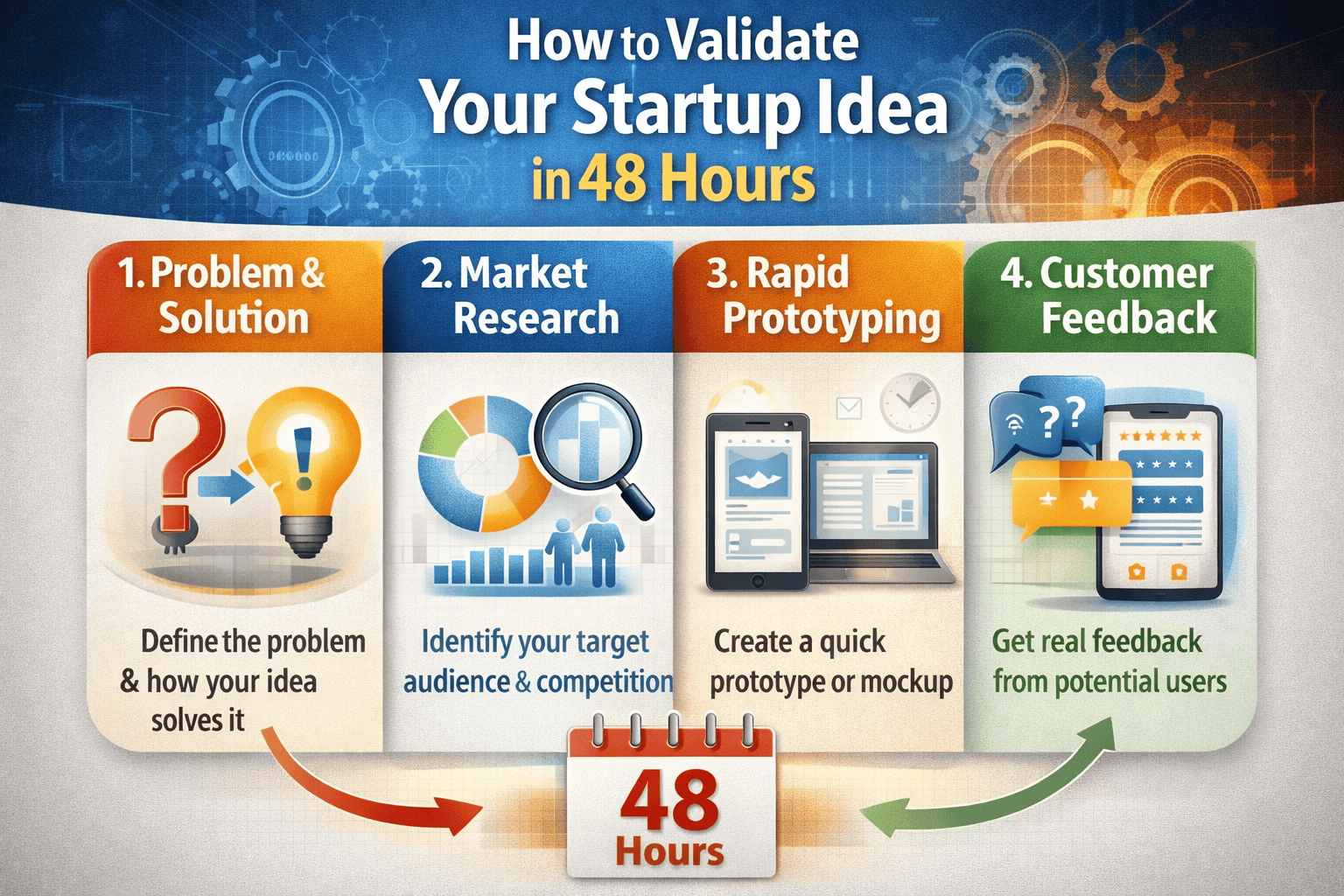
In today’s fast-paced startup world, speed matters. Before investing time and money, it is crucial to validate your startup idea quickly and effectively. Many startups fail not because of poor execution, but because the idea itself lacks real demand.
Validating your idea within 48 hours helps you test assumptions, reduce risks, and ensure you are building something people actually want. A structured Startup Validation Process can save months of effort and prevent costly mistakes.
Why Validation Matters
Many startups fail not because of poor execution, but because there is no real demand. Business idea testing helps you understand whether people actually need your solution.
When you validate startup idea, you reduce risk, save money, and increase your chances of success.
Day 1: Research & Problem Validation
Step 1: Define the Problem Clearly
Start by identifying the exact problem your idea solves. Ask:
- Who is facing this problem?
- How are they currently solving it?
- Is it a real pain point?
Strong startup idea validation begins with a real, urgent problem.
Step 2: Analyze Market Demand
Search online platforms, forums, and competitor products. Look for:
- Existing solutions
- Customer complaints
- Market gaps
This form of business idea testing helps you understand if demand already exists.
Step 3: Talk to Real People
Reach out to potential users and ask direct questions. Avoid pitching-focus on understanding their problems.
When you validate your startup idea, real conversations provide better insights than assumptions.
Day 2: Test & Validate
Step 4: Create a Simple Landing Page
Build a basic page explaining your idea, benefits, and solution. Include a call-to-action like:
- “Sign up”
- “Join waitlist”
- “Pre-order”
This is a powerful method of startup idea validation.
Step 5: Run Quick Marketing Tests
Promote your landing page using:
- Social media
- Online communities
- Ads (small budget)
This stage of business idea testing shows how people react to your idea.
Step 6: Measure Results
Track key metrics:
- Clicks
- Sign-ups
- Engagement
If people show interest, it’s a strong signal to move forward and validate your startup idea further.
Signs Your Idea is Valid (or Not)
Positive Signals
- People show genuine interest
- Users sign up or engage
- You receive useful feedback
Warning Signs
- No engagement
- Confusion about your idea
- Lack of clear demand
Effective startup idea validation means being honest with these results.
Pro Tips for Faster Validation
- Keep your idea simple
- Focus on one problem
- Don’t overthink-test quickly
- Be ready to pivot
Smart business idea testing is about learning fast, not being perfect.
What to Do After Validation
Once you successfully validate your startup idea, the next step is to build your MVP. This ensures you turn validated concepts into real products.
A structured startup idea validation process sets the foundation for successful execution.
Conclusion (My Design Minds Perspective)
Validating an idea is just the beginning of the startup journey. Turning that validated concept into a functional and scalable product requires the right strategy, design, and execution. This is where My Design Minds supports startups as a complete solution provider. From concept validation to product design and manufacturing support, the focus is on transforming ideas into market-ready solutions.
For startups aiming to succeed, combining fast validation with expert execution ensures reduced risk and faster growth. In today’s competitive landscape, having the right partner can make all the difference in turning ideas into impactful businesses.
Once you validate your startup idea, explore how to start a small business in India to build a strong foundation for growth.