
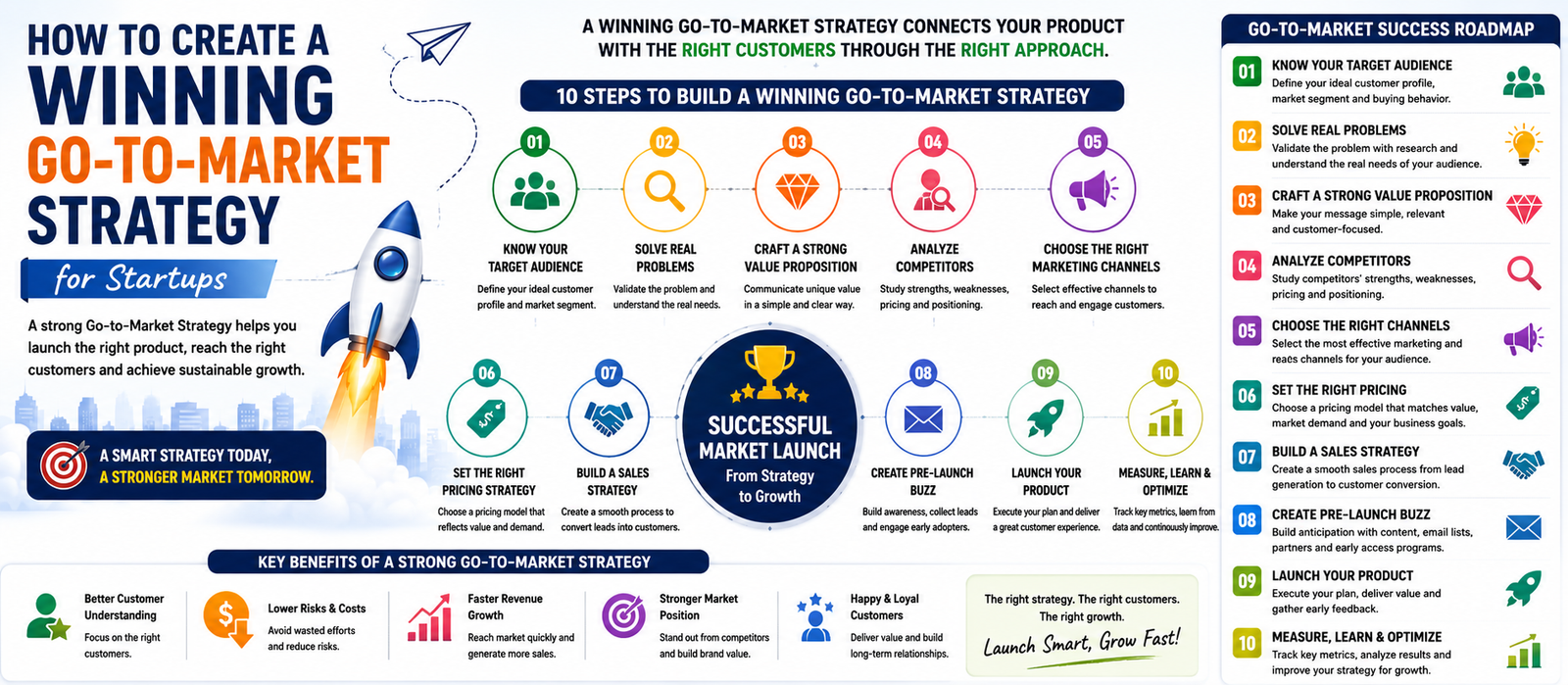
Launching a new product or service is exciting, but having a great idea does not automatically guarantee market success. Startups need to understand their customers, define their value proposition, select the right marketing channels, and create a clear path from awareness to purchase. This is where a strong Go-to-Market Strategy for Startups becomes essential.
A go-to-market (GTM) strategy provides a structured plan for introducing a product to the right audience and generating demand. It connects product development, marketing, sales, pricing, distribution, and customer experience into one coordinated approach.
For startups operating with limited resources, a focused GTM strategy can prevent wasted spending and help teams prioritize the activities most likely to generate customers and revenue.
What Is a Go-to-Market Strategy?
A go-to-market strategy is a detailed plan for launching a product or entering a market. It explains who the product is designed for, what problem it solves, how it is positioned, where it will be promoted, and how customers will purchase it.
A successful Startup Go-to-Market Strategy should answer several important questions:
- Who is the target customer?
- What problem does the product solve?
- Why should customers choose it?
- What makes the product different?
- Which channels will reach potential buyers?
- How should the product be priced?
- How will success be measured?
Answering these questions creates a clear direction for the launch.
1. Define Your Target Market
The first step is identifying exactly who you want to serve. Avoid trying to target everyone because broad targeting can make marketing messages unclear and increase customer acquisition costs.
Analyze:
- Customer demographics
- Industry
- Business size
- Location
- Buying behavior
- Pain points
- Budget
- Existing solutions
Create an ideal customer profile (ICP) that describes the customers most likely to benefit from your product.
A focused target market makes your Startup Market Entry Strategy more efficient and allows you to develop highly relevant messaging.
2. Identify the Customer Problem
Successful products solve genuine customer problems. Before launching, understand what challenges your target audience experiences and how they currently address them.
Conduct:
- Customer interviews
- Surveys
- Competitor research
- Online community research
- Market analysis
Identify the gap between what customers currently have and what they actually need.
The stronger the problem-solution fit, the easier it becomes to communicate the value of your product.
3. Create a Clear Value Proposition
Your value proposition should quickly explain why customers should care about your product.
A strong value proposition communicates:
Who you help + What problem you solve + How you solve it + Why you are different.
Avoid complicated industry language. Use simple, customer-focused messaging that clearly communicates the benefit.
For example, instead of saying that your software uses advanced automation technology, explain how it helps small businesses save time and reduce repetitive work.
4. Research Your Competitors
Understanding competitors helps startups identify opportunities for differentiation.
Study:
- Product features
- Pricing
- Target customers
- Marketing channels
- Customer reviews
- Strengths
- Weaknesses
- Brand positioning
Customer reviews can be especially useful because they reveal what customers like and dislike about existing solutions.
Use this information to develop a stronger Product Launch Strategy.
5. Develop Your Market Positioning
Positioning determines how customers perceive your startup compared with competitors.
Your positioning might focus on:
- Affordability
- Premium quality
- Ease of use
- Innovation
- Speed
- Customer support
- Specialized expertise
Choose a position that matches your actual strengths and customer needs.
Consistency is important. Your website, advertisements, social media, sales presentations, and product messaging should communicate the same core positioning.
6. Choose the Right Marketing Channels
Startups should avoid spreading limited resources across every marketing channel.
Choose channels based on where your target customers are most active.
Potential channels include:
- SEO
- Content marketing
- Social media
- Email marketing
- Paid advertising
- Influencer marketing
- Partnerships
- Webinars
- Industry events
- Direct sales
For a B2B startup, LinkedIn, SEO, email marketing, and direct outreach may be valuable. A consumer startup might focus more heavily on social media, influencers, search, and online advertising.
7. Develop a Pricing Strategy
Pricing can significantly influence your product’s market acceptance.
Consider:
- Customer willingness to pay
- Competitor pricing
- Production costs
- Product value
- Target market
- Subscription versus one-time pricing
Possible models include:
- Freemium
- Subscription
- Tiered pricing
- Usage-based pricing
- One-time purchase
- Enterprise pricing
Test your assumptions and be prepared to adjust pricing based on customer feedback and market performance.
8. Build a Sales Strategy
Marketing generates awareness, but your sales process converts qualified prospects into customers.
Define:
- Lead qualification criteria
- Sales stages
- Outreach methods
- Product demonstrations
- Follow-up process
- Closing process
- Customer handover
For self-service products, the website and product experience may handle most of the conversion process. For complex B2B solutions, a dedicated sales team may be necessary.
9. Create Pre-Launch Awareness
Do not wait until launch day to start building an audience.
Before launch, consider:
- Building an email list
- Publishing educational content
- Sharing product development updates
- Creating social media campaigns
- Offering early access
- Running webinars
- Building partnerships
Pre-launch activity creates awareness and gives your startup an initial audience when the product becomes available.
10. Plan Your Product Launch
Create a detailed launch timeline covering activities before, during, and after launch.
Before Launch
Build awareness, collect leads, test messaging, and prepare marketing assets.
Launch Day
Announce the product, activate marketing channels, contact prospects, and monitor customer response.
After Launch
Analyze performance, gather feedback, fix problems, and optimize campaigns.
A structured Product Launch Strategy reduces confusion and helps teams coordinate their efforts.
11. Use Customer Feedback
Your first customers provide valuable information about your product and GTM strategy.
Ask them:
- Why did they purchase?
- What problem were they trying to solve?
- What almost stopped them from buying?
- Which feature do they value most?
- What could be improved?
Use these insights to improve your product, messaging, pricing, and customer experience.
12. Measure Key Performance Indicators
A GTM strategy should be measurable.
Track KPIs such as:
- Website traffic
- Leads generated
- Conversion rate
- Customer acquisition cost
- Customer lifetime value
- Sales revenue
- Churn rate
- Return on marketing investment
- Product adoption
These metrics help founders determine whether the strategy is producing sustainable results.
Common Go-to-Market Mistakes Startups Should Avoid
Startups often make mistakes such as:
- Targeting too many customer segments
- Launching without validating demand
- Focusing on product features instead of benefits
- Choosing channels without research
- Ignoring competitors
- Setting unrealistic revenue expectations
- Spending heavily before testing campaigns
- Failing to collect customer feedback
Avoiding these mistakes can make your Go-to-Market Strategy for Startups more focused and cost-effective.
Best Practices for a Winning GTM Strategy
To create a successful GTM plan:
- Define a specific target audience.
- Validate the customer problem.
- Develop a clear value proposition.
- Research competitors.
- Establish strong market positioning.
- Select appropriate marketing channels.
- Create a realistic pricing model.
- Build a clear sales process.
- Generate pre-launch demand.
- Measure results and continuously optimize.
A GTM strategy should not remain fixed. Markets, customer expectations, competitors, and technologies change, so startups should regularly review and improve their approach.
Conclusion
A successful Go-to-Market Strategy for Startups provides a roadmap for turning an innovative idea into a commercially successful product. By clearly defining the target market, understanding customer problems, developing a compelling value proposition, researching competitors, selecting the right channels, and creating an effective sales process, startups can enter the market with greater confidence.
A strong Go-to-Market Strategy for Startup also allows businesses to use limited resources more efficiently. Meanwhile, a focused Startup Market Entry Strategy helps identify the right customers, markets, and opportunities for expansion. When combined with a well-planned Product Launch Strategy, continuous customer feedback, and data-driven decision-making, a startup can build stronger market traction and create a foundation for sustainable growth.
If you are planning a new venture, understanding a Go-to-Market Strategy for Startups is an important step alongside learning how to start a small business in India. A carefully planned launch can help your startup attract the right customers, generate early revenue, and build momentum for long-term success.

About StartupSpark
StartupSpark provides practical insights and actionable strategies for entrepreneurs looking to launch, market, and scale successful businesses. From go-to-market planning and digital marketing to branding, funding, technology, sales, and business growth, StartupSpark helps founders make informed decisions and build sustainable businesses in a competitive market.