
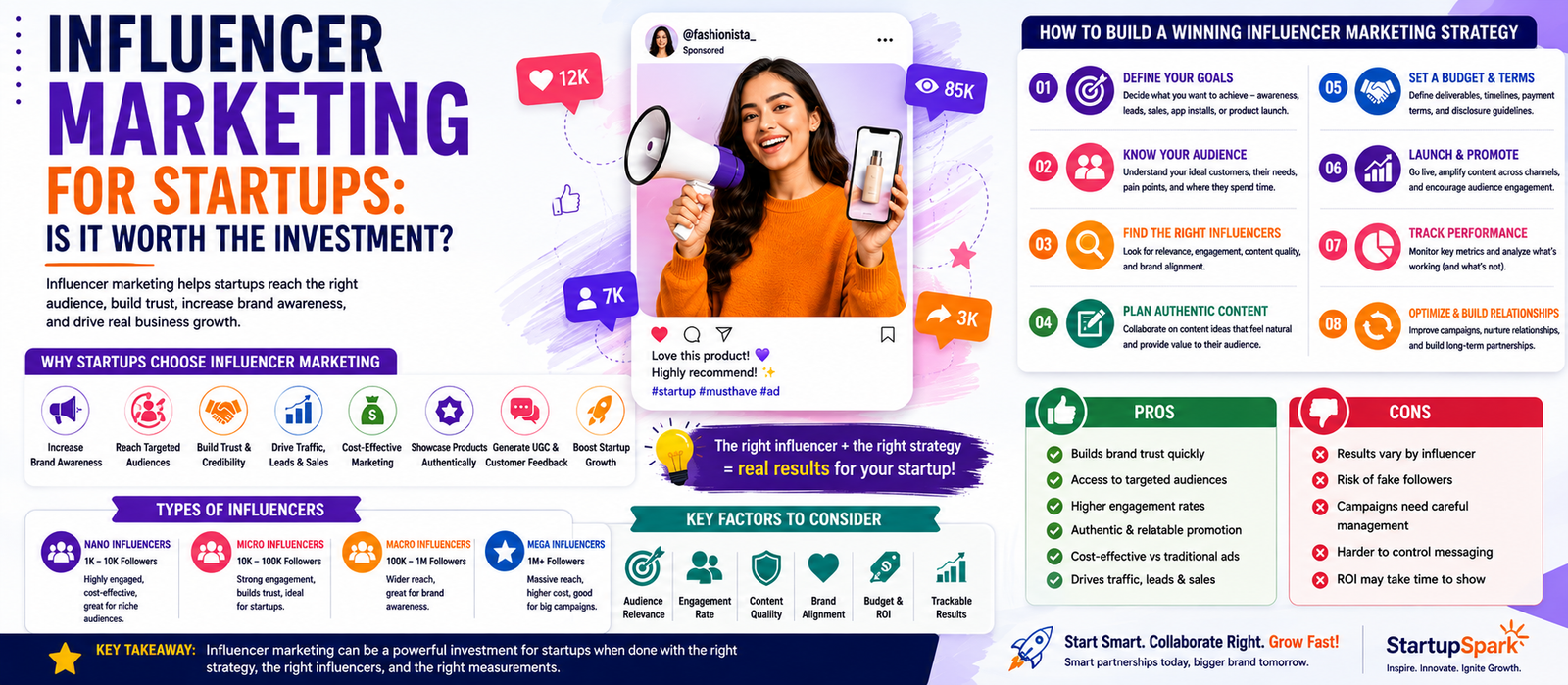
Building awareness is one of the biggest challenges for a new startup. Even when a business offers an excellent product or service, potential customers may not know that it exists. Traditional advertising can help, but it may require a significant budget that many startups cannot afford. This is where Influencer Marketing for Startups can provide an alternative way to reach targeted audiences and build credibility.
Influencer marketing involves partnering with individuals who have an established audience and influence within a particular niche. Instead of communicating with potential customers only through traditional advertisements, startups can collaborate with creators who already have relationships with their followers.
When planned carefully, Startup Influencer Marketing can help a young business increase visibility, demonstrate products, generate website traffic, and build trust. However, influencer marketing is not automatically successful. Startups need to select the right creators, establish measurable objectives, create authentic campaigns, and carefully evaluate the return on investment.
What Is Influencer Marketing?
Influencer marketing is a digital marketing approach in which a brand collaborates with a content creator to promote its products, services, or ideas to the creator’s audience.
Influencers can operate across platforms such as:
- YouTube
- TikTok
- Podcasts
- Blogs
The right platform depends on the target audience and type of product.
For example, a fashion startup may benefit from visual content creators, while a B2B technology startup may find industry experts, LinkedIn creators, or niche YouTubers more relevant.
Why Influencer Marketing Can Benefit Startups
One of the biggest advantages of Influencer Marketing for Startups is access to an existing audience.
A startup may spend months building its own audience, while an established creator may already have thousands of relevant followers. A partnership can introduce the startup to potential customers more quickly.
Influencer campaigns can help startups:
- Increase brand awareness
- Reach niche audiences
- Generate website traffic
- Showcase products
- Build credibility
- Generate leads
- Increase sales
- Collect customer feedback
However, the quality and relevance of the audience are more important than follower numbers.
Choose the Right Influencer
Selecting an influencer should be based on more than popularity.
Consider:
Audience Relevance
Does the creator’s audience match your ideal customer?
Engagement
Do followers actively comment, share, and interact with the creator’s content?
Content Quality
Does the influencer create professional, useful, and authentic content?
Brand Alignment
Do the creator’s values and communication style match your startup?
Audience Authenticity
Check whether the account appears to have genuine engagement rather than large numbers of inactive or suspicious followers.
A smaller creator with a highly relevant audience can sometimes provide more value than a celebrity with millions of followers.
Consider Micro-Influencers
Micro-Influencer Marketing can be particularly useful for startups.
Micro-influencers typically operate within specific niches and have smaller but highly engaged communities. Their audiences may perceive them as more relatable and trustworthy.
For example, a startup selling business software could partner with a productivity expert who has a focused professional audience instead of choosing a general celebrity.
Potential benefits include:
- More targeted audiences
- Stronger engagement
- Authentic communication
- Niche expertise
- Potentially lower campaign costs
The key is to evaluate the creator based on relevance and campaign performance rather than follower count alone.
Define Your Campaign Objective
Before contacting influencers, determine what you want to achieve.
Possible objectives include:
- Brand awareness
- Product launches
- Website traffic
- Lead generation
- App downloads
- Product sales
- Email sign-ups
- Customer reviews
A campaign designed for awareness will have different content and metrics from a campaign designed to generate direct sales.
A clear objective makes your Influencer Marketing Strategy for Startups easier to plan and measure.
Create Authentic Campaigns
Influencer Marketing for Startups works best when promotional content feels natural.
Instead of giving creators a rigid script, provide clear information about your product and allow them to communicate in their own voice.
Campaign ideas include:
- Product demonstrations
- Tutorials
- Reviews
- Unboxing videos
- Educational posts
- Founder interviews
- Live sessions
- Product comparisons
- Customer experiences
Authenticity can make promotional content more engaging and credible.
Build Long-Term Partnerships
One-off influencer campaigns can generate short-term visibility, but long-term partnerships can create stronger brand recognition.
When an influencer consistently uses and discusses a product, followers may become more familiar with the brand.
Long-term collaborations can include:
- Monthly content
- Affiliate partnerships
- Ambassador programs
- Product development feedback
- Exclusive launches
- Educational webinars
A long-term relationship can also help creators understand your product better and produce more authentic content.
Use Affiliate Marketing
Startups can combine influencer marketing with affiliate programs.
Under an affiliate model, creators receive a unique link or promotional code and earn a commission when their audience generates a qualifying sale.
This approach can make campaign costs more closely connected to actual results.
Affiliate marketing can be particularly useful for startups that want to test influencer partnerships while controlling marketing expenses.
Set a Realistic Budget
Influencer campaigns can range from small product-based collaborations to significant paid partnerships.
Before spending money, consider:
- Creator fees
- Product costs
- Content production
- Advertising support
- Affiliate commissions
- Campaign management
- Tracking tools
Start with controlled experiments instead of committing a large budget immediately.
Test several relevant creators, analyze results, and increase investment in campaigns that demonstrate strong performance.
Track Influencer Campaign Performance
A successful Influencer Marketing Strategy for Startups needs measurable results.
Track metrics such as:
- Reach
- Impressions
- Engagement
- Website visits
- Leads
- Sales
- Conversion rate
- Cost per acquisition
- Affiliate revenue
- Return on investment
Use unique landing pages, tracking links, discount codes, or affiliate links to determine which creators are generating actual business results.
Common Influencer Marketing for Startups Mistakes
Startups should avoid several common mistakes.
Choosing Influencers Only Because of Follower Count
Large audiences do not guarantee relevant customers or strong engagement.
Ignoring Audience Quality
A creator may have impressive numbers but an audience that does not match your target market.
Providing Excessively Rigid Scripts
Overly controlled content can appear unnatural.
Not Defining KPIs
Without measurable goals, it becomes difficult to determine whether a campaign worked.
Expecting Immediate Sales
Influencer Marketing can contribute to awareness and trust before customers are ready to purchase.
Failing to Disclose Partnerships
Sponsored relationships should be communicated transparently and follow applicable advertising and platform requirements.
Is Influencer Marketing for Startups Worth the Investment?
The answer depends on your product, target audience, campaign objective, creator selection, and execution.
Influencer marketing can be worthwhile when:
- Your target audience actively follows creators
- Your product is easy to demonstrate
- You have a clear campaign objective
- You choose relevant influencers
- You track conversions
- You test campaigns before scaling
It may be less effective when a startup chooses influencers solely for popularity without considering audience relevance or business goals.
For this reason, startups should treat influencer campaigns as experiments. Begin with a manageable budget, measure performance, learn from the results, and scale successful partnerships.
Best Practices for Startup Influencer Marketing
For better results:
- Define your target audience.
- Set measurable campaign objectives.
- Research relevant influencers.
- Evaluate engagement and audience quality.
- Consider micro-influencers.
- Create authentic content guidelines.
- Use trackable links and codes.
- Test different creators.
- Measure conversions and ROI.
- Build long-term relationships with successful creators.
These practices can make Startup Influencer Marketing more focused and cost-effective.
Conclusion
Influencer Marketing for Startups can be a valuable way to increase brand awareness, reach targeted customers, and establish credibility in competitive markets. However, success depends on choosing the right creators, understanding their audiences, creating authentic content, and measuring meaningful business results.
A carefully planned Influencer Marketing Strategy for Startups can help new businesses reach audiences they may struggle to access through traditional marketing. At the same time, Micro-Influencer Marketing can provide startups with opportunities to connect with highly engaged niche communities without relying entirely on expensive celebrity partnerships.
The goal should not simply be to gain followers or impressions. Startups should focus on building trust, generating relevant traffic, acquiring customers, and creating long-term brand relationships. If you are learning how to start a small business in India, understanding how influencer marketing fits into your wider digital strategy can help you build awareness and compete more effectively in today’s crowded marketplace.

About StartupSpark
StartupSpark provides practical insights and actionable strategies for entrepreneurs looking to launch, market, and scale successful businesses. From influencer marketing and SEO to branding, funding, technology, sales, and business development, StartupSpark helps founders make informed decisions and build sustainable businesses in a competitive digital economy.