
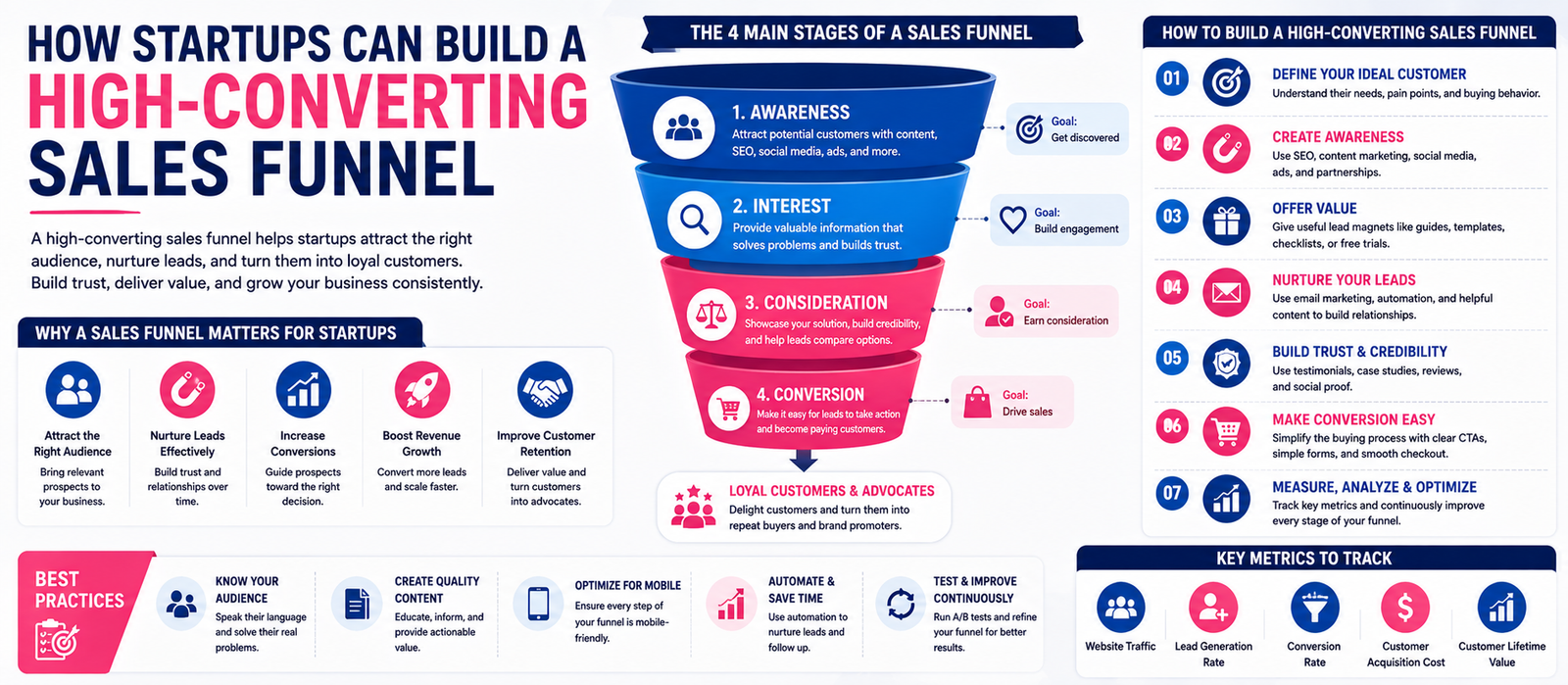
A well-planned Sales Funnel for Startups helps businesses attract the right audience, build trust with potential customers, nurture qualified leads, and turn prospects into paying customers.
Building a great product is only the beginning of startup success. A business also needs a reliable system for attracting potential customers, building trust, and converting interested prospects into paying customers. This is where a well-designed Sales Funnel for Startups becomes important.
A sales funnel represents the journey a potential customer takes from first discovering a startup to eventually making a purchase. By understanding this journey, startups can create targeted marketing and sales activities for each stage.
A high-converting funnel does not simply push products toward customers. It educates prospects, addresses their concerns, demonstrates value, and provides the right information at the right time. With a structured Startup Sales Funnel, businesses can improve lead quality, increase conversions, and build a more predictable sales process.
What Is a Sales Funnel?
A sales funnel is a step-by-step process that moves potential customers toward a purchasing decision.
A typical funnel includes four major stages:
- Awareness – Potential customers discover your startup.
- Interest – They learn more about your product or service.
- Consideration – They compare your solution with alternatives.
- Conversion – They become paying customers.
Some businesses also include retention and advocacy as additional stages because existing customers can generate repeat purchases and referrals.
Understanding each stage is essential for developing an effective Sales Funnel Strategy.
1. Define Your Ideal Customer
Before building your funnel, identify exactly who you want to attract.
Create an ideal customer profile based on:
- Industry
- Age or business size
- Location
- Job role
- Budget
- Pain points
- Buying behavior
- Goals
- Current solutions
Avoid targeting everyone. A specific audience allows you to create more relevant messaging and marketing campaigns.
For example, a Sales Funnel for Startups software may target small-business owners rather than trying to market to every type of company.
2. Create Awareness
The top of the funnel is where potential customers first discover your brand.
Startups can generate awareness through:
- SEO
- Blog content
- Social media
- Video marketing
- Paid advertising
- Guest posts
- Webinars
- Industry communities
- Partnerships
The objective at this stage is not always to make an immediate sale. Instead, focus on attracting people who have a genuine problem that your startup can solve.
High-quality educational content can help introduce your brand while establishing credibility.
3. Create a Strong Value Proposition
Once prospects discover your startup, they need a reason to continue exploring.
Your value proposition should clearly explain:
- What you offer
- Who it is for
- What problem it solves
- What benefit customers receive
- Why your solution is different
Avoid complicated language and excessive technical terms. Focus on outcomes and customer benefits.
A strong value proposition can improve the effectiveness of your Startup Sales Funnel by helping prospects quickly understand why your solution deserves attention.
4. Build Landing Pages That Convert
Landing pages play an important role in turning visitors into leads.
A high-performing landing page should include:
- Clear headline
- Strong value proposition
- Relevant visuals
- Benefits
- Social proof
- Simple form
- Clear call to action
Avoid unnecessary distractions. If the goal is to collect leads, keep the page focused on the specific action you want visitors to take.
5. Offer Something Valuable
Many visitors will not immediately purchase from an unfamiliar startup. A valuable free resource can encourage them to provide their contact information.
Consider offering:
- Free guides
- Checklists
- Templates
- E-books
- Webinars
- Product demos
- Free trials
- Consultations
The offer should be directly related to your product and useful to your target audience.
This helps generate qualified prospects who can enter your Startup Lead Conversion process.
6. Nurture Your Leads
Not every lead is ready to purchase immediately. Lead nurturing helps startups build relationships with prospects over time.
Use:
- Email campaigns
- Educational content
- Case studies
- Product demonstrations
- Customer testimonials
- Webinars
- Follow-up messages
Instead of constantly asking for a sale, provide information that helps prospects understand the problem and evaluate potential solutions.
A strong nurturing process can gradually move leads from interest to purchase.
7. Use Social Proof
Trust is particularly important for startups because potential customers may not know your brand yet.
Include social proof such as:
- Customer reviews
- Testimonials
- Case studies
- Ratings
- Industry awards
- Client logos
- Success statistics
Real customer experiences can reduce uncertainty and help prospects feel more confident about choosing your startup.
8. Create a Simple Conversion Process
Once a prospect is ready to purchase, make the process as simple as possible.
Reduce unnecessary steps in:
- Checkout
- Demo booking
- Consultation forms
- Trial registration
- Quote requests
Use clear calls to action such as:
Start Your Free Trial
Book a Demo
Get a Quote
Talk to an Expert
A complicated conversion process can cause interested prospects to abandon their purchase.
9. Automate Repetitive Activities
Automation can make your funnel more efficient.
Startups can automate:
- Welcome emails
- Lead follow-ups
- Demo reminders
- Trial notifications
- Abandoned cart messages
- Customer onboarding
- Re-engagement campaigns
Automation allows small teams to maintain consistent communication without manually handling every interaction.
10. Align Marketing and Sales
Marketing and sales should work together rather than operate separately.
Marketing teams can focus on generating and educating leads, while sales teams can qualify prospects and close opportunities.
Define:
- What qualifies as a lead
- When a lead should reach sales
- Follow-up timelines
- Sales stages
- Customer handover processes
Better alignment can improve Startup Lead Conversion and reduce wasted opportunities.
11. Track Funnel Performance
A funnel should be measured at every stage.
Important metrics include:
- Website traffic
- Lead generation rate
- Landing-page conversion rate
- Email engagement
- Sales-qualified leads
- Conversion rate
- Customer acquisition cost
- Average order value
- Customer lifetime value
- Revenue
For example, if your website receives thousands of visitors but generates very few leads, your landing pages or offers may need improvement.
If leads are plentiful but sales are low, your nurturing or sales process may require optimization.
12. Test and Improve Your Funnel
There is no single Sales Funnel for Startups that works perfectly
Experiment with:
- Headlines
- CTAs
- Landing-page designs
- Offers
- Email subject lines
- Pricing
- Ad creatives
- Sales messaging
Use A/B testing and performance data to determine what works best.
Continuous optimization is one of the most important parts of a successful Sales Funnel Strategy.
Common Sales Funnel Mistakes Startups Should Avoid
Startups often make mistakes such as:
- Targeting the wrong audience
- Asking for a sale too early
- Creating unclear messaging
- Using complicated landing pages
- Sending irrelevant emails
- Ignoring mobile users
- Failing to follow up
- Not measuring conversions
- Focusing only on traffic instead of revenue
Avoiding these problems can significantly improve funnel performance.
Best Practices for a High-Converting Startup Funnel
For better results:
- Define a specific target audience.
- Create valuable educational content.
- Develop a clear value proposition.
- Use focused landing pages.
- Offer useful lead magnets.
- Nurture prospects consistently.
- Use testimonials and case studies.
- Simplify the buying process.
- Automate repetitive activities.
- Measure and optimize every stage.
These practices create a more efficient Sales Funnel for Startups and help businesses turn more prospects into customers.
Conclusion
A high-converting Sales Funnel for Startups provides a structured way to attract potential customers, build trust, nurture leads, and generate sales. Instead of relying on random marketing activities, startups can use a clear funnel to guide prospects through each stage of the buying journey.
A well-planned Startup Sales Funnel combines content marketing, SEO, social media, landing pages, email nurturing, social proof, automation, and sales follow-up. Meanwhile, an effective Sales Funnel Strategy allows startups to identify weaknesses, measure performance, and continuously improve conversion rates.
For founders, the goal should not simply be generating more leads. The focus should be on attracting the right prospects and creating a smooth experience that encourages them to become customers. A strong Startup Lead Conversion process can ultimately reduce wasted marketing spend, improve sales efficiency, and support sustainable business growth.
If you are learning how to start a small business in India, building a scalable sales funnel early can give your startup a strong foundation for attracting customers and turning business opportunities into long-term revenue.
About StartupSpark
StartupSpark provides practical insights and actionable strategies for entrepreneurs looking to launch, market, and scale successful businesses. From sales funnels and digital marketing to SEO, branding, funding, technology, and business growth, StartupSpark helps founders make smarter decisions and build sustainable businesses in a competitive market.